MCQ
Statement-1 (A): Self-evident true statements are called axioms.
Statement-2 (R): Statements whose truth can be logically established are called theorems.
  • A
    Statement-1 is true, Statement-2 is true; Statement-2 is a correct explanation for Statement-1.
  • Statement-1 is true, Statement-2 is true; Statement-2 is not a correct explanation for Statement-1.
  • C
    Statement-1 is true, Statement-2 is false.
  • D
    Statement-1 is false, Statement-2 is true.
Answer

Correct option: B.
Statement-1 is true, Statement-2 is true; Statement-2 is not a correct explanation for Statement-1.
b

Need a full question paper?

Generate a complete, print-ready paper with questions like this in minutes — across 16+ boards, with answer keys.

Start Generating Free

Similar questions

Statement-1 (A):If the area of an equilateral triangle is $36 \sqrt{3} cm^2$, then its perimeter is $36 . cm ^2$
Statement-2 (R): If the perimeter of an equilateral triangle is 72 cm , then its altitude is $8 \sqrt{3} cm$.
Statement-1 (A): The graph of the linear equation $y=m x+c$ passes through the origin.
Statement-2 (R): The linear equation $a x+b y=0$ represents a straight line passing through the origin.
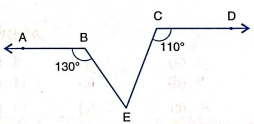
Statement-1 (A): In Fig. if AB || CD, $\angle A B E=130^{\circ}$ and $\angle E C D=110^{\circ}$, then $\angle B E C=60^{\circ}$.
Statement-2 (R): If a transversal intersects two parallel lines, then each pair of alternate angles are equal.
Image
Statement-1 (A): In a $\triangle A B C$, sides $A B$ and $A C$ are produced to $P$ and $Q$ respectively. If the bisectors of $\angle P B C$ and $\angle Q C B$ intersect at O , then $\angle B O C$ is an acute angle.
Statement-2 (R): In a $\triangle A B C$, sides $A B$ and $A C$ are produced to $P$ and $Q$ respectively. If the bisectors of $\angle P B C$ and $\angle Q C B$ intersect at O , then $\angle B O C=90^{\circ}-\frac{A}{2}$.
Directions: In the following questions, the Assertions (A) and Reason(s) (R) have been put forward. Read both the statements carefully and choose the correct alternative from the following:
Assertion: 0.271 is a terminating decimal and we can express this number as $\frac{271}{1000}$ which is of the form $\frac{\text{p}}{\text{q}}$, where p and q are integers and $q \neq0.$
Reason: A terminating or non - terminating decimal expansion can be expressed as rational number.
  1. Assertion and Reason both are correct statements and Reason is the correct explanation of Assertion.
  2. Assertion and Reason both are correct statements but Reason is not the correct explanation of Assertion.
  3. Assertion is correct statement but Reason is wrong statement.
  4. Assertion is wrong statement but Reason is correct statement.
Directions: In the following questions, the Assertions (A) and Reason(s) (R) have been put forward. Read both the statements carefully and choose the correct alternative from the following:
Assertion: A rational number between $\frac{1}{3}$ and $\frac{1}{2}$ is $\frac{5}{12}.$
Reason: Rational number between two numbers a and b is $\sqrt{\text{ab}}.$
  1. Assertion and Reason both are correct statements and Reason is the correct explanation of Assertion.
  2. Assertion and Reason both are correct statements but Reason is not the correct explanation of Assertion.
  3. Assertion is correct statement but Reason is wrong statement.
  4. Assertion is wrong statement but Reason is correct statement.
Statement-1 (A): The boundaries of the solids are surfaces.
Statement-2 (R): The boundaries of surfaces are lines.
Statement-1 $( A )$ : Points $(3,-3)$ and $(12,-4)$ lie in the same quadrant.
Statement-2 (R): Points $(-1,-1)$ and $(7,7)$ lie on the bisectors of third and first quadrant angles.
Statement-1 (A): If $a \neq 0$ and $a x^2+b x+a$ is exactly divisible by $(x-a)$, then $a^2+b+1=0$
Statement-2 $(R)$ : If $(x-a)$ is a factor of a polynomial $f(x)$, then $f(a)=0$.
Statement-1 (A): The area of an equilateral triangle the length of whose each side is positive integer, is an irrational number.
Statement-2 (R): The area of an equilateral triangle having each side equal to a is $\frac{\sqrt{3}}{4} a^2$.