MCQ
Statement $1$: Amniocentesis is often misused

Statement $2$: Amniocentesis is meant for determining the genetic disorders in the foetus, but it is being used to determine the sex of the foetus, to kill the normal female foetus

  • Statement $1$ is True, Statement $2$ is True; Statement $2$ is correct explanation for Statement $1$
  • B
    Statement $1$ is True, Statement $2$ is True; Statement $2$ is not correct explanation for Statement $1$
  • C
    Statement $1$ is True, Statement $2$ is False
  • D
    Statement $1$ is False, Statement $2$ is True
Answer

Correct option: A.
Statement $1$ is True, Statement $2$ is True; Statement $2$ is correct explanation for Statement $1$
a
Both $A$ and $R$ are true and $R$ is the correct explanation of $A$

Need a full question paper?

Generate a complete, print-ready paper with questions like this in minutes — across 16+ boards, with answer keys.

Start Generating Free

Similar questions

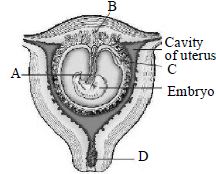
The given figure shows the human foetus within the uterus with few structures marked as $A,\,B,\,C$ and $D$.

Which of the following options shows the correct labeling ?

Cholera, leprosy and diptheria are
What is the percentage of $O_2$ transported in dissolved form through the plasma?
In a test cross involving $F_1$ dihybrid flies, more parental­type offspring were produced than the recombinant­type offspring. This indicates
In Mendel experiment he crossed tall and dwarf pea plant to study inheritance of one.....
Factor affecting the Hardy-Weinberg principlesare

$(I)$ Gene flow ;

$(II)$ Genetic drift

$(III)$ Mutation

$(IV)$ Genetic recombination

$(V)$ Natural selection

The correct combination is

Biofertilizers
The naturalist who worked in Malayarchipelogo?
Which of the following statement not true regarding regulation of respiration ?
(i) A specialised centre present in the medulla called respiratory rhythm centre.
(ii) Another centre present in the region pons of the brain called pneumotaxic centre can moderate the functions of the respiratory rhythm centre.
(iii) Neural signal from pneumotaxic centre can increase the duration of inspiration and thereby alter the respiratory rate.
(iv) Receptors associated with aortic arch and carotid artery also can recognise changes in CO2 and H concentration in blood.
(v) A chemo sensitive area is situated adjacent to the rhythm centre which is highly sensitive to O2 and hydrogen ions.
(vi) The role of oxygen in the regulation of respiratory rhythm is quite significant.
The first "geneticist'' was