MCQ
$STATEMENT-1$: $\quad \mathrm{Pb}^{4+}$ compounds are stronger oxidizing agents than $\mathrm{Sn}^{4+}$ compounds.and

$STATEMENT-2$: The higher oxidation states for the group $14$ elements are more stable for the heavier members of the group due to 'inert pair effect'.

  • A
    $STATEMENT-1$ is True, $STATEMENT-2$ is True; $STATEMENT-2$ is correct explanation for $STATEMENT-1$
  • B
    $STATEMENT-1$ is True, $STATEMENT-2$ is True; $STATEMENT-2$ is $NOT$ a correct explanation for $STATEMENT-1$
  • $STATEMENT-1$ is True, $STATEMENT-2$ is False
  • D
    $STATEMENT-1$ is False, $STATEMENT-2$ is True
Answer

Correct option: C.
$STATEMENT-1$ is True, $STATEMENT-2$ is False
c
The lower oxidation states for the group $14$ elements are more stable for the heavier member of the group due to inert pair effect.

Need a full question paper?

Generate a complete, print-ready paper with questions like this in minutes — across 16+ boards, with answer keys.

Start Generating Free

Similar questions

The electron affinity of chlorine is $3.7\,eV.$ $1\,gram$ of chlorine is completely converted to $Cl^-$ ion in a gaseous state. $(1\,eV = 23 .06\,kcal\,mol^{-1}).$ Energy released in the process is......$kcal$
The element whose a atom has mass of $10.86 \times {10^{ - 26}}$ $kg$ is
Arrange the following in order of increasing reactivity (least $\to$ most) towards nucleophile

$\underset{1}{\mathop{\begin{matrix}
   O\,\,\,\,\,\,\,\,\,\,\,\,  \\
   ||\,\,\,\,\,\,\,\,\,\,\,\,\,  \\
   C{{H}_{3}}COCHC{{H}_{3}}  \\
\end{matrix}}}\,$   $\underset{2}{\mathop{\begin{matrix}
   \,\,\,\,O \\
   \,\,\,\,|| \\
   C{{H}_{3}}CCl  \\
\end{matrix}}}\,$   $\underset{3}{\mathop{\begin{matrix}
   O\,\,\,\,\,\,\,\,\,  \\
   ||\,\,\,\,\,\,\,\,\,  \\
   C{{H}_{3}}CNHC{{H}_{3}}  \\
\end{matrix}}}\,$

Image
For a reaction, $I^-+ OCl^-\to IO^-+ Cl^-$ is an aqueous medium, the rate of reaction is given by $\frac{{d[I{O^ - }]}}{{dt}} = K\frac{{[{I^ - }][OC{l^ - }]}}{{[O{H^ - }]}},$ The overall order of reaction is
$C{H_3} - CN\xrightarrow{{{H_2}O/{H^ \oplus }}}X\xrightarrow[{{H^ \oplus }}]{{{C_6}{H_5}OH}}Y;\,Y$ is
A compound whose molecules are superimposable on their mirror images even through they contain an asymmetric carbon atom is called
What is the major product of the following reaction?

(figure) $ + \xrightarrow[{{H_2}O}]{{B{r_2}}}$ ?

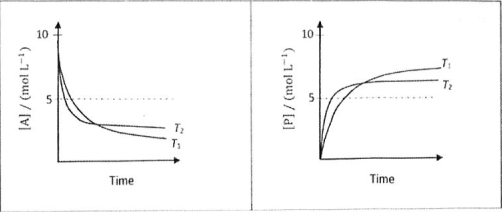
For a reaction, $A \rightleftharpoons P$, the plots of $[ A ]$ and $[ P ]$ with time at temperatures $T _1$ and $T _2$ are given below.

If $T _2> T _1$, the correct statement(s) is (are)

(Assume $\Delta H ^{\ominus}$ and $\Delta S ^{\ominus}$ are independent of temperature and ratio of $\ln K$ at $T _1$ to $\ln K$ at $T_2$ is greater than $T_2 / T_1$. Here $H, S, G$ and $K$ are enthalpy, entropy, Gibbs energy and equillibrium constant, respectively.)

$(A)$ $\Delta H ^{\ominus}<0, \Delta S ^{\ominus}<0$  $(B)$ $\Delta G ^{\ominus}<0, \Delta H ^{\ominus}>0$  $(C)$ $\Delta G ^{\ominus}<0, \Delta S ^{\ominus}<0$  $(D)$ $\Delta G ^{\ominus}<0, \Delta S ^{\ominus}>0$

$0.2\,gm$ of fine animal charcoal is mixed with half litre of acetic acid $( - SM)$ solution and shaken for $30$ minutes