MCQ
Statement $-1$: Two particles moving in the same direction do not lose all their energy in a completely inelastic collision.
Statement $-2$ : Principle of conservation of momentum holds true for all kinds of collisions.
  • A
    Statement $-1$ is true, Statement $-2$ is false
  • Statement $-1$ is true, Statement $-2$ is true ;

    Statement $-2$ is the correct explanation of Statement $-1$

  • C
    Statement $-1$ is true, Statement $-2$ is true ;

    Statement $-2$ is not the correct explanation of Statement $-1$

  • D
    Statement $-1$ is false, Statement $-2$ is true
Answer

Correct option: B.
Statement $-1$ is true, Statement $-2$ is true ;

Statement $-2$ is the correct explanation of Statement $-1$

b
In completely inelastic collision, all energy is not lost(so,  tatement $-1$ is true) and the principle of conservation of momentum holds good for all kinds of collisions (so, statement $-2$ is true) . Statement $-2$ explains statement $-1$ correctly because applying the principle of conservation of momentum, we can get the common velocity and hence the kinetic energy of the combined body. 

Need a full question paper?

Generate a complete, print-ready paper with questions like this in minutes — across 16+ boards, with answer keys.

Start Generating Free

Similar questions

A jet of liquid of cross-sectional area $'a'$ strikes a wall making angle $\theta $ with wall. The water strikes with the wall with velocity $v$ and rebounds elastically. If density of liquid be $\rho $, the normal force on the wall is
An inclined plane makes an angle of $30^o$ with the horizontal. $A$ solid sphere rolling  down this inclined plane from rest without slipping has a linear acceleration equal to
Two discs of the same material and thickness have radii $0.2\, m$ and $0.6\, m.$  Their moments of inertia about their axes will be in the ratio 
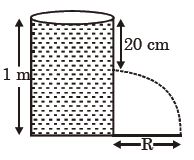
A tank is filled with water upto a height $1\,m$. A hole is made at a distance $20\, cm$ from top. Find, the horizontal distance from the base of the tank, where the water strikes the ground. ......... $cm$
$\mathrm{C}_{\mathrm{v}}$ and $\mathrm{C}_{\mathrm{p}}$ denote the molar specific heat capacities of a gas at constant volume and constant pressure, respectively. Then

$(A)$ $\mathrm{C}_{\mathrm{p}}-\mathrm{C}_{\mathrm{v}}$ is larger for a diatomic ideal gas than for a monoatomic ideal gas

$(B)$ $\mathrm{C}_{\mathrm{p}}+\mathrm{C}_{\mathrm{v}}$ is larger for a diatomic ideal gas than for a monoatomic ideal gas

$(C)$ $\mathrm{C}_{\mathrm{p}} / \mathrm{C}_{\mathrm{v}}$ is larger for a diatomic ideal gas than for a monoatomic ideal gas

$(D)$ $\mathrm{C}_{\mathrm{p}} \cdot \mathrm{C}_v$ is larger for a diatomic ideal gas than for a monoatomic ideal gas

Match List-$I$ with List-$II$ :

List-$I$ List-$II$
$(A)$  A force thatrestores anelastic body of unit area to its original state $(I)$ Bulkmodulus
$(B)$  Two equal andopposite forcesparallel toopposite faces $(II)$Young'smodulus
$(C)$Forcesperpendiculareverywhere tothe surface perunit areasameeverywhere $(III)$ Stress
$(D)$Two equal andopposite forceperpendicular toopposite faces $(IV)$ Shearmodulus

Choose the correct answer from the options given below:

Two point masses of mass $m_1 = fM$ and $m_2 = (1 -f)\,M\,(f < 1 )$ are in outer space ( far from gravitational influence of other objects) at a distance $R$ from each other. They move in circular orbits about their centre of mass with angular vaocities $\omega _1$ for $m_1$ and $\omega _2$ for $m_2.$ In that case
A closed organ pipe and an open organ pipe are tuned to the same fundamental frequency. What is the ratio of lengths
The range of a particle when launched at an angle of ${15^o}$ with the horizontal is $1.5 \,km$. What is the range of the projectile when launched at an angle of ${45^o}$ to the horizontal ........ $km$
Young's modulus of a material has the same units as