MCQ
Statement $I:$- Dipole moment is a vector quantity and by convention it is depicted by a small arrow with tail on the negative centre and head pointing towards the positive centre.

Statement $II:$- The crossed arrow of the dipole moment symbolizes the direction of the shift of charges in the molecules.

In the light of the above statements, choose the most appropriate answer from the options given below :-

  • A
    Both Statement $I$ and Statement $II$ are correct.
  • B
    Statement $I$ is incorrect but Statement $II$ is correct.
  • C
    Both Statement $I$ and Statement $II$ are incorrect.
  • Statement $I$ is correct but Statement $II$ is incorrect.
Answer

Correct option: D.
Statement $I$ is correct but Statement $II$ is incorrect.
d
Statement $II$ : The corssed arrow symbolises the direction of the shift of electron density in the molecule.

Need a full question paper?

Generate a complete, print-ready paper with questions like this in minutes — across 16+ boards, with answer keys.

Start Generating Free

Similar questions

$C{u^{2 + }}(aq.) + {X^ - }(aq.)\xrightarrow{{R.T.}}CuX \downarrow  + {X_2}$

$'X'$ cannot be

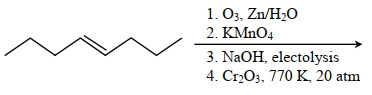
The number of $- CH _2$ - (methylene) groups in the product formed from the following reaction sequence is. . . . . . . 
Among the following, the nurnber of compounds than can react with $PCl _5$ to give $POCl _3$ is $O _2, CO _2, SO _2, H _2 O , H _2 SO _4, P _4 O _{10}$
$2.5\, g$ of protein containing only glycine $\left( C _{2} H _{5} NO _{2}\right)$ is dissolved in water to make $500 \,mL$ of solution. The osmotic pressure of this solution at $300\, K$ is found to be $5.03 \times 10^{-3}$ $bar.$ The total number of glycine units present in the protein is $....$

(Given : $R =0.083\, L\, bar \,K ^{-1} \,mol ^{-1}$ )

Which of the following compound has trans as well as $Z$ configuration around double bond
Which one is correct for bond angle?
A $C_8H_{10}$ hydrocarbon is nitrated by $HNO_3$ and sulphuric acid. Two, and only two, $C_8H_9NO_2$ isomers are obtained, Which of the following fits this evidence ?
The standard state Gibbs free energies of formation of $C$ (graphite) and $C$(diamond) at $\mathrm{T}=298 \mathrm{~K}$ are

$\Delta_f G^0[\mathrm{C}(\text { graphite })]=0 \mathrm{kJmol}^{-1}$

$\Delta_f G^0[\mathrm{C}(\text { diamond })]=2.9 \mathrm{kJmol}^{-1}$

The standard state means that the pressure should be $1$ bar, and substance should be pure at a given temperature. The conversion of graphite [C(graphite)] to diamond [C(diamond)] reduces its volume by $2 \times 10^{-6} \mathrm{~m}^3 \mathrm{~mol}^{-1}$. If $\mathrm{C}$ (graphite) is converted to $\mathrm{C}$ (diamond) isothermally at $\mathrm{T}=298 \mathrm{~K}$, the pressure at which $C$ (graphite) is in equilibrium with C(diamond), is

[Useful information: $1 \mathrm{~J}=1 \mathrm{~kg} \mathrm{~m}^2 \mathrm{~s}^{-2} ; 1 \mathrm{~Pa}=1 \mathrm{~kg} \mathrm{~m}^{-1} \mathrm{~s}^{-2} ; 1 \mathrm{bar}=10^5 \mathrm{~Pa}$ ]

Solid sodium chloride is bad conductor of electricity because
Transition metals are related to which block