Question
Statement(A): Negative charges always move from a higher potential to lower potential point
Statement (B): Electric potential is vector.

Answer

  1. Both A and B false.
Explanation:
Positive charges move from higher to lower potential whereas negative charges move from lower to higher potential. Hence, A is false. Electric potential does not have direction and is a scalar quantity.

Need a full question paper?

Generate a complete, print-ready paper with questions like this in minutes — across 16+ boards, with answer keys.
Start Generating Free

Similar questions

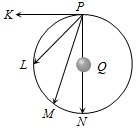
In the figure the charge $Q$ is at the centre of the circle. Work done is maximum when another charge is taken from point $P$ to
A thin lens is made with a material having refractive index $\mu=1.5.$ Both the sides are convex. It is dipped in water $(\mu=1.33).$ It will behave like:
In an apparatus, the electric field was found to oscillate with an amplitude of $18 V/m$. The magnitude of the oscillating magnetic field will be
When the current through the electromagnet of a relay reaches a particular value:
Assertion  : The number of electrons in a P-type silicon semiconductor is less than the number of electrons in a pure silicon semiconductor at room temperature.
Reason      : It is due to law of mass action.(a) If both assertion and reason are true and the reason is the correct explanation of the assertion.(b) If both assertion and reason are true but reason is not the correct explanation of the assertion.(c) If assertion is true but reason is false.(d) If the assertion and reason both are false.


If the resistance of a conductor is $5 W$ at $50^\circ C$ and $7 W$ at $100^\circ C$ then the mean temperature coefficient of resistance of the material is
When a straight wire is moved up and down rapidly between two poles of a horseshoe magnet then _______ is produced in the wire.
Ideal $P - N$ junction can be used :
A parallel plate condenser is immersed in an oil of dielectric constant 2. The field between the plates is:
If the de Broglie wavelength of a proton is $10^{−13}m,$ the electric potential through which it must have been accelerated is: