MCQ
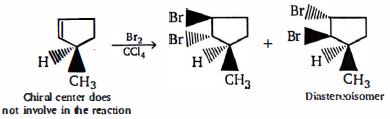
stereochemistry of the product is
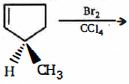
- ✓Diastereomers
- BRacemic mixture
- CMeso
- DPure Enantiamers
Generate a complete, print-ready paper with questions like this in minutes — across 16+ boards, with answer keys.
$(A)$ $NO _3^{-}$ $(B)$ $Cl ^{-}$ $(C)$ $SCN ^{-}$ $(D)$ $CN ^{-}$
$(i)\, KCl$ or $MgO$ $(ii) \,LiF$ or $LiBr$ $(iii)\, Mg_3N_2$ or $NaCl$
$(A)$ $\mathrm{Bu}-\mathrm{OH}$
$(B)$ $IMAGE$ $(C)$ $IMAGE$ $(D)$ $IMAGE$
Choose the correct answer from the options given below :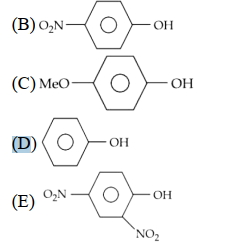
$A.$ For 1 s orbital, the probability density is maximum at the nucleus.
$B.$ For $2 s$ orbital, the probability density first increases to maximum and then decreases sharply to zero.
$C.$ Boundary surface diagrams of the orbitals encloses a region of $100 \%$ probability of finding the electron.
$D.$ $p$ and d-orbitals have $1$ and $2$ angular nodes respectively.
$E.$ Probability density of p-orbital is zero at the nucleus.