MCQ
Strongest conjugate base is
  • A
    $C{l^ - }$
  • B
    $B{r^ - }$
  • ${F^ - }$
  • D
    ${I^ - }$

Answer

Correct option: C.
${F^ - }$
(c) $ {F^ - }$ strongest conjugate base due to it smallest size in a group and gain proton due to most electronegative capacity.

${H^ + } + {F^ - } \to HF$

Need a full question paper?

Generate a complete, print-ready paper with questions like this in minutes — across 16+ boards, with answer keys.

Start Generating Free

Similar questions

Which of the following form cyclic silicones on hydrolysis
For $N{H_4}H{S_{\left( s \right)}} \rightleftharpoons N{H_3}_{\left( g \right)} + {H_2}{S_{\left( g \right)}}$; observed pressure for reaction mixture at equilibrium is $1.12\, atm$ at $106\,^oC$. The value of $K_P$ for the reaction is
Which scientist proposed the concept of atomic mass?
Chemical equations convey quantitative information on the
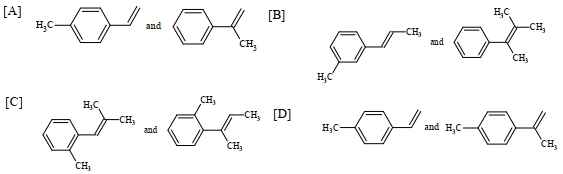
Compounds $P$ and $R$ upon ozonolysis produce $Q$ and $S$, respectively. The molecular formula of $Q$ and $S$ is $C_8 \mathrm{H}_8 \mathrm{O}$. $Q$ undergoes Cannizzaro reaction but not haloform reaction, whereas $\mathrm{S}$ undergoes haloform reaction but not Cannizzaro reaction.

($i$) $P \xrightarrow[\text { ii) } \mathrm{Zn} / \mathrm{H}_2 \mathrm{O}]{\text { i) } \mathrm{O}_3 / \mathrm{CH}_2 \mathrm{Cl}_2} \underset{\left(\mathrm{C}_8 \mathrm{H}_8 \mathrm{O}\right)}{Q}$

($ii$) $R \xrightarrow[\text { ii) } \mathrm{Zn} / \mathrm{H}_2 \mathrm{O}]{\text { i) } \mathrm{O}_3 / \mathrm{CH}_2 \mathrm{Cl}_2} \underset{\left(\mathrm{C}_8 \mathrm{H}_8 \mathrm{O}\right)}{S}$

The option(s) with suitable combination of $P$ and $R$, respectively, is(are)
A species having carbon with sextet of electrons and can act as electrophile is called
The enthalpy of formation of ammonia is $-46.0\, kJ\, mol^{-1}$. The enthalpy change for the reaction $2NH_3 (g) \longrightarrow 2N_2(g) + 3H_2 (g$) is.....$kJ\, mol^{-1}$
An aqueous $\mathrm{KCl}$ solution of density $1.20 \mathrm{~g} \mathrm{~mL}^{-1}$ has a molality of $3.30 \mathrm{~mol} \mathrm{~kg}^{-1}$. The molarity of the solution in $\mathrm{mol} \mathrm{L}^{-1}$ is ..... . (Nearest integer)

[Molar mass of $\mathrm{KCl}=74.5$ ]

$5\, g$ of benzene on nitration gave $6.6\, g$ of nitrobenzene . The theoretical yield of the nitrobenzene will be ............... $\mathrm{g}$
The number of $sp^2 - s$ sigma bonds in benzene are