MCQ
Strongest nucleophile is
  • A

  • B


  • D
    $\begin{matrix}
       O  \\
       ||  \\
       C{{H}_{3}}-C-\overset{\overset{\circleddash }{\mathop{\centerdot \,\,\centerdot }}\,}{\mathop{C}}\,{{H}_{2}}  \\
    \end{matrix}$

Answer

Correct option: C.

c
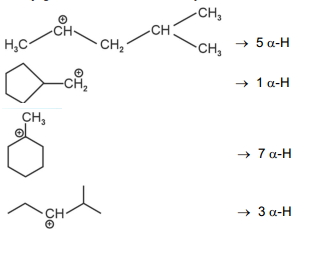
The stability of carbocation can be described by the hyperconjugation. Greater the extent of hyperconjugation, more is the stability of carbocation.

$Image$

Stability order of carbocations $=(3)>(1)>(4)>(3)$
Need a full question paper?

Generate a complete, print-ready paper with questions like this in minutes — across 16+ boards, with answer keys.

Start Generating Free

Similar questions

Consider the following elements.

Which of the following is/are true about $\mathrm{A}^{\prime}, \mathrm{B}^{\prime}, \mathrm{C}^{\prime}$ and $\mathrm{D}^{\prime}$ ?

$A$. Order of atomic radii: $\mathrm{B}^{\prime}<\mathrm{A}^{\prime}<\mathrm{D}^{\prime}<\mathrm{C}^{\prime}$

$B$. Order of metallic character: $\mathrm{B}^{\prime}<\mathrm{A}^{\prime}<\mathrm{D}^{\prime}<\mathrm{C}^{\prime}$

$C$. Size of the element : $\mathrm{D}^{\prime}<\mathrm{C}^{\prime}<\mathrm{B}^{\prime}<\mathrm{A}^{\prime}$

$D$. Order of ionic radii : $\mathrm{B}^{\prime+}<\mathrm{A}^{\prime+}<\mathrm{D}^{\prime+}<\mathrm{C}^{\prime+}$

Choose the correct answer from the options given below :
Ethylbenzene $+ Cl_2$ $\xrightarrow{{Light}}$ (main) compound is:
Equal volumes of methanoic acid and sodium hydroxide are mixed. If $x$ is the heat of formation of water, then heat evolved on neutralisation is
The main reaction during electrovalent bond formation is
The electronic configuration of silicon is $ ......... $ and that of sulphur is $ .........$
Atomic number of calcium is?
Which of the following information can be obtained on the basis of Le-chatelier's principle
Which of the following has maximum difference in $1^{st}$ and $2^{nd}$ ionisation enthalpy.
The hydrocarbon with seven carbon atoms containing a neopentyl and a vinyl group is
The electrons, identified by quantum by numbers $n$ and $l,$ $(i)\, n = 4, l= 1$ $(ii)\, n = 4, l = 0$ $(iii)\, n = 3, l = 2$ $(iv)\,n = 3, l = 1$ can be placed in order of increasing energy, from the lowest to highest, as