Question
Structure and function are correlatable in living organisms. Can you justify this by taking plasma membrane as an example?

Answer

This is true that structure and function are correlated in living organisms. Following aspects of structure and function of plasma membrane justify this fact.
  • Plasma membrane provides a boundary to the cell contents. This is made possible because of its ability to segregate the inside of the cell with the external environment.
  • Plasma membrane is a semi-permeable membrane. This attribute helps the plasma membrane to allow exchange of some selected materials between the cell and its external environment.
  • We know that plasma membrane is composed of a lipid bilayer which has proteinintersperse in a mosaic like pattern. The protein molecules serve as channels for those substances which need active transport mechanism to enter or exit a cell.
  • The fluid layer of lipid allows those molecules to pass through the membrane which can easily travel through osmosis.

Need a full question paper?

Generate a complete, print-ready paper with questions like this in minutes — across 16+ boards, with answer keys.
Start Generating Free

Similar questions

What is meant by double circulation? What is its significance?
Describe the structure of endoplasmic reticulum. Write any four of its functions.
Name the type of joint between the following:-
  1. atlas/axis
  2. carpal/metacarpal of thumb
  3. between phalanges
  4. femur/acetabulum
  5. between cranial bones
  6. between pubic bones in the pelvic girdle
Describe the nephron by making a labelled diagram.
Plants show temporary and permanent wilting. Differentiate between the two. Do any of them indicate the water status of the soil?
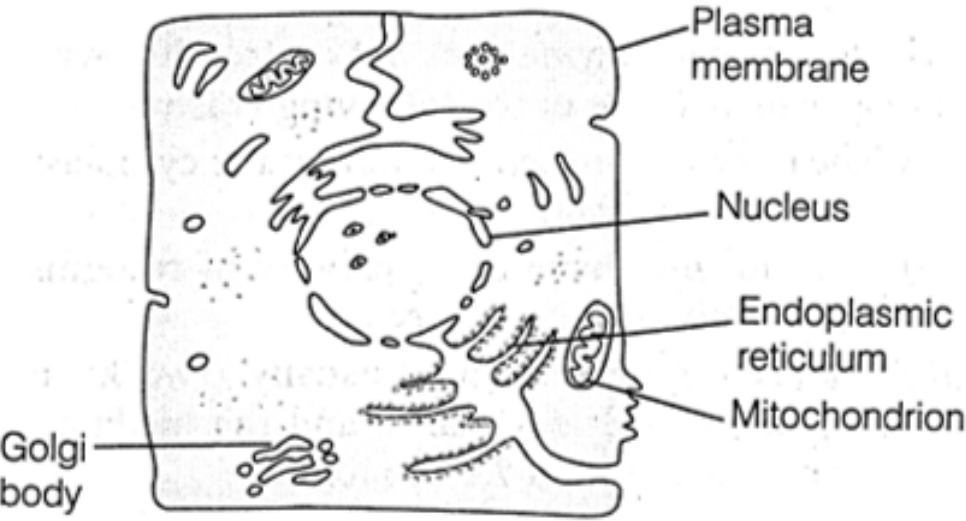
The diagram shows some of the structures present in an animal cell.

Image

Which of these structures is responsible for
i. Manufacture of lipids and steroids
ii. Release of energy
iii. Manufacture of hormones and digestive enzymes
iv. Production of spindle fibres in cell division
v. Endo and exocytosis?
  1. Where is sino-atrial node (SAN) located in human heart? Why is SAN called pacemaker of the heart?
  2. What is electrocardiogram? What represents P-wave, QRS complex and T-wave in a standard ECG?
  3. What are the causes of Angina and Coronary Artery Disease?
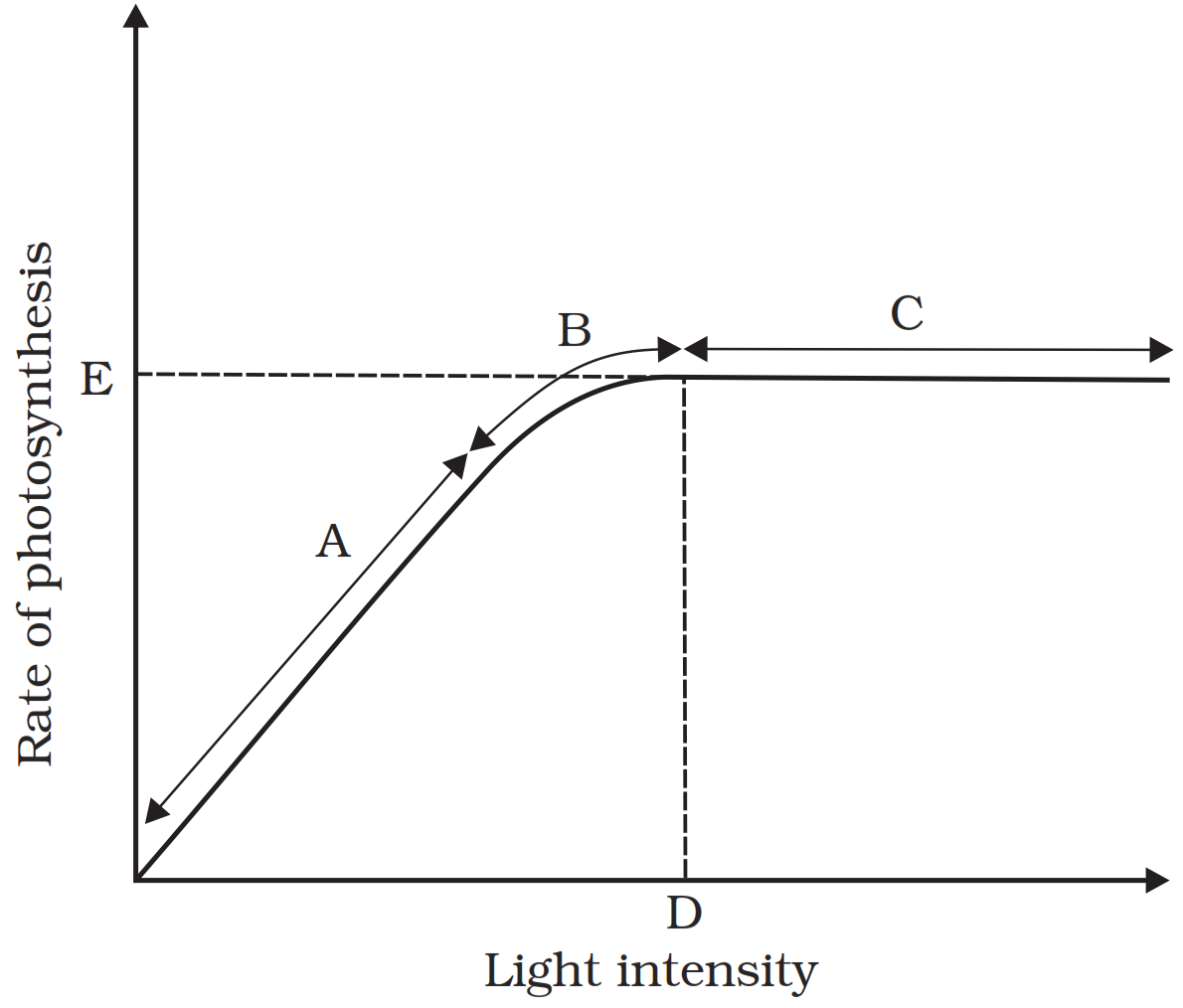
Figure shows the effect of light on the rate of photosynthesis. Based on the graph, answer the following questions:
  1. At which point/s (A, B or C) in the curve is light a limiting factor?
  2. What could be the limiting factor/s in region A?
  3. What do C and D represent on the curve?
What is the difference between living and non-living?
  1. Name the first stable compound formed in sugarcane plant during $\mathrm{CO}_2$, fixation.
  2. Describe Hatch and Slack pathway of $\mathrm{CO}_2$, fixation.