Question
Study the circuits (a) and (b) shown in Fig. and answer the following questions.
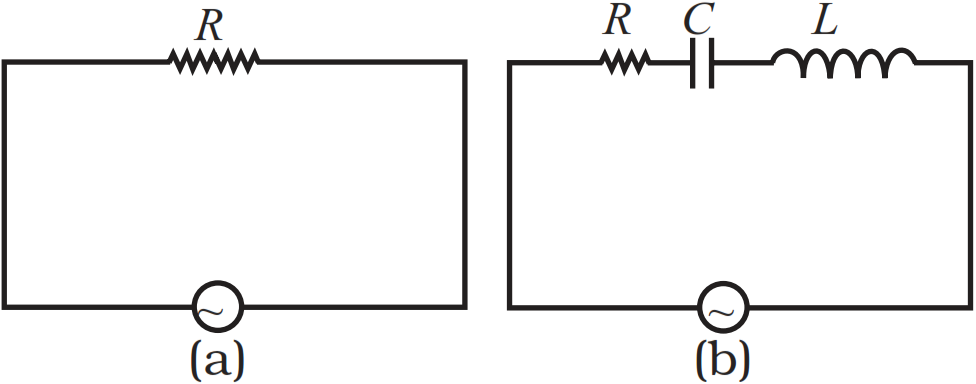
  1. Under which conditions would the rms currents in the two circuits be the same?
  2. Can the rms current in circuit (b) be larger than that in (a)?
Answer


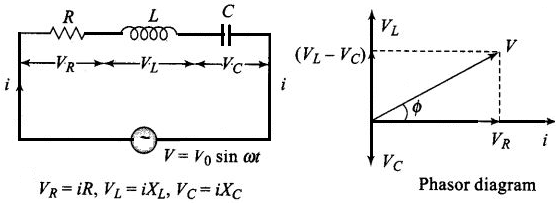
Key concept: Series RLC - Circuit
  1. Equation of current: $\text{i}=\text{i}_0\sin(\omega\text{t}\pm\phi);\text{ where i}_0=\frac{\text{V}_0}{\text{Z}}$
  2. Equation of vpltage: From phasor diagram $\text{V}=\sqrt{\text{V}^2_\text{R}+(\text{V}_\text{L}-\text{V}_\text{C})^2}$
  3. Impedance of the circuit: $\text{Z}=\sqrt{\text{R}^2(\text{X}_\text{L}-\text{X}_\text{C})^2}=\sqrt{\text{R}^2+\Big(\omega\text{L}-\frac{1}{\omega\text{C}}\Big)^2}$
  4. Phase difference: From phasor diagram $\tan\phi=\frac{\text{V}_\text{L}-\text{V}_\text{C}}{\text{V}_\text{R}}=\frac{\text{X}_\text{L}-\text{X}_\text{L}}{\text{R}}=\frac{\omega\text{L}-\frac{1}{\omega\text{C}}}{\text{R}}=\frac{2\pi\text{vL}-\frac{1}{2\pi\text{vC}}}{\text{R}}$
  5. If net reactance is inductive: Circuit behaves as LR circuit
  6. If net reactance is capacitive: Circuit begaves as CR circuit
  7. If net reactance is zero: Means $X = X_L - X_C = 0 \Rightarrow X_L = X_C$​​​​​​​, This is the condition of resonance.
  8. At resononce (series resonant circuit),
  1. $X_L = X_C \Rightarrow Z_{min} = R,$ i.e., circuit behaves as a resistive circuit.
  2. $V_L = V_C \Rightarrow V = V_R$, i.e., whole
  3. applied voltage appeared across the resistance.
  4. Phase difference: $\phi=0^\circ\Rightarrow\ \text{p.f.}=\cos\phi=1$
  5. Power consumption: $\text{P}=\text{V}_\text{rms}\text{i}_\text{rms}=\frac{1}{2}\text{V}_0\text{i}_0$
  6. Current in the circuit is maximum and it is $\text{i}_0=\frac{\text{V}_0}{\text{R}}$
Let us first assume, rms current in circuit $A = (I_{rms}) A$
And rms current in circuit $B = (I_{rms}) B$
$(\text{I}_\text{rms})\text{A}=\frac{\text{E}_\text{rms}}{\text{Z}}=\frac{\text{E}_\text{rms}}{\text{R}}$
$(\text{I}_\text{rms})\text{B}=\frac{\text{E}_\text{rms}}{\text{Z}}=\frac{\text{E}_\text{rms}}{\sqrt{\text{R}^2+(\text{X}_\text{L}-\text{X}_\text{C})^2}}$
  1. When $(I_{rms})A = (I_{rms})B$
$\text{R}=\sqrt{\text{R}^2+(\text{X}_\text{L}-\text{X}_\text{C})^2}$
$\Rightarrow X_L = X_C,$ resonance condition
If Erms in the two circuit are same, then at resonance the rms currnet in LCR will be same as that in R circuit (circuit A).
  1. As $\text{Z}\geq\text{R}$
$\Rightarrow\ \frac{(\text{I}_\text{rms})_\text{B}}{(\text{I}_\text{rms})_\text{A}}=\frac{\frac{\text{E}_\text{rms}}{\text{Z}}}{\frac{\text{E}_\text{rms}}{\text{R}}}=\frac{\text{R}}{\sqrt{\text{R}^2}(\text{X}_\text{L}-\text{X}_\text{C})^2}=\frac{\text{R}}{\text{Z}}\leq1$
$\Rightarrow\ (\text{I}_\text{rms})\text{a}\geq(\text{I}_\text{rms})\text{b}$
No, $\text{R}\leq\text{Z}$. So, rms current in circuit (b) cannot be larger than that in (a).

Need a full question paper?

Generate a complete, print-ready paper with questions like this in minutes — across 16+ boards, with answer keys.

Start Generating Free

Similar questions

Let $\text{X}=\overline{\text{ABC}}+\overline{\text{BCA}}+\overline{\text{CAB}}.$ Evaluate X for:
  1. $\text{A}=1,\text{B}=0,\text{C}=1$
  2. $\text{A}=\text{B}=\text{C}=1$
  3. $\text{A}=\text{B}=\text{C}=0$
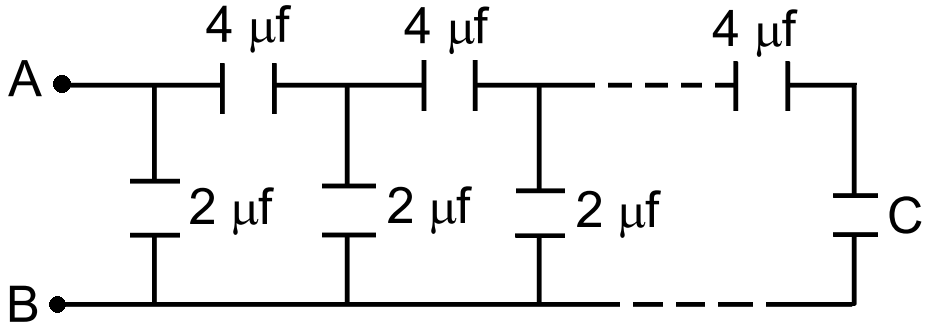
A finite ladder is constructed by connecting several sections of $2\mu\text{F},\ 4\mu\text{F}$ capacitor combinations as shown in figure. It is terminated by a capacitor of capacitance C. What value should be chosen for C, such that the equivalent capacitance of the ladder between the points A and B becomes independent of the number of sections in between?
The magnetic field B and the magnetic intensity H in material are found to be 1.6T and 1000A/m reepectively. Calculate the relative permeability $\mu_\text{r}$ and the susceptibility x of the material.
Find the expression for the energy stored in the capacitor. Also find the energy lost when the charged capacitor is disconnected from the source and connected in parallel with the uncharged capacitor. Where does this loss of energy appear?
A car moving at 108km/h finds another car in front of it going in the same direction at 72km/h. The first car sounds a horn that has a dominant frequency of 800Hz. What will be the apparent frequency heard by the driver in the front car? Speed of sound in air = 330m/s.
$a.$ Use Huygen's geometrical construction to show how a plane wavefront at $t = 0$ propagates and produces a wavefront at a later time.
$b.$ Verify, using Huygen's principle, Snell's law of refraction of a plane wave propagating from a denser to a rarer medium.
$c.$ Illustrate with the help of diagrams the action of
$i.$ convex lens and
$ii.$ concave mirror, on a plane wavefront incident on it.
Write the expression for the force, $\vec{\text{F}}$ acting on a charged particle of charge ‘q’, moving with a velocity $\vec{\text{v}}$ in the presence of both electric field $\vec{\text{E}}$ and magnetic field $\vec{\text{B}}$. Obtain the condition under which the particle moves undeflected through the fields.
A particle A with a mass $m_A$ is moving with a velocity v and hits a particle $B ($mass $m_B) $ at rest (one dimensional motion). Find the change in the de Broglic wavelength of the particle A. Treat the collision as elastic.
An atom is in its excited state. Does the probability of its coming to ground state depend on whether the radiation is already present or not? If yes, does it also depend on the wavelength of the radiation present?
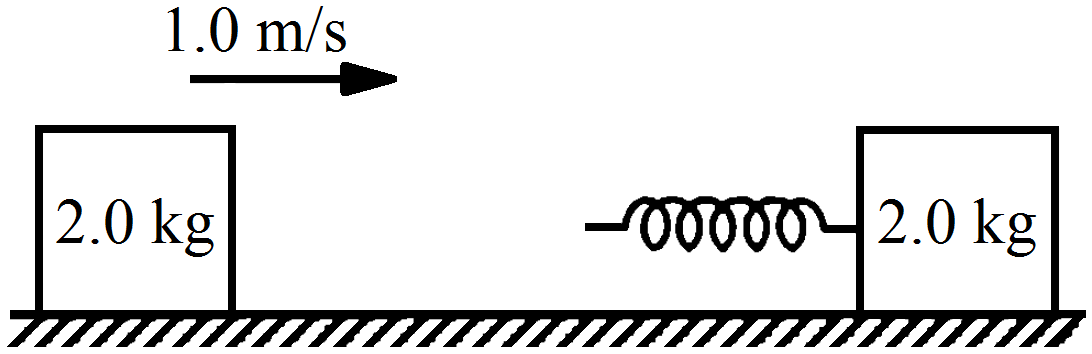
A block of mass 2.0kg is moving on a frictionless horizontal surface with a velocity of 1.0m/s towards another block of equal mass kept at rest. The spring constant of the spring fixed at one end is 100N/m. Find the maximum compression of the spring.