Question
Study the diagram given below and then answer the question that follows:
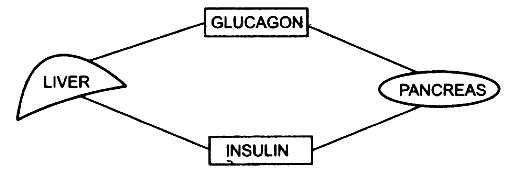
Why is the pancreas referred to as an exo-endocrine gland?

Answer

An endocrine gland is one which does not pour its secretions into a duct, while an exocrine gland is a gland which pours its secretions into a duct. Because the pancreas produces hormones such as insulin, glucagon and somatostatin directly into the blood and not into a duct, it functions as an endocrine gland. Because it secretes the pancreatic juices for digestion via a duct, it functions as an exocrine gland. Hence, the pancreas is an exo-endocrine gland.

Need a full question paper?

Generate a complete, print-ready paper with questions like this in minutes — across 16+ boards, with answer keys.
Start Generating Free

Similar questions

Mention three differences between DNA and RNA.
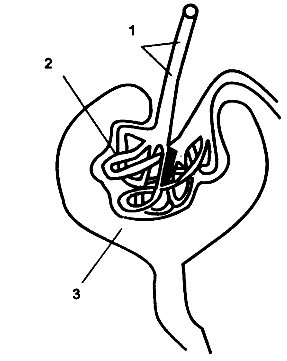
Study the diagram given below and then answer the questions that follow:

(i) Name the region in the kidney where the shown structure is present?
(ii) Name the parts labeled 1, 2,3, and 4.
(iii) Name the stages involved in the formation of urine.
(iv) What is the technical term given to the process occurring in 2 and 3?
Briefly describe the process.
Differentiate between :
Plasmolysis and Deplasmolysis
Differentiate between the following:
Eosinophil and Basophil
Mention characteristic features of mitosis.
List some adaptations found in desert plants to reduce transpiration.
A potted destarched plant was taken in order to prove that light is necessary for photosynthesis.
(i) What is meant by 'destarched plant'? How can it be destarched?
(ii) Using the destarched plant describe step by step how you would proceed to prove that in the absence of light the leaf cannot manufacture starch.
Write constituents of urine.
Draw a diagram of the human eye as seen in a vertical section and label the parts which suit the following descriptions relating to the:
(i) photosensitive layer of the eye.
(ii) structure which is responsible for holding the eye lens in its position.
(iii) structure which maintains the shape of the eyeball and the area of no vision.
(iv) anterior chamber seen in front of the eye lens.
(v) outermost transparent layer seen in front of the eyeball.
Give Reasons for the following:
Transplanting of seedlings to a flowerbed in the evening is better than doing so in the morning.