Question
Study the diagram given below and then answer the question that follows:
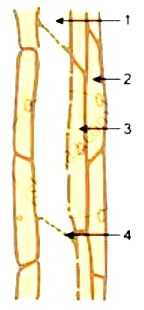
State the function of the parts labelled 1, 2, 3 and 4.

Answer

1 → Sieve cells: Help in the transport of food from leaves to storage organs and other parts of the plant.
2 → Phloem parenchyma cells:Storage of starch, fat and other organic food material.
3 → Companion cells:Help inthefunctioningofthe sieve tube cells.
4 → Sieve plate: Perforations in thesieve platesallow water and dissolved organic solutes to flow along the sieve tube.

Need a full question paper?

Generate a complete, print-ready paper with questions like this in minutes — across 16+ boards, with answer keys.
Start Generating Free

Similar questions

Give the structure and function of the following:
Crystal
Give two examples each of the following types of seeds:
Dicotyledonous albuminous seed.
Dicotyledonous exalbuminous seed.
Monocotyledonous albuminous seed.
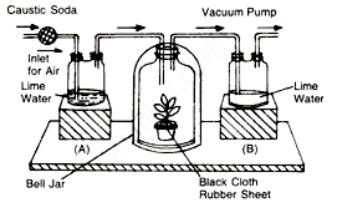
Given alongside is an experimental set up to demonstrate a phenomenon in a plant:
(a) What is the aim of this experiment?
(b) Why was the bell jar covered with a black cloth?
(c) What is the function of caustic soda in this experiment?
(d) Give an overall chemical equation of the process mentioned in (a) above. (e) Mention one precaution that should be taken to ensure more accurate results.
What change, if any, would you observe in the lime water in Flask A and B? In each case give a reason for your answer.
Image
Match the items given in Column A with the appropriate item of Column B:
Column A Column B
Degenerative diseases Vector
Diabetes Filaria
AIDS Viral disease
Cholera Rheumatic heart disease
Influenza Bacterial disease
Mosquito Insulin
Elephantiasis HIV virus
- Entamoeba histolytica
Describe the advantages and disadvantages of cross-pollination to the plant.
Explain the terms Monadelphous, Diadelphous and Polyadelphous. In each case name a flower possessing such an androecium.
How is micropropagation carried out?
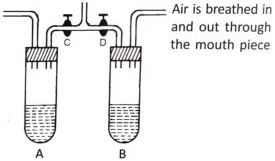
The diagram given below represents an experimental setup for demonstrating certain aspects of the air breathed in/out. The two valves C and D help to regulate the direction of the flow of air.
Image
Answer the following questions:
(i) There are mistakes at two places in the diagram. Redraw the diagram correctly to eliminate these mistakes.
(ii) What is the aim of the experiment?
(iii) Name the liquid contained in the test tube A and the liquid in test tube B.
(iv) what would be the observations after performing the experiment?
Give any four reasons why water is necessary in our body.
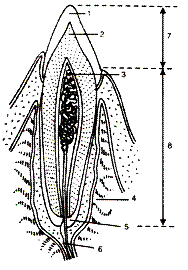
Observe the diagram given alongside and answer the following:
  1. Name the parts numbered 1-8.
  2. Which parts shown in the diagram are non-living?
  3. Is the tooth suited for cutting, tearing or grinding?
  4. What is the function of parts 8 and 7?
  5. What is the total number of teeth present in adult human beings?
  6. Write the dental formula of human beings.