Question
Study the figure given alongside and answer the questions that follow :
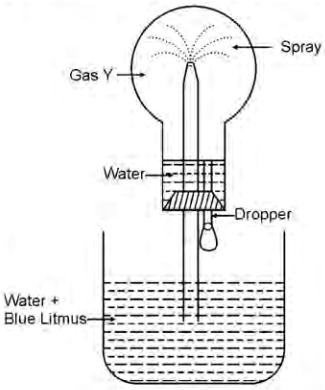
Image
(i) Name the experiment illustrated here.
(ii) Identify the gas Y.
(iii) What property of gas Y demonstrated by this experiment?
(iv) Explain the observations of the experiment.

Answer

(i) Fountain experiment.
(ii) The gas Y is HCl gas.
(iii) HCl gas is extremely soluble in water.
(iv) There is the formation of the fountain as water introduced from the dropper completely absorbs hydrogen chloride gas, thereby creating a very low pressure within the flask. Thus, to make up for this loss in pressure, blue litmus solution rises up the jet tube. The colour of litmus changes to red, because hydrogen chloride is an acidic gas.

Need a full question paper?

Generate a complete, print-ready paper with questions like this in minutes — across 16+ boards, with answer keys.

Start Generating Free

Similar questions

Concentrated nitric acid oxidizes phosphorous to phosphoric acid according to the following equation :
$P + 5HNO_3 \rightarrow H_3PO_4 + H_2O + 5NO_2$
What will be the volume of steam at the same time measured at $760\ mm$ of Hg pressure and $273^\circ C$ ? $[H=1, N=14, O=16, P=31]$
A compound X when treated with an organic acid Y (having vinegar-like smell) in the presence of the acid Z, forms a compound P which has a fruity smell.
(a) Identify X, Y, and Z
(b) Write the structural formula of X and Y.
(c) What type of compound P is?
(d)Name the above reaction.
(e) If compound X and Y both have 2 carbon atoms. Write the reaction.
A gas cylinder can hold $1\ \ kg$ of hydrogen at room temperature and pressure.
$(a)$ Find the number of moles of hydrogen present
$(b)$ What weight of $CO_2$ can the cylinder hold under similar conditions of temperature and pressure? $(H = 1 C = 12, O = 16)$
$(c)$ If the number of molecules of hydrogen in the cylinder is $X,$ calculate the number of $CO_2$​​​​​​​ molecules in the cylinder with the same conditions of temperature and pressure.
$(d)$ State the law that helped you to arrive at the above result.
Hydrogen chloride gas is very soluble in water. It is dissolved in water to prepare hydrochloric acid by using an anti-suction device, as shown in the diagram. Very briefly explain how this device prevents the suction of water into the flask, in which hydrogen chloride gas is produced.
The following is an extract from Metals in the service of Man, Alexander and street /Pelican 1976:
Alumina (aluminium oxide) has a very high melting point of over $2000^oC $so that it cannot readily be liquefied. However, conversion of alumina to aluminium and oxygen, by electrolysis, can occur when it is dissolved in some other substance.
(a) Which solution is used to react with bauxite as a first step in obtaining pure aluminium oxide?
(b) The aluminium oxide for the electrolytic extraction of aluminium is obtained by heating aluminium hydroxide. Write the balanced chemical equation for this reaction.
(c) Name the element which serves both as the anode and the cathode in the extraction of aluminium.
(d) Write the balanced chemical equation for the reaction that occurs at the cathode during the extraction of aluminium by electrolysis.
(e) Give the balanced chemical equation for the reaction which occurs at the anode when aluminium is purified by electrolysis.
What are the products obtained by heating ethane in:
(a) Excess of air
(b) Absence of air
(c) Air in presence of copper and 120atm pressure
(d) Air with molybdenum oxide at 100 atm pressure.
From the list given below, select the word (s) required complete the blanks (i) to (v) in the following passage :
Note : words chosen from the list are to be used only once. Write only the answers. Do not copy the passage
[reddish brown, ammonium, nitrogen dioxide, hydroxyl, dirty green, ammonia, acidic, alkaline]
Nitrogen and hydrogen combine in the presence of a catalyst to give (i) ________ gas. When the above mentioned gas is passed through water it forms a solution which will be (ii) ______ in nature and the solution contains (iii) ______ ions and (iv) _______ions. The above solution when added to iron (II) sulphate solution gives a (v) _________coloured precipitate of iron (II) hydroxide.
Mr Ramu wants electrolyte his key chain with nickel to prevent rusting. For this electroplating
(i) Name the electrolyte
(ii) Name the cathode
(iii) Name the anode
(iv) Give the reaction at the cathode
(v) Give the reaction at the anode
Complete the following table and write one equation for each to justify the statement :
Reactants Products Method
Soluble base + Acid (dil) Salt + water Neutralisation Titration
Metal + Non-metal Salt (soluble/insoluble) ……………
Insoluble base + .......... Salt (soluble) + water …………….
Active metal + Acid (dil) ………… + ………… …………….
Soluble salt solution (A) + Soluble salt solution (B) Precipitated salt + Soluble salt …………….
Carbonate/ bicarbonate + Acid (dil) Salt + ………. + ………… Decomposition of carbonate
Chlorides/nitrates + Acid (conc) …………. + ………… Decomposition of chlorides and nitrates
Draw the structure of ammonia and give the reason for alkaline nature of aqueous ammonia.