Question
Study the given flow chart and answer:
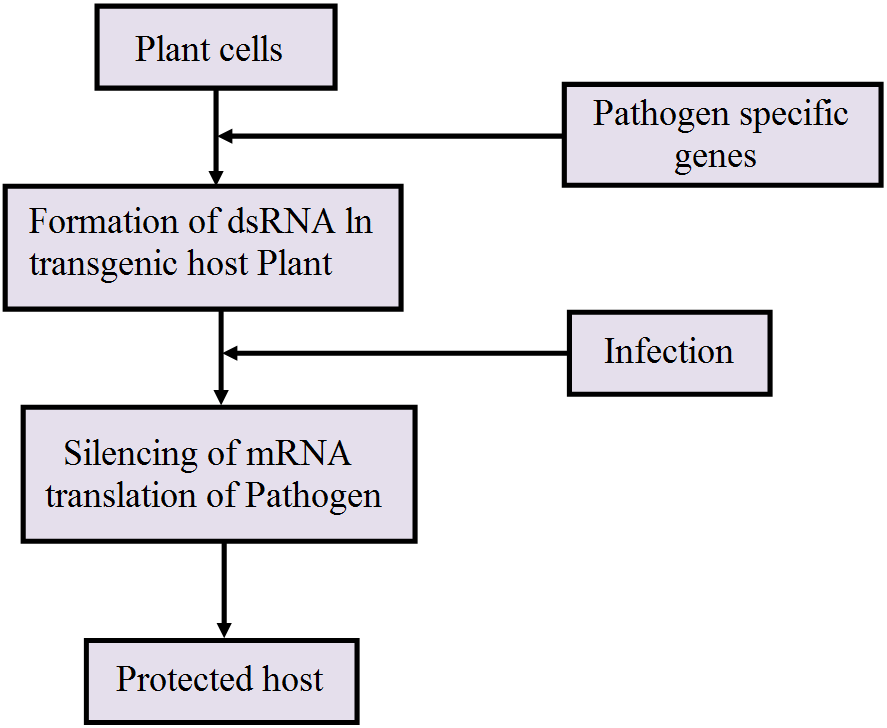
  1. Name the defence mechanism used.
  2. In which plant it has been done?
  3. Name the pathogen.
  4. Name the vector used in this technique.
Answer

  1. RNA interference (RNAI).
  2. Tobacco plant.
  3. Meloidegyne incognitia (nematode).
  4. Agrobacterium tumefaciens vector.

Need a full question paper?

Generate a complete, print-ready paper with questions like this in minutes — across 16+ boards, with answer keys.

Start Generating Free

Similar questions

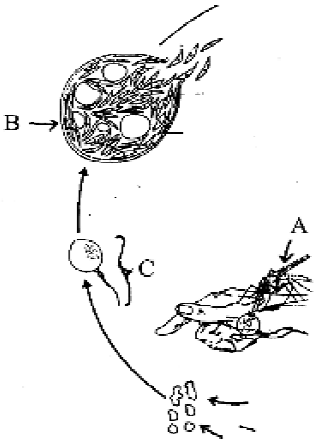
Study a part of the life cycle of malarial parasite given below. Answer the questions that follow:
  1. Mention the roles of ‘A’ in the life cycle of the malarial parasite.
  2. Name the event ‘C and the organ where this event occurs.
  3. Identify the organ ‘B’ and name the cells being released from it.
Give reasons : There is steady concentration of ozone in the stratosphere.
Name the cell from which the endosperm develops in a coconut. Mention its ploidy. Explain the process of endosperm development in a coconut.
  1. What are the transcriptional products of RNApolymerase III?
  2. Differentiate between 'Capping' and 'Tailing'.
  3. Expand hnRNA.
  1. Match the microbes listed under Column-A with the products mentioned under Column-B.
 
Column-A
 
Column-B
(a)
Penicillium notatum
(i)
Statin
(b)
Trichoderma polysporum
(ii)
Ethanol
(c)
Monascus purpurea
(iii)
Antibiotic
(d)
Saccharomyces cerevisiae
(iv)
Cyclosporin-A
  1. Why does ‘Swiss Cheese’ develop large holes?
Describe the effects of human activities in influencing natural ecosystem cycles with special reference to carbon cycle.
Define poultry Name any four animals included in poultry.
What are edible vaccines? How are they produced?
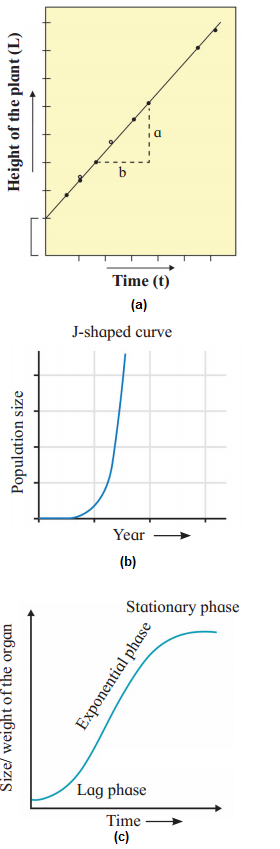
Identify the type of growth curves observed in plants.
Image
  1. What do ‘Y and ‘B’ stand for in ‘YAC’ and ‘BAC’ used in Human Genome Project (HGP)? Mention their role in the project.
  2. Write the percentage of the total human genome that codes for proteins and the percentage of discovered genes whose functions are known as observed during HGP.
  3. Expand ‘SNPs’ identified by scientists in HGP.