MCQ
Study the given flowchart carefully.
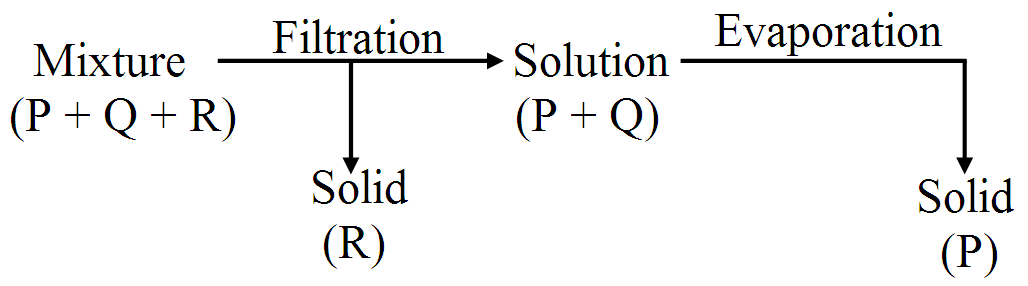
$P, Q$ and $R$ could be respectively.
$P, Q$ and $R$ could be respectively.
- AChalk powder, water and sawdust.
- BSalt, water and sugar.
- ✓Sugar, water and sawdust.
- DSawdust, water and sugar.
In the mixture of sugar, water and sawdust, firstly sawdust $(R)$ being insoluble in water, is removed by filtration and then sugar $(P)$ is separated from water $(Q)$ by evaporation.
Generate a complete, print-ready paper with questions like this in minutes — across 16+ boards, with answer keys.
|
Property
|
$X$
|
$Y$
|
$Z$
|
|
Occupies space
|
Yes
|
Yes
|
Yes
|
|
Has a definite shape
|
No
|
Yes
|
No
|
|
Has a definite volume
|
No
|
Yes
|
Yes
|
|
Can be compressed
|
Yes
|
No
|
No
|
|
S.No.
|
Column-$I$
|
S.No.
|
Column-$II$
|
|
$A.$
|
The process involved when a heavier con in a mixture settles after water is added to it
|
$(p)$
|
Condensation.
|
|
$B.$
|
The process whereby the liquid layer above the settled heavier component is removed
|
$(q)$
|
Evaporation.
|
|
$C.$
|
The process in which the liquids get converted to gases (vapours) on heating.
|
$(r)$
|
Sedimentation.
|
|
$D.$
|
The process in which gases (vapours) get converted to liquids on cooling
|
$(s)$
|
Decantation.
|
| S.No. | Column-$I$ | S. No. | Column-$II$ |
| $A.$ | Formation of day and night. | $(p)$ | Chemical change. |
| $B.$ | Ripening of a mango. | $(q)$ | Physical change. |
| $C.$ | Dissolving of sugar in water. | $(r)$ | Periodic change. |
| $D.$ | Occurrence of rainbow. | $(s)$ | Non-periodic change. |