Question
Study the given pedigree chart and answer the questions that follow.
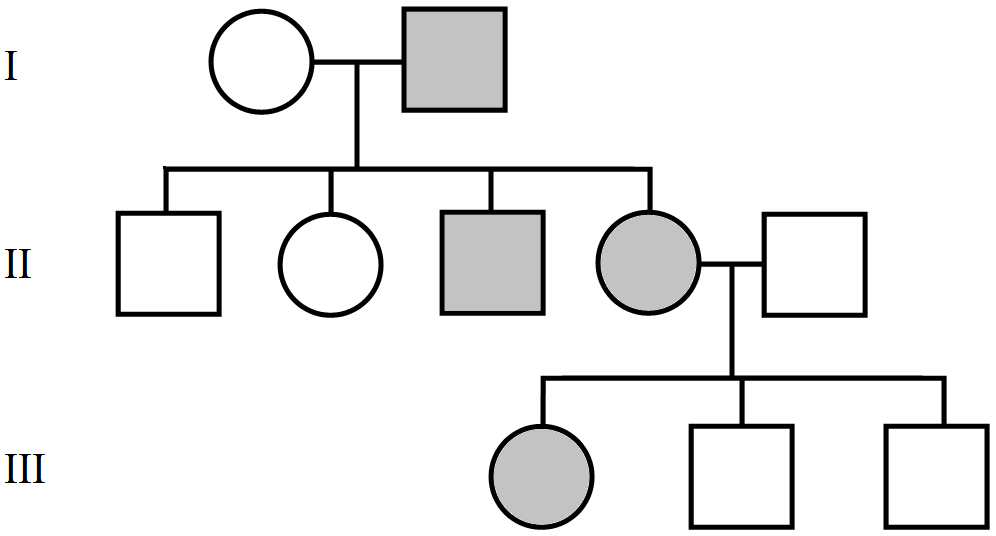
  1. Is the trait recessive or dominant?
  2. Is the trait sex linked or autosomal?
  3. Give the genotypes of the parents shown in generation I and their III child shown in generation II and the first grandchild shown in generation III.

Answer

  1. Dominant.
  2. Autosomal.
  3. Parents-Mother- aa.
Father-Aa.

Third child-Aa.

First grand-child-Aa.

Need a full question paper?

Generate a complete, print-ready paper with questions like this in minutes — across 16+ boards, with answer keys.

Start Generating Free

Similar questions

List in proper sequence the processes involved in recombinant DNA (rDNA) technology.
How has RNAi technique helped to prevent the infestation of roots in tobacco plants by a nematode Meloidegyne incognitia?
Suggest and explain any three Assisted Reproductive Technologies (ART) to an infertile couple.
In which food would you find lactic acid bacteria? Mention some of their useful applications.
What is genetic code? How did genetic code came into existence ?
Name the kind of organisms which constitute the pioneer community of xerarch and hydrarch succession, respectively.
In the 1950s, there were hardly any mosquitoes in Delhi. The use of pesticide DDT on standing water killed their larvae. It is believed that now there are mosquitoes because they evolved DDT resistance through the interaction of mutation and Natural selection. Pointwise, state in a sequence how that could have happened.
When Morgan conducted dihybrid cross on Drosophila like Mendel did with pea plants, the $F_2$ ratio deviated significantly from that of Mendel's F, ratio. Write the explanation Morgan and his group gave to the observations they obtained from their experiment.
A burglar in a huff forgot to wipe off his blood-stains from the place of crime where he was involved in a theft and fight. Name the technique which can help in identifying the burglar from the blood-stains. Describe the technique.
Two children, A and B aged 4 and 5 years respectively visited a hospital with a similar genetic disorder. The girl A was provided enzyme-replacement therapy and was advised to revisit periodically for further treatment. The girl, B was, however, given a therapy that did not require revisit for further treatment.
  1. Name the ailments the two girls were suffering from?
  2. Why did the treatment provided to girl A required repeated visits?
  3. How was the girl B cured permanently?