MCQ
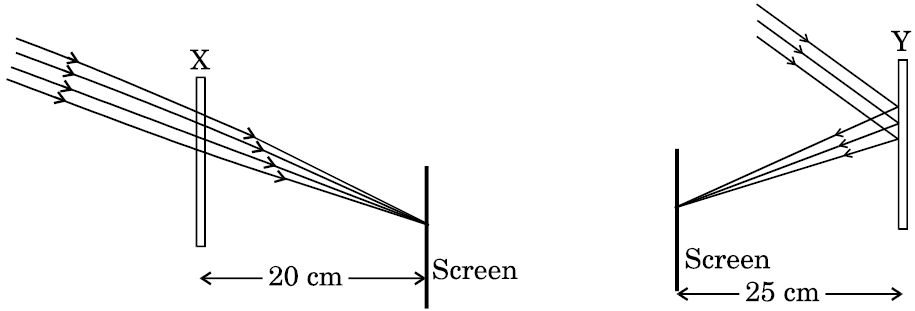
Study the given ray diagrams and select the correct statement from the following:
  • A
    Device X is a concave mirror and device Y is a convex lens, whose focal lengths are 20 cm and 25 cm respectively.
  • B
    Device X is a convex lens and device Y is a concave mirror, whose focal lengths are 10 cm and 25 cm respectively.
  • C
    Device X is a concave lens and device Y is a convex mirror, whose focal lengths are 20 cm and 25 cm respectively.
  • D
    Device X is a convex lens and device Y is a concave mirror, whose focal lengths are 20 cm and 25 cm respectively.
Answer

  1. Device X is a convex lens and device Y is a concave mirror, whose focal lengths are 20 cm and 25 cm respectively.

Explanation:

From the given figures we can conclude that the device X is a convex lens as it converges the rays and the device Y is a concave mirror as it also converges the rays but in the same side of the mirror .Their focal lengths are 20 cm and 25 cm respectively Regards.

Need a full question paper?

Generate a complete, print-ready paper with questions like this in minutes — across 16+ boards, with answer keys.

Start Generating Free

Similar questions

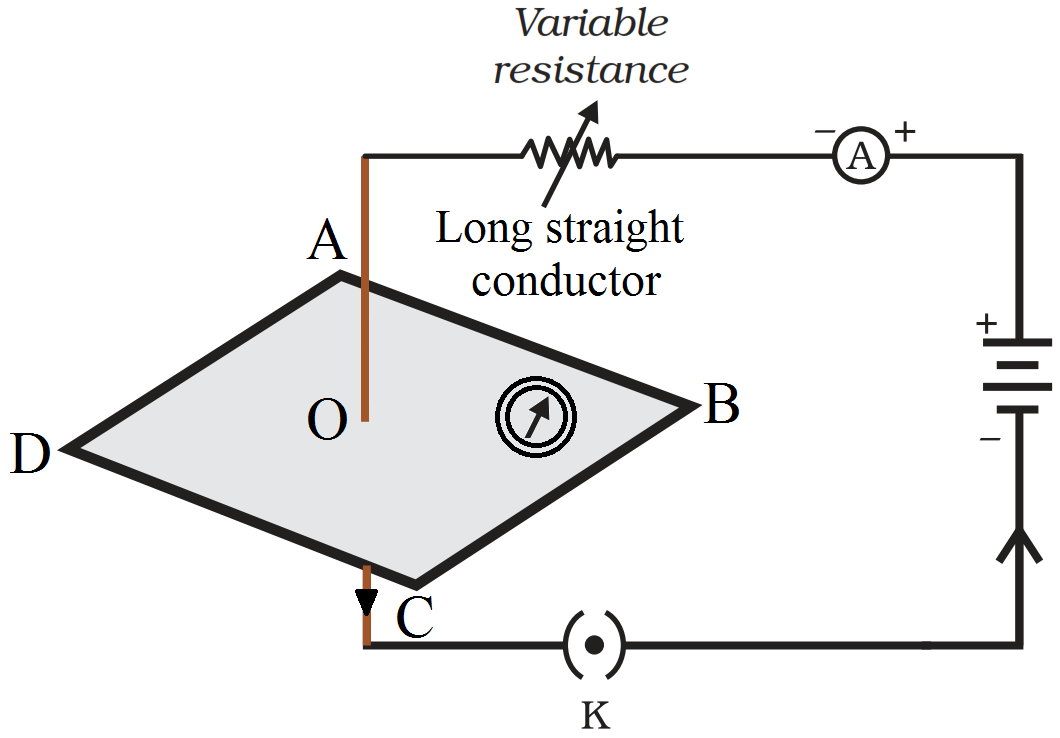
If the key in the arrangement as shown below is taken out (the circuit is made open) and magnetic field lines are drawn over the horizontal plane ABCD, the lines are.
Which of the following can make a parallel beam of light from a bulb falls on it?
  1. Concave mirror as well as concave lens.
  2. Convex mirror as well as concave lens.
  3. Concave mirror as well as convex lens.
  4. Concave mirror as well as convex lens.
In an electrical circuit two resistors of 2Ω and 4Ω respectively are connected in series to a 6V battery. The heat dissipated by the 4Ω resistor in 5s will be:
Variable focal length of eye is responsible for:
The angle of reflection is equal to the angle of incidence:
What name is given to a cylindrical coil of diameter less than its length ?
A concave mirror cannot be used as:
  1. A magnifying mirror
  2. A torch reflector
  3. A dentist's mirror
  4. A real view mirror
A student is observing the diagram showing the path of a ray of light passing through a glass prism. He would find that for all angles of incidence the ray of light bends:
The resistivity of a certain material is $0.6 Ω\ \text{m}. $ The material is most likely to be:
  1. An insulator.
  2. A superconductor.
  3. A conductor.
  4. A semiconductor.