Question
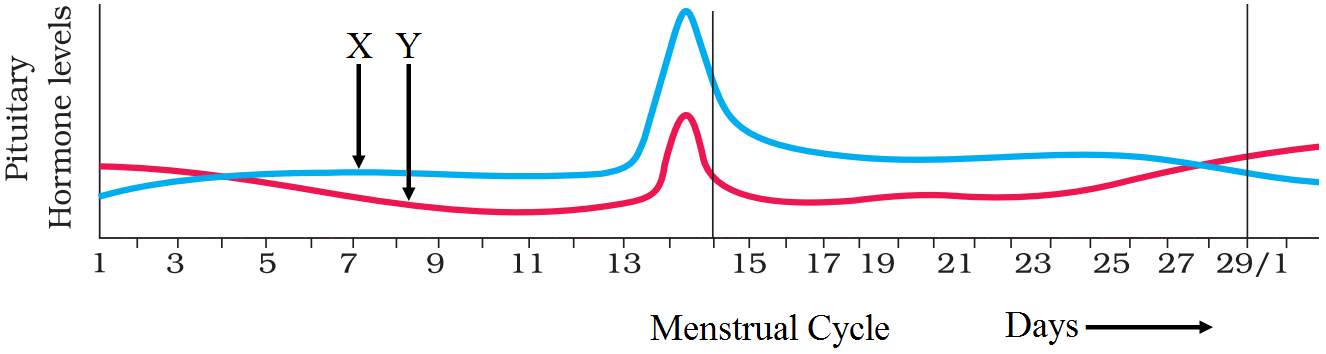
Study the graph given below and answer the questions that follow:
Explain the ovarian events (i), (ii) and (iii) under the influence of hormones ‘X’ and ‘Y’.

Answer

Both LH and FSH attain a peak level in the middle of cycle (about 14th day).
Rapid secretion of LH leading to its maximum level during the mid-cycle called LH surge induces rupture of Graafian follicle and thereby the release of ovum (ovulation).
The remaining cells of ovarian follicles are stimulated by the LH to transform into corpus luteum. The corpus luteum secretes large amount of progesterone which is essential for maintenance of the endometrium.

Need a full question paper?

Generate a complete, print-ready paper with questions like this in minutes — across 16+ boards, with answer keys.

Start Generating Free

Similar questions

What are biofertilisers? Name the categories of organisms used as biofertilisers with an example for each. How do they function in organic farming?
How bacterial cells are made competent to take up DNA?
The following is the illustration of the sequence of ovarian events (a – i) in a human female.
Draw a labelled sketch of the structure of a human ovum prior to fertilisation.
What is ecological pyramid? Describe the different types of pyramid.
Explain the histological structure of ovary in human.
Read the following and answer any four questions from (i) to (v) given below:
Transgenic animals can serve as factories that in some cases, may produce large amount of proteins more efficiently. Transgenic mice have been engineered to express human antibodies by introducing large segment of human DNA encoding human immunoglobulin genes. In transgenic large animals such as cow or sheep proteins of pharmaceutical value can be produced in large quantities in milk which is later purified. Transgenesis can be used to alter many phenotypic properties including growth rate, fat composition, milk production, hair texture, etc.
  1. The production of transgenic animals includes
  1. Identification and separation of desired gene.
  2. Combining the desired gene with appropriate vector.
  3. Introduction of vector in cells, tissues or embryos.
  4. All of these.
  1. In transgenic animals, i.e., cow and sheep proteins of pharmaceutical value are produced in large quantities in the
  1. Blood.
  2. Accumulated fat.
  3. Mammary glands.
  4. None of these.
  1. Mouse is mostly preferred animal for studies on gene transfer because.
  1. Short oestrous cycle.
  2. Long gestation period.
  3. Short generation time.
  4. Production of one or two offspring per pregnancy.
  1. Both (A) and (C)
  2. Both (A) and (B)
  3. Only D
  4. Both (C) and (D).
  1. Transgenic genes alter many phenotypic properties including:
  1. Growth rate.
  2. Fat composition.
  3. Milk production.
  4. All of these.
  1. Assertion: Transgenic mice have been engineered to express human antibodies.
Reason: Large segment of human DNA encoding human immunoglobulin have been transferred to mice.
  1. Both assertion and reason are true and reason is the correct explanation of assertion.
  2. Both assertion and reason are true but reason is not the correct explanation of assertion.
  3. Assertion is true but reason is false.
  4. Both assertion and reason are false.
Can a child have blood group O if his parents have blood group ‘A’ and ‘B’. Explain.
What are male hormones? What is their source and functions?
OR
Write a short note on the functions of androgens.
List the components of the embryo sac and mention their fate on fertilisation.
OR
Mention the fate of all the components of the embryo sac after fertilisation.
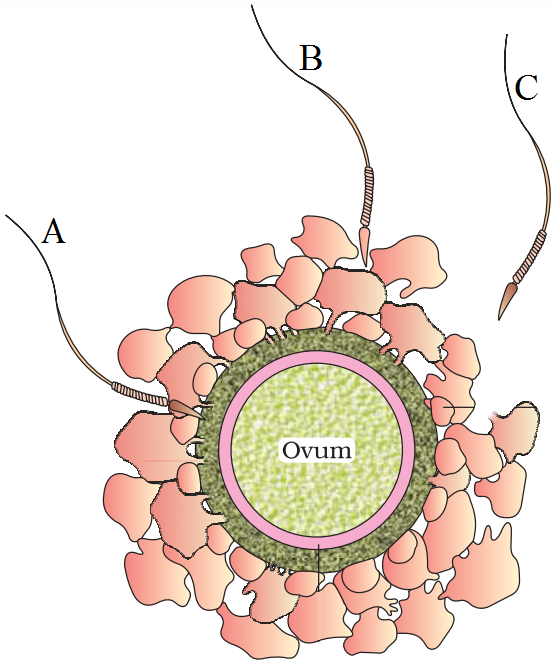
Given below is the diagram of a human ovum surrounded by a few sperms. Observe the diagram and answer the following questions:
Compare the fate of sperms shown in the diagram.