MCQ
Study the structures given below carefully and choose the type of isomerism they represent.
$ \ \ \ \ \ \ \ \ \ \ \ \ \text{CH}_3 \\ \ \ \ \ \ \ \ \ \ \ \ \ \ \ |\\\ \text{CH}_3-\text{C}-\text{CH}_3 \ \ \ \ \ \ \ \ \ \ \ \ \ \ \ \ \ \ \ \ \ \ \ \ \ \ \ \ \\ \ \ \ \ \ \ \ \ \ \ \ \ \ \ |\\ \ \ \ \ \ \ \ \ \ \ \ \ \ \text{CH}_3$
$ \ \ \ \ \ \ \ \ \ \ \ \ \text{CH}_3 \\ \ \ \ \ \ \ \ \ \ \ \ \ \ \ |\\\ \text{CH}_3-\text{CH}- \text{CH}_2-\text{CH}_3$
  • Chain isomerism.
  • B
    Position isomerism.
  • C
    Functional isomerism.
  • D
    Metamerism.

Answer

Correct option: A.
Chain isomerism.
$ \ \ \ \ \ \ \ \ \ \ \ \ \text{CH}_3 \\ \ \ \ \ \ \ \ \ \ \ \ \ \ \ |\\\ \text{CH}_3-\text{C}-\text{CH}_3 \ \ \ \ \ \ \ \ \ \ \ \ \ \ \ \ \ \ \ \ \ \ \ \ \ \ \ \ \\ \ \ \ \ \ \ \ \ \ \ \ \ \ \ |\\ \ \ \ \ \ \ \ \ \ \ \ \ \ \text{CH}_3 \ \ \ \ \ \ \ \ \ \ \ \ \text{CH}_3 \\ \ \ \ \ \ \ \ \ \ \ \ \ \ \ |\\\ \text{CH}_3-\text{CH}- \text{CH}_2-\text{CH}_3$
chain isomers as they have different carbon chains.

Need a full question paper?

Generate a complete, print-ready paper with questions like this in minutes — across 16+ boards, with answer keys.

Start Generating Free

Similar questions

The main source of organic compounds is :
At ${27\,^o}C,$ one mole of an ideal gas is compressed isothermally and reversibly from a pressure of $2 $ atm to $10 $ $atm$. The values of $\Delta E$ and $q $ are $(R = 2)$
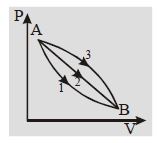
A given mass of gas expands reversibly from the state $A$ to the state $B$ by three paths $1, 2$ and $3$ as shown in the figure. If $w_1, w_2$ and $w_3$ respectively be the work done by the gas along three paths then:
Chlorine is in $+1$ oxidation state in
The $pK_b$ of $C{N^\Theta }$ is $4.7.$ The $pH$ of solution prepared by mixing $2.5\,mol$ of $KCN$ and $2.5\,mol$ of $HCN$ in water and making the total volume upto $500\,mL$ is.
According to the Bohr theory, which of the following transitions in the hydrogen atom will give rise to the least energetic photon ?
The most important method of preparation of hydrocarbons of lower carbon number is
Choose the correct order of stability of carbocation using the concept of hyperconjugation.
$\begin{matrix}{\ \ \ \ \ \ \ \ \ \ \ \ \text{CH}_3\\ \ \ \ \ \ \ \ \ \ \ \ \ \ |\\\text{CH}_3-\text{C}^\oplus\\ \ \ \ \ \ \ \ \ \ \ \ \ \ |\\\ \ \ \ \ \ \ \ \ \ \ \ \text{CH}_3} & { \ \ \ \ \ \ \ \ \ \ \ \ \text{CH}_3\\ \ \ \ \ \ \ \ \ \ \ \ \ \ |\\\text{CH}_3-\text{C}^\oplus\\ \ \ \ \ \ \ \ \ \ \ \ \ \ |\\ \ \ \ \ \ \ \ \ \ \ \ \ \text{H} } & {\text{CH}_3\stackrel{{\oplus} }{\hbox{CH}_2}} & \stackrel{{\oplus} }{\hbox{CH}_3} \\ \ \ \ \ \ \ \ \ \text{I} & \ \ \ \ \ \ \ \text{II} & \ \ \text{III} & \text{IV} \end{matrix}$
Benzene reacts with $\ce{CH_3Cl}$ in the presence of anhydrous $\ce{AlCl_3}$​ to form :
Each orbital has a nodal plane. Which of the following statements about nodal planes are not true :