Question
Study the table related to colour change with indicators and answer the questions that follow.
SolutionsColour change with phenolphthalein indicatorColour change with methyl orange indicator
PPinkYellow
QColourlessOrange
RColourlessRed

(i) Name the solution which is acidic.
(ii) Arrange the given solutions in increasing order of their $pH$ value.
(iii) What is the name of solution $P$ and $Q$ ?
or
(iv) When solution $P$ added to the china rose indicator, what is the colour of solution $P$ ?
Answer

COMING SOON

Need a full question paper?

Generate a complete, print-ready paper with questions like this in minutes — across 16+ boards, with answer keys.

Start Generating Free

Similar questions

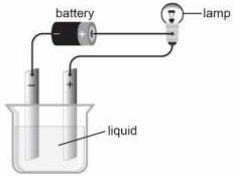
Mike placed an electric circuit separately in a dilute acid and a dilute base.

Image
Mike observed whether the lamp in the circuit glowed or not for each liquid.
8. Which property of acids and bases was Mike trying to test through his experiment?
9. Will the lamp glow if the circuit is placed in distilled water? 
Explain your answer.
10. Acid + Metal →Salt + X
What is X in the equation?

Read the following and answer any four questions from (i) to (v).Reactions, in which one element takes place of another element in a compound, are known as displacement reactions. ln general, more reactive elements displaces a less reactive element from its compound. ln all single displacement reactions, only one element displaces another element from its compound. The single displacement reactions are, however, written as just displacement reactions. The displacement reaction between iron (III) oxide and powdered aluminum produces so much heat that iron metal obtained is in molten form.
  1. which of the metals from its salt solution displaces copper ?
  2. When zinc reacts with dilute sulfuric acid, which gas is evolved ?
  3. When dry hydrogen is passed over a heated oxide of metal X using the apparatus , what substance is obtained and it could be in which form ?
          OR
    a) Which reactions are called displacement reaction?
    b) When dilute hydrochloric acid is added to granulated zinc placed in a test tube, what result will be there after observation ?
Read the following and answer any three questions from (i) to (iv).The table given below shows six organic compounds A, B, C, D, E and F having different molecular formula:
Organic compound
Molecular formula
A
C7H16
B
C8H16
C
C4H6
D
C6H10
E
C5H10
F
C9H20
  1. Write compounds belonging to the same homologous series?

  2. Write the member of the same homologous series as E with the help of the table?

  3. Identify Compound B from a given table.

           OR

  4. A) Write the general formula of Compound (F).
    B) Explain Different between organic and molecular compounds.
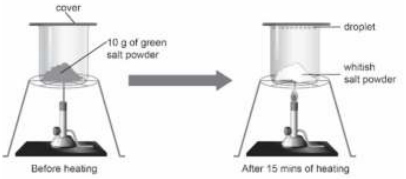
Madhav took 10 g of a green salt powder in a covered beaker.
He heated the beaker for 15 minutes.
Madhav noticed that the salt powder turned whitish after 15 minutes.
He also found some droplets on the inner surface of the beaker cover.

Image
Madhav added a few drops of water to the whitish powder.
The powder turned green.
6. What can be concluded about the green salt powder from Madhav’s activity?
Circle ‘Yes’ or ‘No’ to mark your responses.

Is the reason correct?

Yes or No

It contains moisture.

Yes/No

It changes colour on heating.

Yes/No

It changes to a new chemical on heating.

Yes/No

7. Madhav repeated the same activity but kept the beaker uncovered.
Will the results remain the same? Explain your answer. 

Read the following and answer any three questions from (i) to (iv).

A series of organic compounds having same functional group, with similar or almost identical chemical characteristics in which all the members can be represented by the same general formula and the two consecutive members of the series differ by-CH2 group or 14 mass unit in their molecular formulae is called a homologous series. For example, all the members of alcohol family can be represented by the general formula, CnH2n+1OH where, n may have the values 1, 2, 3, etc. The various members of a particular homologous series are called homologous. The physical properties such as density, melting point, boiling point, solubility, etc. of the members of a homologous series show almost regular variation in ascending or descending the series.

  1. What are the characteristic of members of a homologous series?

  2. Write the general formula of all the members of homologous series of alkynes.

  3. What is a homologous series? Write example.

                     OR

  4.  What are the 3 types of homologous series and define each.


Read the following and answer any three questions from (i) to (iv).

As neutral atom carbon has electronic configuration $\text{K}\ \ \ \text{L}\\2\ \ \ \ 4$ To gain inert gas configuration carbon can either donate 4 valence electrons (helium gas configuration) or gain 4 electrons (neon gas configuration), but it cannot do so. To acquire inert gas configuration carbon can only share its 4 valence electrons with other atoms forming covalent bonds. A covalent bond can be defined as a chemical bond formed between two atoms by mutual sharing of valence electrons so that each atom acquires the stable electronic configuration of the nearest noble gas. The concept of covalent bonds was given by Langmuir and Lewis to explain bonding in non-ionic compounds. The covalent bonds are of three types. If each atom contributes one electron, the covalent bond formed is called a single covalent bond and is represented by a single line (-) and if each atom contributes two electrons, the covalent bond formed is called a double bond and is represented by a double line (=) and if each atom contributes three electrons, the covalent bond formed is called a triple bond and is represented by a triple line $(\equiv).$

  1. Which compounds do not contain a double bond?

  2. Write compounds which contains a triple bond?

  3. Which molecules has all its atoms joined together by double covalent bond? Give two example.
                                             
                                         OR
  4. A) Langmuir and Lewis has given which concept?

    B) Explain three types of covalent bonds?  
Those reactions in which two compounds react by an exchange of ions to form two new compounds are called double displacement reactions. A double displacement reaction usually occurs in solution and one of the products, being insoluble, precipitate out (separates as a solid). Any reaction in which an insoluble solid (called precipitate) is formed that separates from the solution is called a precipitation reaction. The reaction in which acid or acidic oxide reacts with base or basic oxide to form salt and water is called neutralisation reaction. For example, $2 \mathrm{NaOH}+\mathrm{H}_{2} \mathrm{SO}_{4} \longrightarrow \mathrm{Na}_{2} \mathrm{SO}_{4}+\mathrm{H}_{2} \mathrm{O}$
i. When hydrogen sulphide gas is passed through a blue solution of copper sulphate, a black precipitate of copper sulphide is obtained and the sulphuric acid so formed remains in the solution. Mention the type of reaction.
ii. Balance the following chemical reaction.
$\mathrm{Pb}\left(\mathrm{NO}_{3}\right)_{2(\mathrm{aq})}+\mathrm{KI}_{(\mathrm{aq})} \longrightarrow \mathrm{PbI}_{2(\mathrm{~s})}+\mathrm{KNO}_{3(\mathrm{aq})}$
iii. Barium chloride in reaction with ammonium sulphate forms barium sulphate and ammonium chloride. Which type of chemical reaction represents in this reaction?
OR
Identify A in the following reaction.
$\mathrm{AlCl}_{3(\mathrm{aq})}+3 \mathrm{NH}_{4} \mathrm{OH}_{(\mathrm{aq})} \longrightarrow \mathrm{A}+3\mathrm{NH}_{4} \mathrm{Cl}_{(\mathrm{aq})}$
As neutral atom carbon has electronic configuration $\underset{2,}{K} \underset{4}{L}$. To gain inert gas configuration carbon can either donate 4 valence electrons (helium gas configuration) or gain 4 electrons (neon gas configuration), but it cannot do so. To acquire inert gas configuration carbon can only share its 4 valence electrons with other atoms forming covalent bonds. A covalent bond can be defined as a chemical bond formed between two atoms by mutual sharing of valence electrons so that each atom acquires the stable electronic configuration of the nearest noble gas. The concept of covalent bonds was given by Langmuir and Lewis to explain bonding in non-ionic compounds. The covalent bonds are of three types. If each atom contributes one electron, the covalent bond formed is called a single covalent bond and is represented by a single line (-) and if each atom contributes two electrons, the covalent bond formed is called a double bond and is represented by a double line ( $=$ ) and if each atom contributes three electrons, the covalent bond formed is called a triple bond and is represented by a triple line ( $\equiv$ ).
i. Define Catenation.
ii. What are name given for carbon atoms linked with single, double, triple bond?
iii. Define Valency and write two examples of molecules containing double bond.
OR
Draw the electron dot structure for $\mathrm{Cl}_{2}$ molecule.
Read the following and answer any three questions from (i) to (iv).

Bleaching powder is also known as chloride of lime. It is a solid and yellowish white in colour. Bleaching powder can be easily identified by the strong smell of chlorine. When calcium hydroxide (slaked lime) reacts with chlorine, it gives calcium oxychloride (bleaching powder) and water is formed. Aqueous solution of bleaching powder is basic in nature. The material to be bleached is first passed through solution of Na OH to remove greasy matter. Then it is passed through aqueous solution of bleaching powder and very dil. HCl solution. HCl reacts with bleaching powder to liberate nascent oxygen which bleaches material.

  1. Write two uses of Bleaching powder?

  2. Bleaching powder is also known as?

  3. A) Why does Bleaching powder gives smell of chlorine?
    B) What happens when calcium hydroxide reacts with chlorine?

                          OR
    What happens when HCl reacts with bleaching powder?