Question
Suppose in an imaginary world the angular momentum is quantized to be even integral multiples of $\frac{\text{h}}{2\pi}$ What is the longest possible wavelength emitted by hydrogen atoms in visible range in such a world according to Bohr's model?
Answer

Even quantum numbers are allowed,
$\text{n}_1=2,\text{n}_2=4\xrightarrow{\ \ \ }$ For minimum energy or for longest possible wavelength.
$\text{E}=13.6\bigg(\frac{1}{\text{n}^2_1}-\frac{1}{\text{n}^2_2}\bigg)$
$\text{E}=13.6\Big(\frac{1}{2^2}-\frac{1}{4^2}\Big)=2.55$
$2.55=\frac{\text{hc}}{\lambda}$
$\lambda=\frac{\text{hc}}{2.55}=\frac{1242}{2.55}$
$\lambda=487.05\text{nm}=487\text{nm}$

Need a full question paper?

Generate a complete, print-ready paper with questions like this in minutes — across 16+ boards, with answer keys.

Start Generating Free

Similar questions

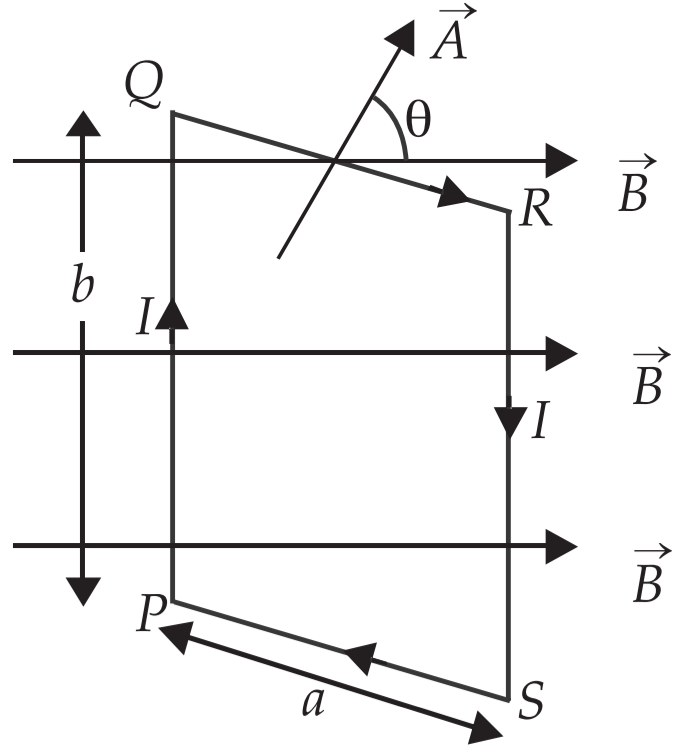
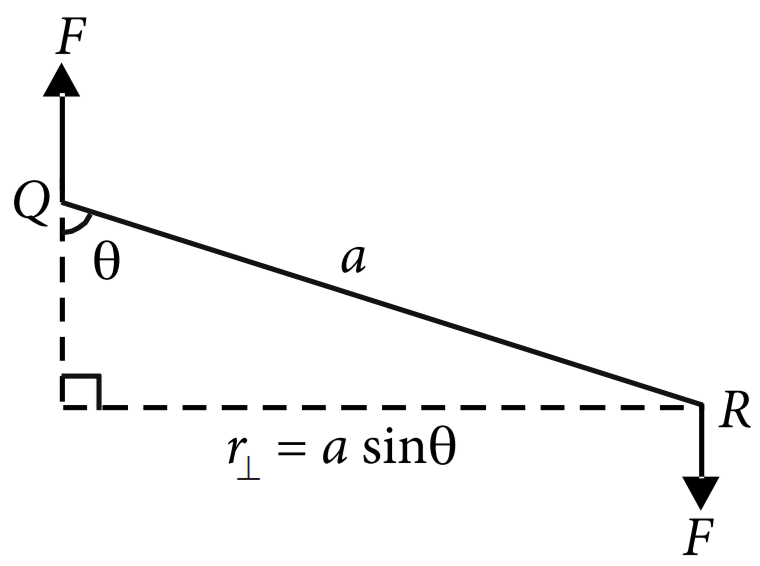
When a rectangular loop $\text{PQRS}$ of sides $' a\ ' $and $' b\ '$ carrying current $I$ is placed in uniform magnetic field $B,$ such that area vector ii makes an angle $8$ with direction of magnetic field, then forces on the arms $QR$ and $SP$ of loop are equal, opposite and collinear, thereby perfectly cancel each other, whereas forces on the arms $PQ$ and $RS$ of loop are equal and opposite but not collinear, so they give rise to torque on the loop.
Force on side $PQ$ or $RS$ of loop is $F = JbB \sin 90^\circ = lb B$ and perpendicular distance between two non-collinear forces is $\text{r}_\bot=\text{a}\sin\theta$
So, torque on the loop. $\tau=\text{IAB}\sin\theta$ In vector form torque, $\vec{\tau}=\vec{\text{M}}\times\vec{\text{B}}$
Where $\vec{\text{M}}=\text{NI}\vec{\text{A}}$ is called magnetic dipole moment of current loop and is directed in direction of area vector $\vec{\text{A}}$ i.e., normal to the plane ofloop.
  1. A circular loop of area $1\ cm^2, $carrying a current of $10A$ is placed in a magnetic field of $0.1T$ perpendicular to the plane of the loop. The torque on the loop due to the magnetic field is:
  1. Zero
  2. $10^{-4}Nm$
  3. $10^{-2}Nm$
  4. $1Nm$
  1. Relation between magnetic moment and angular velocity is:
  1. $\text{m}\propto\omega$
  2. $\text{m}\propto\omega^2$
  3. $\text{m}\propto\sqrt{\omega}$
  4. None of these.
  1. A current loop in a magnetic field:
  1. Can be in equilibrium in two orientations, both the equilibrium states are unstable.
  2. Can be in equilibrium in two orientations, one stable while the other is unstable.
  3. Experiences a torque whether the field is uniform or non uniform in all orientations.
  4. Can be in equilibrium in one orientation.
  1. The magnetic moment of a current $I$ carrying circular coil of radius rand number of turns $N$ varies as:
  1. $\frac{1}{\text{r}^2}$
  2. $\frac{1}{\text{r}}$
  3. $\text{r}$
  4. $\text{r}^2$
  1. A rectangular coil carrying current is placed in a non-uniform magnetic field. On that coil the total:
  1. Force is non$-$zero.
  2. Force is zero.
  3. Torque is zero.
  4. $ZN$one of these.  
In a plane electromagnetic wave, the electric field oscillates sinusoidally at a frequency of $2.0 \times 10^{10} Hz$ and amplitude $48 V m ^{-1}$.
(a) What is the wavelength of the wave?
(b) What is the amplitude of the oscillating magnetic field?
(c) Show that the average energy density of the E field equals the average energy density of the B field $\left[ c =3 \times 10^8 m s ^{-1}\right]$.
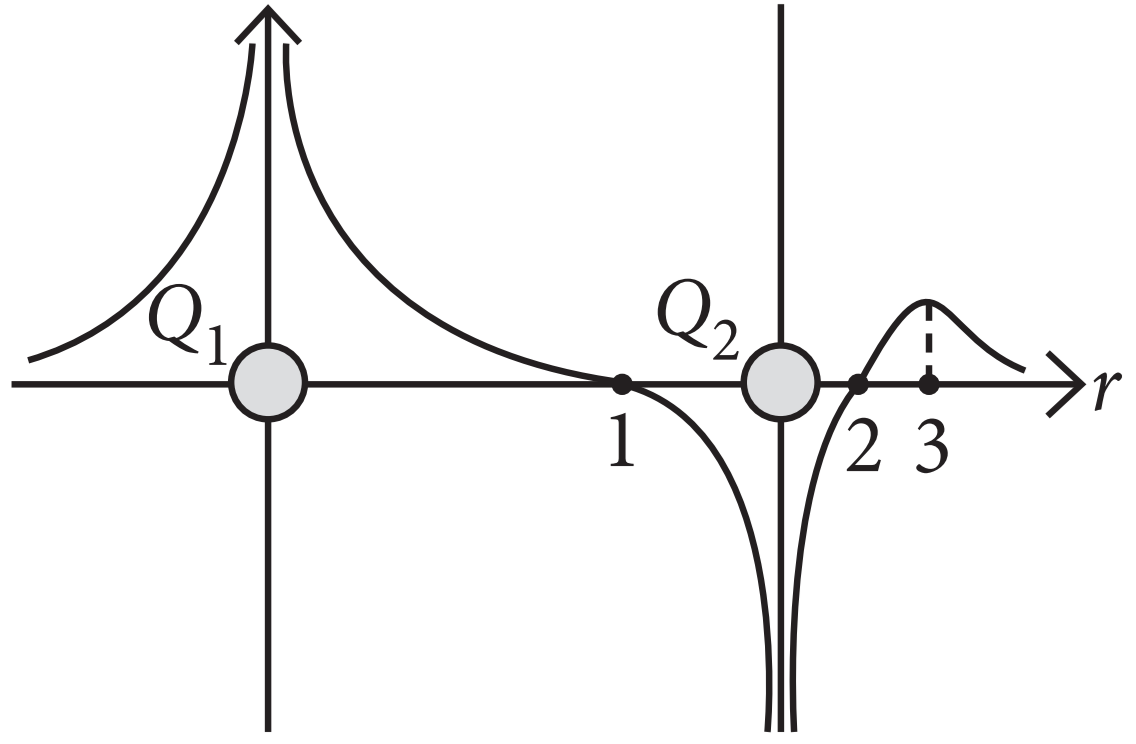
The potential at any observation point $P$ of a static electric field is defined as the work done by the external agent $($or negative of work done by electrostatic field$)$ in slowly bringing a unit positive point charge from infinity to the observation point. Figure shows the potential variation along the line of charges. Two point charges $Q_1 $ and $Q_2$ lie along a line at a distance from each other.
  1. At which of the points $1, 2,$ and $3$ is the electric field is zero?
  1. $1$
  2. $2$
  3. $3$
  4. Both $(a)$ and $(b)$
The work done by the electric field when another positive point charge is moved from
  1. $(-a, 0, 0)$ to $(0, a, 0)$ 
  2. Positive.
  3. Negative.
  4. Zero.
Depends on the path connecting the initial and final positions.Positive and negative point charges of equal magnitude are kept at $\Big(0,0,\frac{\text{a}}{2}\Big)$ and $\Big(0,0,\frac{\text{-a}}{2}\Big)$ respectively.
  1. Electrostatic force is a conservative force.
  2. Potential energy of charge $q$ at a point is the work done per unit charge in bringing a charge from any point to infinity.
  3. When two like charges lie infinite distance apart, their potential energy is zero.
  4. Both $(a) $ and $(c).$
Which of the following statement is not true?
  1. $Q_2$
  2. $Q_1$
  3. Same.
  4. Can't determined.
Which of the two charges $Q_1$ and $Q_2 $ is greater in magnitude?
  1. Positive and negative.
  2. Negative and positive.
  3. Positive and positive.
  4. Negative and negative.
The signs of charges $Q_1$ and $Q_2$ respectively are:
What is nuclear force? Write its properties. What do you mean by stability of a nucleus ?
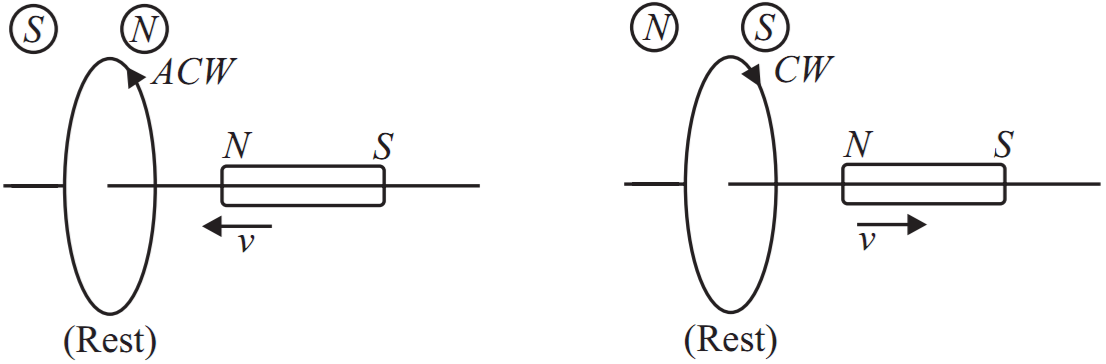
Lenz's law states that the direction of induced current in a circuit is such that it opposes the change which produces it. Tims, if the magnetic flux linked with a closed circuit increases, the induced current flows in such a direction that a magnetic flux is created in the opposite direction of the original magnetic flux. If the magnetic flux linked with the closed circuit decreases, the induced current flows in such a direction so as to create a magnetic flux in the direction of the original flux.
  1. Which of the following statements is correct?
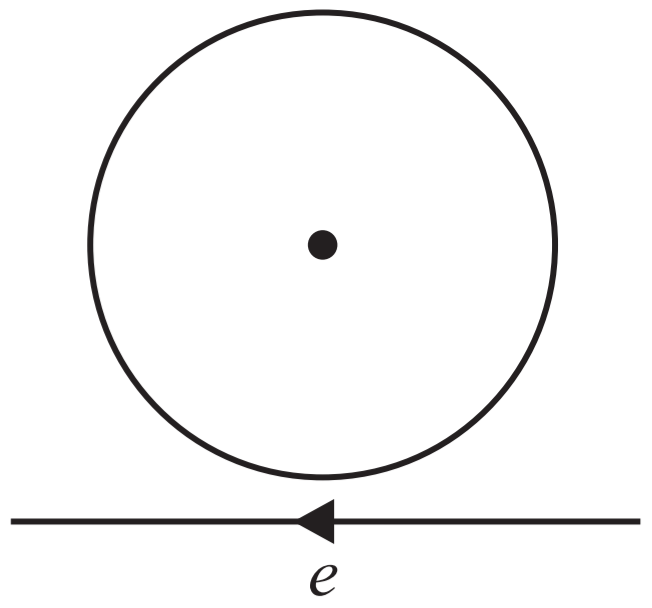
  1. Near a circular loop of conducting wire as shown in the figure, an electron moves along a straight line. The direction of the induced current if any in the loop is:
  2. Charge.
  3. Mass.
  4. Momentum.
  5. Energy.
  6. Lenz's law is a consequence of the law of conservation of:
  7. Ampere's circuital law.
  8. Biot$-$Savart law.
  9. Lenz's law.
  10. Fleming's right hand rule.
  11. The polarity of induced emf is given by:
  12. The induced e.m.f is not in the direction opposing the change in magnetic flux so as to oppose the cause which produces it.
  13. The relative motion between the coil and magnet produces change in magnetic flux.
  14. Emf is induced only if the magnet is moved towards coil.
  15. Emf is induced only if the coil is moved towards magnet.
  1. Variable.
  2. Clockwise.
  3. Anticlockwise.
  4. Zero.
  5. Two identical circular coils $A$ and Bare kept in a horizontal tube side by side without touching each other. If the current in the coil $A$ increases with time, in response, the coil $B:$
  6. Is attracted by $A$.
  7. Remains stationary.
  8. Is repelled.
  9. Rotates.
Explain refraction at spherical surfaces and derive formula $-\frac{n_1}{n}+\frac{n_2}{v}=\frac{n_2-n_1}{ R }$.
For the $L - C - R$ series $AC$ circuit derive the phase relationship between instantaneous current and voltage, using the phasor diagram.
An astronomical telescope is an optical instrument which is used for observing distinct images of heavenly bodies libe stars, planets etc. It consists of two lenses. In normal adjustment of telescope, the final image is formed at infinity. Magnifying power of an astronomical telescope in normal adjustment is defined as the ratio of the angle subtended at the eye by the angle subtended at the eye by the final image to the angle subtended at the eye, by the object directly, when the final image and the object both lie at infinite distance from the eye. It is given by, $\text{m}=\frac{\text{f}_0}{\text{f}_\text{g}}.$ To increase magnifying power of an astronomical telescope in normal adjustment, focal length of objective lens should be large and focal length of eye lens should be small.
  1. An astronomical telescope of magnifying power $7$ consists of the two thin lenses $40\ cm$ apart, in normal adjustment. The focal lengths of the lenses are
  1. $5\ cm, 35\ cm$
  2. $7\ cm, 35\ cm$
  3. $17\ cm, 35\ cm$
  4. $5\ cm, 30\ cm$
  1. An astronomical telescope has a magnifying power of $10.$ In normal adjustment, distance between the objective and eye piece is $22\ cm.$ The focal length of objective lens is:
  1. $25\ cm$
  2. $10\ cm$
  3. $15\ cm$
  4. $20\ cm$
  1. In astronomical telescope compare to eye piece, objective lens has:
  1. Negative focal length.
  2. Zero focal length.
  3. Small focal length.
  4. Large focal length.
  1. To see stars, use:
  1. Simple microscope.
  2. Compound microscope.
  3. Endoscope.
  4. Astronomical telescope.
  1. For large magnifying power of astronomical telescope.
  1. $f_0 << f_e$
  2. $f_0 << f_e$
  3. $f_0 << f_e$
  4. None of these.
Establish the formula : $\frac{n_{2}}{v}-\frac{n_{1}}{u}=\frac{n_{2}-n_{1}}{R}$ for refraction at single curved surface, where symbols have their usual meanings.
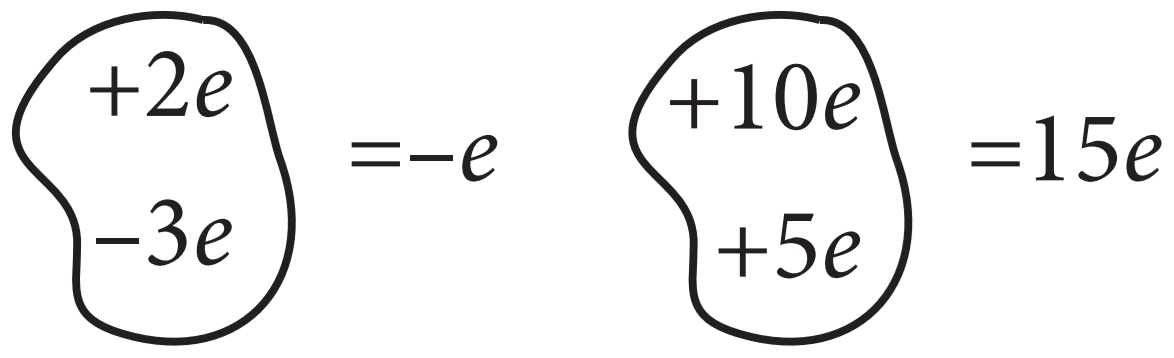
Smallest charge that can exist in nature is the charge of an electron. During friction, it is only the transfer of electrons which makes the body charged. Hence, net charge on any body is an integral multiple of charge of an electron $[1.6 x 10^{-19}C]$ i.e. $q = ± $ ne Where $n = 1, 2, 3, 4,....$
Hence, no body can have a charge represented as $1.1 e, 2. 7e, \frac{3}{5}\text{e,}$ etc.
Recently, it has been discovered that elementary particles such as protons or neutrons are composed of more elemental units called quarks.
  1. Which of the following properties is not satisfied by an electric charge?
  1. Total charge conservation.
  2. Quantization of charge.
  3. Two types of charge.
  4. Circular line of force.
  1. Which one of the following charges is possible?
  1. $2 \times 10^{12}$
  2. $3 \times 10^{12}$
  3. $2 \times 10^{14}$
  4. $3 \times 10^{14}$
  5. $A$ polythene piece rubbed with wool is found to have a negative charge of $3.2 \times 10^{-7} C$. Calculate the number of electrons transferred.
  6. $190.19$ years
  7. $150.12$ years
  8. $198.19$ years
  9. $188.21$ years
  10. If a body gives out $10^9$ electrons every second, how much time is required to get a total charge of $1C$ from it?
  11. $6.25 \times 10^{27}$
  12. $1.16 \times 10^{19}$
  13. $6.25 \times 10^{28}$
  14. $6.25 \times 10^9$
  15. If a charge on a body is $1nC,$ then how many electrons are present on the body?
  16. $5.8 \times 10^{-18}C$
  17. $3.2 \times 10^{-18}C$
  18. $4.5 \times 10^{-19}C$
  19. $8.6 \times 10^{-18}C$