MCQ
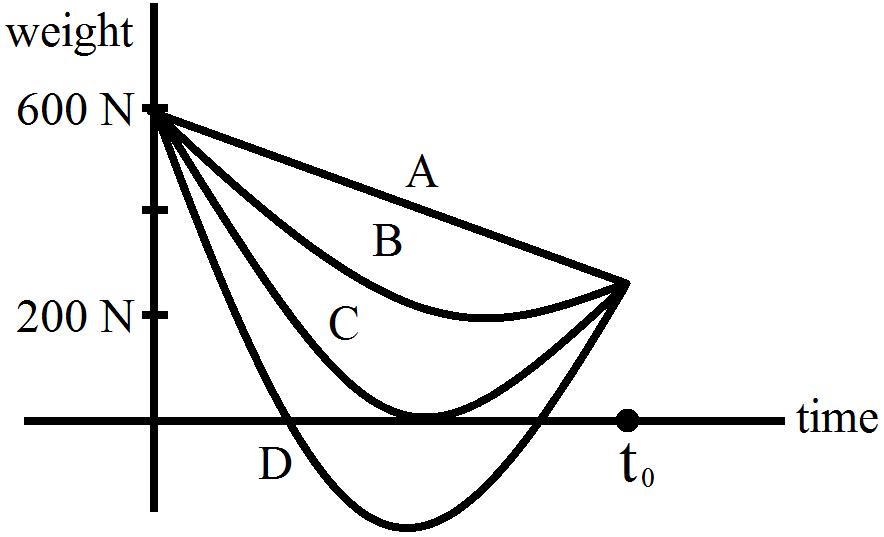
Suppose, the acceleration due to gravity at the earth's surface is $10 \mathrm{~ms}^{-2}$ and at the surface of Mars it is $4.0 \mathrm{~ms}^{-2}$. A $60 \ kg$ passenger goes from the earth to the Mars in a spaceship moving with a constant velocity. Neglect all other objects in the sky. Which part of best represents the weight $($net gravitational force$)$ of the passenger as a function of time?
  • A
    $A$
  • B
    $B$
  • $C$
  • D
    $D$

Answer

Correct option: C.
$C$
At one point between the Earth and Mars, the gravitational field intensity is zero. So, at that point, the weight of the passenger is zero. The curve $C$ indicates that the weight of the passenger is zero at a point between the Earth and Mars.

Need a full question paper?

Generate a complete, print-ready paper with questions like this in minutes — across 16+ boards, with answer keys.

Start Generating Free

Similar questions

A rocket of initial mass $6000\, kg$ ejects gases at a constant rate of $16\, kgs^{-1}$ with constant relative speed of $11\, kms^{-1}$ in gravity free space. What is the acceleration of the rocket $1\, min$. after the blast ............ $ m/sec^2$
Given below are two statements :

Statement-I: When a capillary tube is dipped into a liquid, the liquid neither rises nor falls in the capillary. The contact angle may be $0^{\circ}$.

Statement-II: The contact angle between a solid and a liquid is a property of the material of the solid and liquid as well :

In the light of above statement, choose the correct answer from the options given below.

The point on the pressure temperature phase diagram where all the phases co-exist is called
A massless string is wrapped round a disc of mass $M$ and radius $R$. Another end is tied to a mass $m$ which is initially at height $h$ from ground level as shown in the fig. If the mass is released then its velocity while touching the ground level will be
A cyclist starts from the point $P$ of a circular ground of radius $2 \mathrm{~km}$ and travels along its circumference to the point $\mathrm{S}$. The displacement of a cyclist is:
Three weights $W, 2W$ and $3W$ are connected to identical springs suspended from a rigid horizontal rod. The assembly of the rod and the weights fall freely. The positions of the weights from the rod are such that
The lengths of the second pendulum at two places are/and/respectively the result of gravitational acceleration at those places $(g_1: g_2)$ will be :
Two discs of moment of inertia $I_1=4 \mathrm{~kg} \mathrm{~m}^2$ and $\mathrm{I}_2=2 \mathrm{~kg} \mathrm{~m}^2$ about their central axes & normal to their planes, rotating with angular speeds $10 \mathrm\ {rad} / \mathrm{s}$ & $4  \mathrm\ {rad} / \mathrm{s}$ respectively are brought into contact face to face with their axe of rotation coincident. The loss in kinetic energy of the system in the process is____ $\mathrm{J}$.
The periodic time of a body executing simple harmonic motion is $3\, sec$. After how much interval from time $t = 0$, its displacement will be half of its amplitude ..... $\sec$
The ratio of period of oscillation of the conical pendulum to that of the simple pendulum is : (Assume the strings are of the same length in the two cases and $\theta$ is the angle made by the string with the verticla in case of conical pendulum)