Question
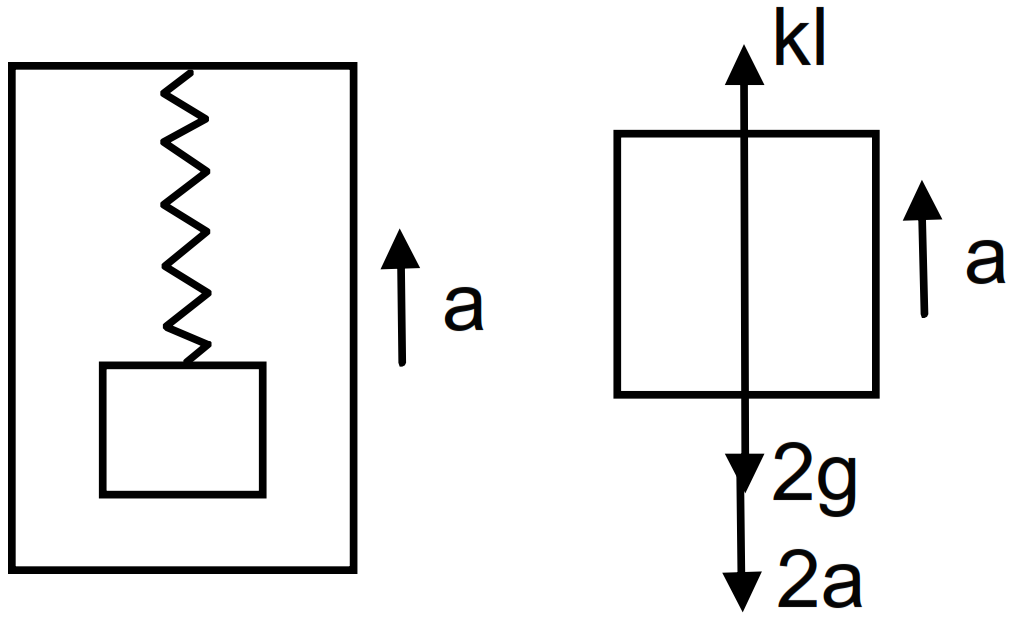
Suppose the ceiling in the previous problem is that of an elevator which is going up with an acceleration of $2.0m/s^2$. Find the elongations.
Answer

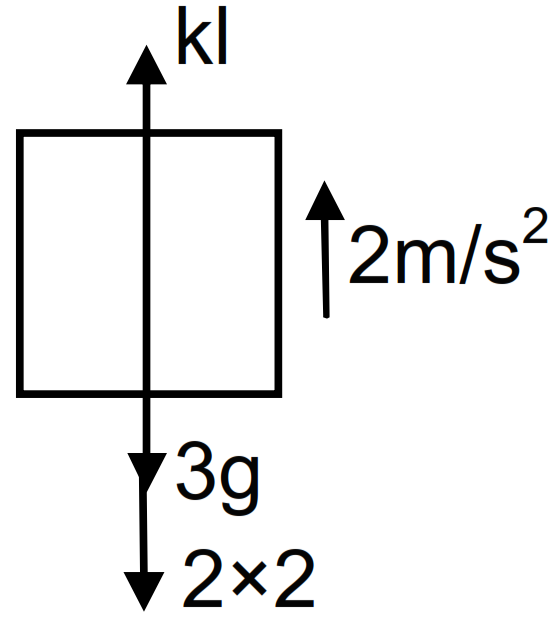
$a = 2m/s^2 kl - (2g + 2a) = 0$
$\Rightarrow kl = 2g + 2a = 2 \times 9.8 + 2 \times 2 = 19.6 + 4 = 23.6$
$\Rightarrow\text{I}=\frac{23.6}{100}=0.236\text{m}=0.24\text{m}$

 When $1\ kg$ body is added total mass $(2 + 1)kg = 3\ kg$.
elongation be$ l_1 kl_1 = 3g + 3a = 3 \times 9.8 + 6 = 33.4$
$\Rightarrow\text{I}_1=\frac{33.4}{100}=0.0334=0.36$
Further elongation $= l_1 - l = 0.36 - 0.24 = 0.12m$.

Need a full question paper?

Generate a complete, print-ready paper with questions like this in minutes — across 16+ boards, with answer keys.

Start Generating Free

Similar questions

A car moving at a speed of 36 km/hr is taking a turn on a circular road of radius 50m. A small wooden plate is kept on the seat with its plane perpendicular to the radius of the circular road (figure In). A small block of mass 100g is kept on the seat which rests against the plate. The friction coefficient between the block and the plate is $\mu=0.58.$
  1. Find the normal contact force exerted by the plate on the block.
  2. The plate is slowly turned so that the angle between the normal to the plate and the radius of the road slowly increases. Find the angle at which the block will just start sliding on the plate.
(a) For circuits used for transporting electric power, a low power factor implies large power loss in transmission. Explain.
(b) Power factor can often be improved by the use of a capacitor of appropriate capacitance in the circuit. Explain.
What will be the energy corresponding to the first excited state of a hydrogen atom if the potential energy of the atom is taken to be $10eV$ when the electron is widely separated from the proton? Can we still write $\text{E}_\text{n}=\frac{\text{E}_1}{\text{n}^2}?\text{ r}_\text{n}=\text{a}_0\text{n}^2?$ 
The frequency of vibration of a string depends on the length L between the nodes, the tension F in the string and its mass per unit length m. Guess the expression for its frequency from dimensional analysis.
Find the speed at which the kinetic enei:gy of a particle will differ by 1% from its nonrelativistic value $\frac{1}{2}\text{m}_0\text{v}^2$
A long, straight wire is fixed horizontally and carries a current of $50.0A.$ A second wire having linear mass density $1.0 \times 10^{-4}kg/m$ is placed parallel to and directly above this wire at a separation of $5.0\ mm.$ What current should this second wire carry such that the magnetic repulsion can balance its weight?
Write the name of different waves in electromagnetic spectrum and give brief introduction of their discovery, wavelength range, properties and applications.
A myopic adult has a far point at $0.1m.$ His power of accomodation is $4$ diopters.
  1. What power lenses are required to see distant objects?
  2. What is his near point without glasses?
  3. What is his near point with glasses? $($Take the image distance from the lens of the eye to the retina to be $2\ cm.)$
Two particles $A$ and $B,$ having opposite charges$ 2.0 \times 10^{-6}C$ and $2.0 \times 10^{-6}C,$ are placed at a separation of $1.0\ cm$.
  1. Write down the electric dipole moment of this pair.
  2. Calculate the electric field at a point on the axis of the dipole $1.0\ m$ awa.y from the centre.
  3. Calculate the electric field at a point on the perpendicular bisector of the dipole and $1.0\ m$ away from the centre.
A parallel$-$plate capacitor having plate area $400\ cm^2 $and separation between the plates $1.0\ mm$ is connected to a power supply of $100V.$ A dielectric slab of thickness $1.0\ mm$ and dielectric constant $5.0$ is inserted into the gap:
  1. Find the increase in electrostatic energy.
  2. If the power supply is now disconnected and the dielectric slab is taken out, find the further increase in energy.
  3. Why does the energy increase in inserting the slab as well as in taking it out?