Question
Suppose the entire system of the previous question is kept inside an elevator which is coming down with an acceleration a < g. Repeat parts (a) and (b).
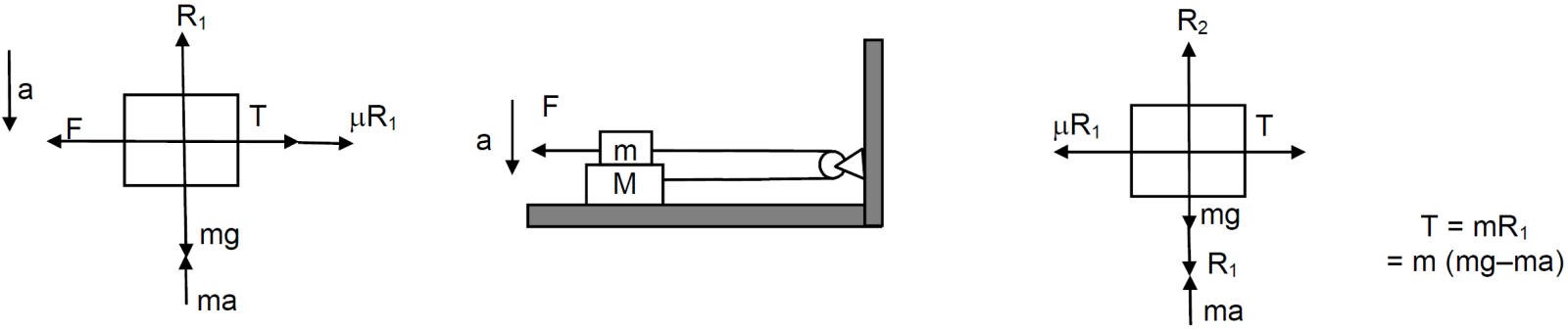
$\text{R}_1+\text{ma}-\text{mg}=0$
$\Rightarrow\text{R}_1=\text{m(g}-\text{a) = mg}-\text{ma} \ ...(\text{i})$
$\text{T}-\mu\text{R}_1=0\Rightarrow\text{T = m(mg}-\text{ma}) \ ...(\text{ii})$
Again, $\text{F}-\text{T}-\mu\text{R}_1=0$
$\Rightarrow\text{F}-\{\mu(\text{mg}-\text{ma})\}-\text{u}(\text{mg}-\text{ma})=0$
$\Rightarrow\text{F}-\mu\text{mg}+\mu\text{ma}-\mu\text{mg}+\mu\text{ma}=0$
$\Rightarrow\text{F}=2\mu\text{mg}-2\mu\text{ma}\Rightarrow\text{F}=2\mu\text{m(g}-\text{a})$
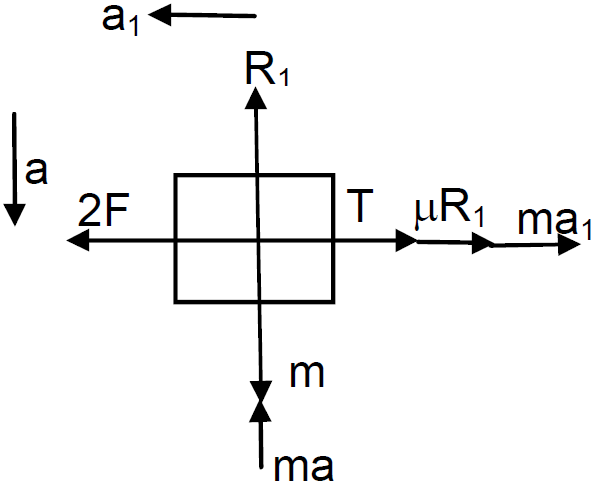
$\text{R}_1=\text{mg}-\text{ma} \ ...(\text{i})$
$2\text{F}-\text{T}-\mu\text{R}_1-\text{ma}_1=0$
$\Rightarrow2\text{F}-\text{t}-\mu\text{mg}+\mu\text{a}-\text{ma}_1=0 \ ...(\text{ii})$
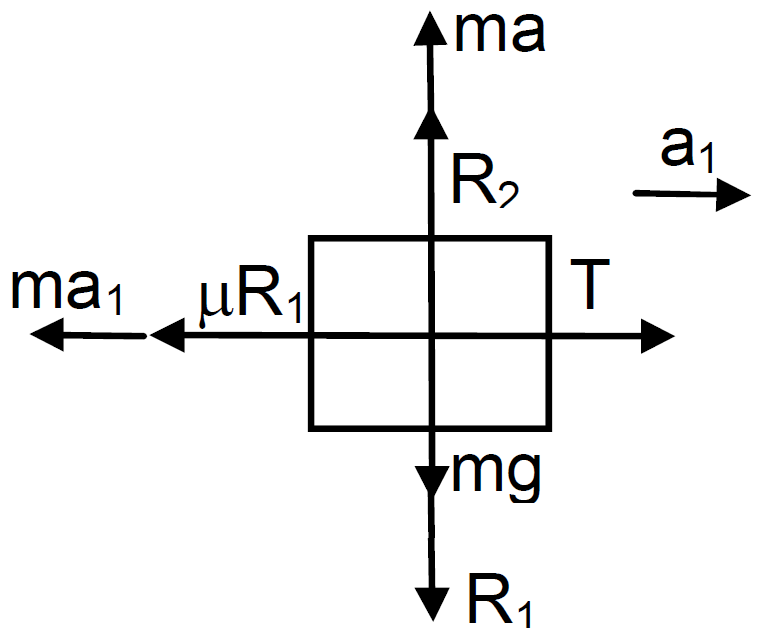
$\text{T}-\mu\text{R}_1-\text{Ma}_1=0$
$\Rightarrow\text{T}=\mu\text{R}_1+\text{Ma}_1$
$\Rightarrow\text{T}=\mu(\text{mg}-\text{ma})+\text{Ma}_1$
$\Rightarrow\text{T}=\mu\text{mg}-\mu\text{ma + Ma}_1$
Subtracting values of F & T, we get
$2(2\mu\text{m(g}-\text{a}))-2(\mu\text{mg}-\mu\text{ma}+\text{Ma}_1)\\-\mu\text{mg}+\mu\text{ma}-\mu\text{a}_1=0$
$\Rightarrow4\mu\text{mg}-4\mu\text{ma}-2\mu\text{mg}+2\mu\text{ma = ma}_1+\text{Ma}_1$
$\Rightarrow\text{a}_1=\frac{2\mu\text{m(g}-\text{a})}{\text{M + m}}$
Both blocks move with this acceleration but in opposite directions.
Generate a complete, print-ready paper with questions like this in minutes — across 16+ boards, with answer keys.
$\text{X}=\text{a}^2\text{b}^3\text{c}^\frac{5}{2}\text{d}^{-2}.$
The percentage error in the measurement of a, b, c and d are 1%, 2%, 3% and 4%, respectively. What is the percentage error in quantity X? If the value of X calculated on the basis of the above relation is 2.763, to what value should you round off the result.| Speed m/s | 200 | 400 | 600 | 800 | 1000 |
| % of molecules | 10 | 20 | 40 | 20 | 10 |