Question
Suppose the medium in the previous question is water. Select the correct option(s) from the list given in that question.
  1. vA > vB > vC
  2. vA < vB < vC
  3. vA = vB = vC
  4. $\text{v}_\text{B}=\frac{1}{2}(\text{v}_\text{A}+\text{v}_\text{C})$
Answer

  1.  $\text{v}_\text{A}>\text{v}_\text{B}>\text{v}_\text{C}$

  2. $\text{v}_\text{B}=\frac{1}{2}(\text{v}_\text{A}+\text{v}_\text{C})$

Explanation:

Since the speed of light is a universal constant,

$\text{v}_\text{A}=\text{v}_\text{B}=\text{v}_\text{C}=3\times 10^8\text{m/s}$

$\text{v}_\text{B}=\frac{1}{2}(\text{u}_\text{A}+\text{u}_\text{C})$ This expression also implies that vA = vB = vC 

Need a full question paper?

Generate a complete, print-ready paper with questions like this in minutes — across 16+ boards, with answer keys.

Start Generating Free

Similar questions

One bar magnet is kept in the direction of north-south such that its north pole is towards north.The direction of points of zero magnetic field is towards which side of the centre of the magnet:
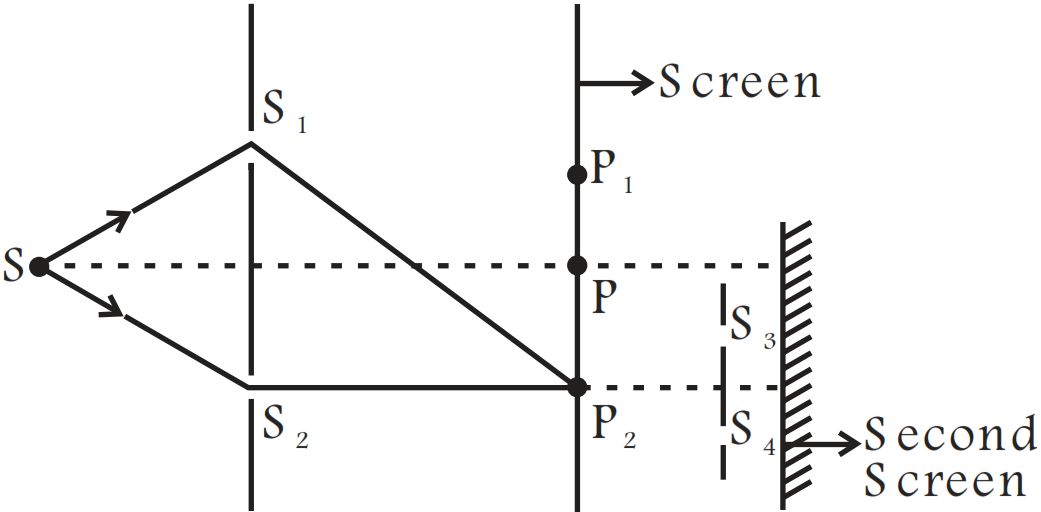
Figure shows a standard two slit arrangement with slits S1, S2. P1, P2 are the two minima points on either side of P (Fig). At P2 on the screen, there is a hole and behind P2 is a second 2- slit arrangement with slits S3, S4 and a second screen behind them.

Assertion :  The setting sun appears to be red.

Reason     :  Scattering of light is directly proportional to the wavelength.

(a) If both assertion and reason are true and the reason is the correct explanation of the assertion.

(b) If both assertion and reason are true but reason is not the correct explanation of the assertion.

(c) If assertion is true but reason is false.

(d) If the assertion and reason both are false.

The angular frequency of an AC source is $\frac{10\text{radian}}{\text{sec}}$ The reactance of $1\mu\text{F}$ capacitor will be.

The momentum of a photon in an X-ray beam of    metre wavelength is

(a) 1.5  m/sec

(b) 6.6  m/sec

(c) 6.6  m/sec

(d) 2.5 m/sec

When light is incident on a doubly refracting crystal, two refracted rays-ordinary ray (O-ray) and extra ordinary ray (E-ray) are produced. Then

(a) Both O-ray and E-ray are polarised perpendicular to the plane of incidence

(b) Both O-ray and E-ray are polarised in the plane of incidence

(c) E-ray is polarised perpendicular to the plane of incidence and O-ray in the plane of incidence

(d) E-ray is polarised in the plane of incidence and O-ray perpendicular to the plane of incidence

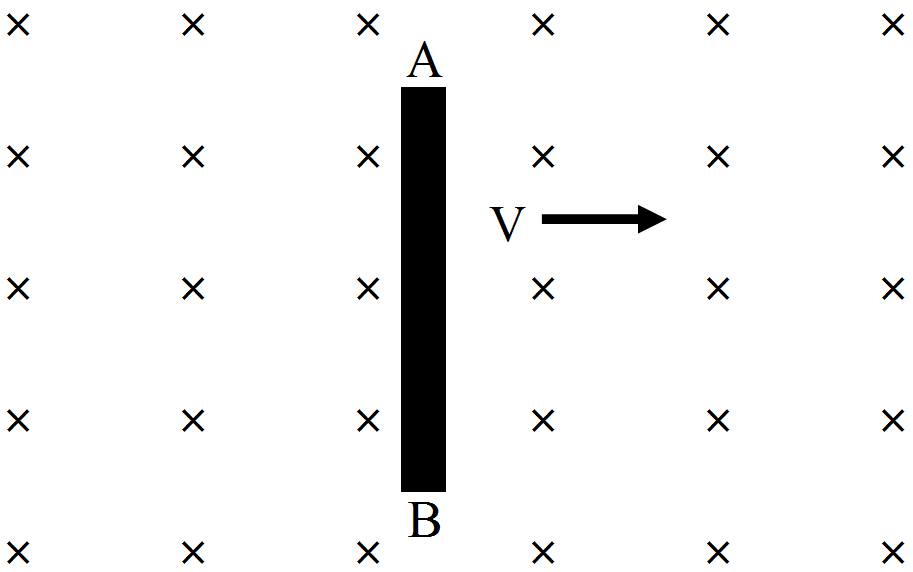
A rod AB moves with a uniform velocity v in a uniform magnetic field as shown in figure.
  1. The rod becomes electrically charged.
  2. The end A becomes positively charged.
  3. The end B becomes positively charged.
  4. The rod becomes hot because of Joule heating.

A substance is behaving as convex lens in air and concave in water, then its refractive index is

(a) Smaller than air

(b) Greater than both air and water

(c) Greater than air but less than water

(d) Almost equal to water

For a solid with a small expansion coefficient:
  1. Cp - Cv = R
  2. Cp = Cv
  3. Cp is slightly greater than Cv
  4. Cp is slightly less than Cv
Two ions have equal masses but one is singly-ionised and the other is doubly-ionised. They are projected from the same place in a uniform magnetic field with the same velocity perpendicular to the field.
  1. Both ions will move along circles of equal radii.
  2. The circle described by the singly-ionised charge will have a radius that is. double that of the other circle.
  3. The two circles do not touch each other.
  4. The two circles touch each other.