Question
Suppose the platform with the kid in the previous problem is rotating in anticlockwise direction at an angular speed $\omega.$ The kid starts walking along the rim with a speed v relative to the platform also in the anticlockwise direction. Find the new angular speed of the platform.

Answer

From a inertial frame of reference when we see the (man wheel) system, we can find that the wheel moving at a speed of $\omega$ and the man with $\Big(\omega+\frac{\text{V}}{\text{R}}\Big)$ after the man has started walking. $(\omega'=$ angular velocity after walking, $\omega=$ angular velocity of the wheel before walking$).$

Since $\sum\text{l}=0$

Extended torque = 0

Therefore, $(1+\text{MR}^2)\omega=\text{l}\omega'+\text{mR}^2\Big(\omega'+\frac{\text{V}}{\text{R}}\Big)$

$\Rightarrow(1+\text{MR}^2)\omega=\text{l}\omega'+\text{mR}^2\omega'+\text{mVR}$

$\Rightarrow\omega'=\omega-\frac{\text{mVR}}{(1+\text{mR}^2)}.$

Need a full question paper?

Generate a complete, print-ready paper with questions like this in minutes — across 16+ boards, with answer keys.

Start Generating Free

Similar questions

On the basis of Bohr's postulate obtain the formula for radius and total energy of electron in the $n^{\text {th }}$ stable orbit for hydrogen atom.
Define semiconductors on the basis of energy band theory. What are the charge carriers in semiconductor? What do semiconductors start behaving like at absolute zero temperature?
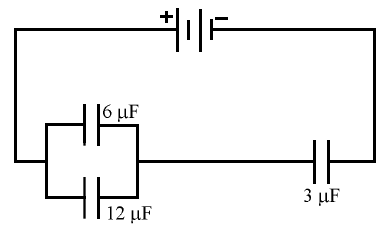
  1. In the following arrangement of capacitors, the energy stored in the 6 μF capacitor is E. Find the value of the following:
  2. Energy stored in 12 μF capacitor.
  3. Energy stored in 3 μF capacitor.
  4. Total energy drawn from the battery.

Explain two  main important points for astronomical telescope.
A cylinder rotating at an angular speed of 50rev/s is brought in contact with an identical stationary cylinder. Because of the kinetic friction, torques act on the two cylinders, accelerating the stationary one and decelerating the moving one. If the common magnitude of the acceleration and deceleration be one revolution per second square, how long will it take before the two cylinders have equal angular speed?
  1. State the law of radioactive decay. Write the SI unit of ‘activity’.
  2. There are $4\sqrt{2}\times10^6$ radioactive nuclei in a given radioactive sample. If the half life of the sample is 20 s, how many nuclei will decay in 10 s?
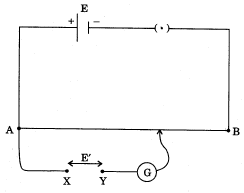
For the potentiometer circuit shown in the given figure, points X and Y reprensent the two terminals of an unknown emf E'. A student observed that when the jockey in moved from the end A to the end B of the potentiometer wire, the deflection in the galvanometer remains in the same direction.What may be the two possible faults in the circuit that could result in this obsevation?
If the galvanometer deflection at the end B is (i) more, (ii) less, than that at the end A, which of the two faults, listed above, would be there in the circuit?
Give reasons in support of your answer in each case.
Name the charge carriers of electric current in:
  1. Silver foil.
  2. Hydrogen discharge tube.
  3. Germanium semiconductor.
  4. Wire made of alloy nichrome.
  5. Superconductor.
Write and explain the super position principle (of waves).
Find the Q-value and the kinetic energy of the emitted α-particle in the $\alpha $-decay of

  1.  $^{226}_{88}\text{Ra}$ and  
  2. $^{220}_{86}\text{Rn}.$

Given

$\text{m}(^{226}_{88}\text{Ra})=226.02540\text{ u}.$ $\text{m}(^{222}_{86}\text{Rn})=222.01750\text{ u}.$

$\text{m}(^{222}_{86}\text{Rn})=220.01137\text{ u}.$ $\text{m}(^{216}_{84}\text{Po})=216.00189\text{ u}.$