MCQ
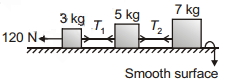
$T_1$ and $T_2$ in the given figure are
  • A
    $28\; N , 48\; N$
  • B
    $48\; N , 28\; N$
  • $96 \;N , 56\; N$
  • D
    $56 \;N , 96\; N$

Answer

Correct option: C.
$96 \;N , 56\; N$
c
(c)

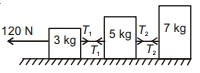
Acceleration of the system $a=\frac{F_{\text {ext }}}{M_{\text {Total }}}=\frac{120}{3+5+7}=8 \,m / s ^2$ Writing equation for $7 \,kg$ mass

$T_2=7(8)$

$=56 \,N$

Writing equation for $5 \,kg$ mass

$T_1=T_2+5(a)$

$=56+5(8)=96 \,N$
Need a full question paper?

Generate a complete, print-ready paper with questions like this in minutes — across 16+ boards, with answer keys.

Start Generating Free

Similar questions

The position of a particle as a function of time $t$, is given by $x\left( t \right) = at+ b{t^2} - c{t^3}$ where $a, b$ and $c$ are constants. When the particle attains zero acceleration, then its velocity will be
A solid cylinder of mass $M$ and radius $R$ rolls without slipping down an inclined plane of length $L$ and height $h$.  What is the speed of its centre of mass when the cylinder reaches its bottom 
A particle starts from rest and traverses a distance $l$ with uniform acceleration, then moves uniformly over a further distance $2 l$ and finally comes to rest after moving a further distance $3 l$ under uniform retardation. Assuming entire motion to be rectilinear motion the ratio of average speed over the journey to the maximum speed on its ways is
Different physical quantities are given in Column - $\mathrm{I}$ and their dimensional formula are given in Column - $\mathrm{II}$. Match them appropriately.
Column - $\mathrm{I}$ Column - $\mathrm{II}$
$(a)$ Viscous force $(i)$ $\left[ {{M^1}{L^1}{T^{ - 2}}} \right]$
$(b)$ Coefficient of viscosity $(ii)$ $\left[ {{M^1}{L^{ - 1}}{T^{ - 1}}} \right]$
  $(iii)$ $\left[ {{M^1}{L^{ - 1}}{T^{ - 2}}} \right]$
A beam consisting of protons and electrons moving at the same speed goes through a thin region in which there is a magnetic field perpendicular to the beam. The protons and the electrons:
  1. Will go undeviated.
  2. Will be deviated by the same angle and will not separate.
  3. Will be deviated by different angles and hence separate.
  4. Will be deviated by the same angle but will separate.
Three identical rods $AB$, $CD$ and $PQ$ are joined as shown. $P$ and $Q$ are mid points of $AB$ and $CD$ respectively. Ends $A, B, C$ and $D$ are maintained at $0^o C, 100^o C, 30^o C$ and $60^o C$ respectively. The direction of heat flow in $PQ$ is
A solid cube and a solid sphere both made of same material are completely submerged in water but to different depths. The sphere and the cube have same surface area. The buoyant force is
If the density of the earth is doubled keeping its radius constant then acceleration due to gravity will be........ $m/{s^2}$ . $(g = 9.8\,m/{s^2})$
A thin uniform stick of length $l$ and mass $m$ is held horizontally with its end $B$ hinged on the edge of a table. Point $A$ is suddenly released. The acceleration of the centre of mass of the stick at the time of release, is
A vector is of magnitude $10\sqrt{3}$ units and making equal angles with the positive direction of x, y and z axis is: