MCQ
Tailing of mercury is ___________ redox change.
- AIntramolecular.
- BIntermolecular.
- CDisproportion.
- DNone.
Explanation:
When ozone is passed through mercury, mercurous oxide (Hg2O) is formed.
Due to this, mercury loses its meniscus and starts sticking to the glass.
This phenomenon is known as Tailing of mercury.
2Hg + O3 → Hg2O + O2.
In this reaction, the oxidation number of mercury changes from 0 to +1. Thus, it is oxidized.
The oxidation number of oxygen changes from 0 to -2. Thus, it is reduced.
Generate a complete, print-ready paper with questions like this in minutes — across 16+ boards, with answer keys.
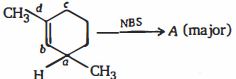
The mass (in $\mathrm{mg}$ ) of $\mathrm{S}$ obtained is. . . . . . . [Use molar mass (in g mol ${ }^{-1}$ ) : $\mathrm{H}=1, \mathrm{C}=12, \mathrm{~N}=14, \mathrm{Br}=80$ ]
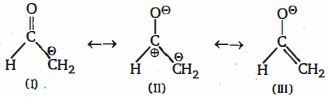
$(i)$ $\begin{array}{*{20}{c}}
{\,\,\,\,\,\,\,\,\,\,\,\,\,\,\,\,\,\,\,\,C{H_3}} \\
{\,\,\,\,\,\,\,\,\,\,\,\,\,\,\,|} \\
{C{H_3} - {C^ \mathbf{-} }} \\
{\,\,\,\,\,\,\,\,\,\,\,\,\,\,\,|} \\
{\,\,\,\,\,\,\,\,\,\,\,\,\,\,\,\,\,\,C{H_3}}
\end{array}$
$(ii)$ $H _{2} C = CH - CH _{2}$
$(iii)$ $HC \equiv \stackrel{\ominus}{ C }$
$(iv)$ $\stackrel{\ominus}{ CH _{3}}$
$(v)$ $\stackrel{\ominus}{{ }_{ CN }}$
$(A)$ The decreasing order of atomic radii of group $13$ elements is $\mathrm{Tl}>\mathrm{In}>\mathrm{Ga}>\mathrm{Al}>\mathrm{B}$.
$(B)$ Down the group $13$ electronegativity decreases from top to bottom.
$(C)$ $\mathrm{Al}$ dissolves in dil. $\mathrm{HCl}$ and liberate $\mathrm{H}_2$ but conc. $\mathrm{HNO}_3$ renders Al passive by forming a protective oxide layer on the surface.
$(D)$ All elements of group 13 exhibits highly stable +1 oxidation state.
$(E)$ Hybridisation of $\mathrm{Al}$ in $\left[\mathrm{Al}\left(\mathrm{H}_2 \mathrm{O}\right)_6\right]^{3+}$ ion is $\mathrm{sp}^3 \mathrm{~d}^2$.
Choose the correct answer from the options given below: