Question
Take any three non-collinear points $A, B, C$ and draw $\angle\text{ABC}.$ Through each vertex of the triangle, draw a line parallel to the opposite side.
Answer


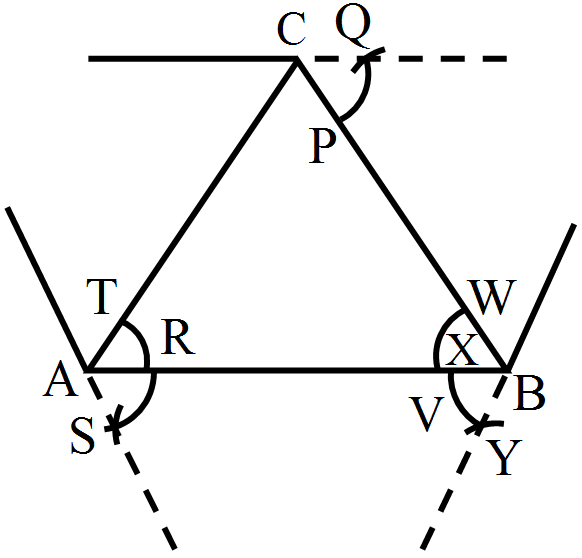
Steps of construction: Step I: Mark three non collinear points $A, B$ and $C$ such that none of them lie on the same line.
Step II: Join $A B, B C$ and $C A$ to form triangle $A B C$.
Step III: Parallel line to $A C$
Step IV: With $A$ as centre, draw an arc cutting $A C$ and $A B$ at $T$ and $U$, respectively.
Step V: With centre $B$ and the same radius as in the previous step, draw an arc on the opposite side of $A B$ to cut $A B$ at $X .$
Step VI: With centre $X$ and radius equal to $T U$, draw an arc cutting the arc drawn in the previous step at $Y$.
Step VII: Join $B Y$ and produce in both directions to obtain the line parallel to $A C$.
Parallel line to AB: Step I: With $B$ as centre, draw an arc cutting $B C$ and $B A$ at $W$ and $V$, respectively.
Step II: With centre $C$ and the same radius as in the previous step, draw an arc on the opposite side of $B C$ to cut $B C$ at $P .$
Step III: With centre $P$ and radius equal to $W V$, draw an arc cutting the arc drawn in the previous step at $Q .$
Step IV: Join $CQ$ and produce in both directions to obtain the line parallel to $A B$.

Need a full question paper?

Generate a complete, print-ready paper with questions like this in minutes — across 16+ boards, with answer keys.

Start Generating Free

Similar questions

Write the following rational numbers as integers: $\frac{7}{1}, \frac{-12}{1}, \frac{34}{1}, \frac{-73}{1}, \frac{95}{1}$
Two hundred students of 6th and $7th$ classes were asked to name their favourite colour so as to decide upon what should be the colour of their school building. The results are shown in the table. Represent the given data on a bar graph.
Favourite Colour Red Green Blue Yellow Orange
Number of Students $43$ $19$ $55$ $49$ $34$
Answer the question with the help of the bar graph: How many colours are there in all? What are they?
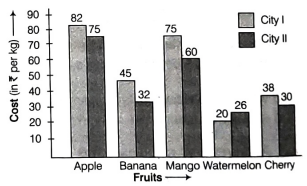
Study the double bar graph given below and answer the questions that follow
Image
(i) What information does the above double graph depict?
(ii) Name the fruits for which cost of 1 kg is greater in City I as compared to City II.
(iii) What is the difference of rates for apples in both the cities?
(iv) Find the ratio of the cost of mangoes per kg in City! to the cost of mangoes per kg in City II.
A dice is thrown $100$ times and the outcomes are noted as given below:
Outcome
$1$
$2$
$3$
$4$
$5$
$6$
Frequency
$21$
$14$
$18$
$15$
$23$
$9$
When a dice is thrown at random, what is the probability of getting a $(i)\ 3,\ (ii)\ 6,\ (iii)\ 6,\ (iv) \ 1?$
$D$ is a point on the side $B C$ of $\triangle A B C$. $A$ line $P D Q$, through $D$, meets side $A C$ in $P$ and $A B$ produced at $Q$. If $\angle A=80^{\circ}, \angle A B C=60^{\circ}$ and $\angle P D C=15^{\circ}$, find (i) $\angle A Q D$ (ii) $\angle A P D$.
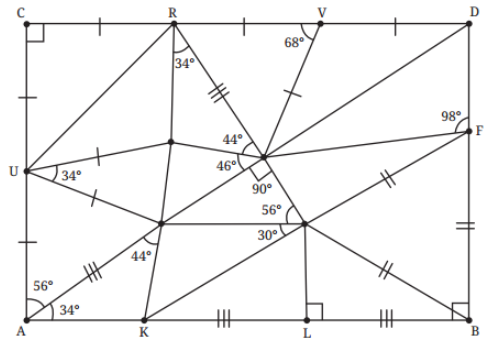
Find the missing angles. As per the convention that we have been following, all line segments marked with a single ‘|’ are equal to each other, and those marked with a double ‘|’ are equal to each other, etc.
Image
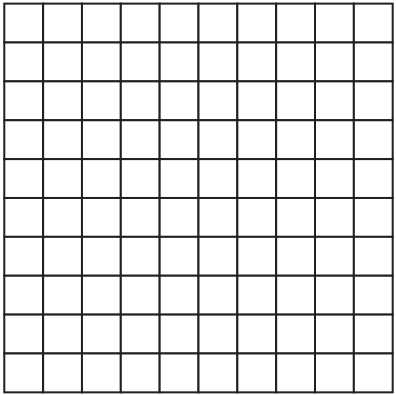
Imagine that, a $10 \times 10$ grid has value $300$ and that this value is divided evenly among the small squares. In other words, each small square is worth $3.$ Use a new grid for each part of this problem and label each grid “Value $: 300”.$
$a.$ Shade $25\%$ of the grid. What is $25\%$ of $300?$ Compare the two answers.
$b.$ What is the value of $25$ squares?
$c.$ Shade $17\%$ of the grid. What is $17\%$ of $300?$ Compare the two answers.
$d.$ What is the value of $\frac{1}{10}$ of the grid?
A sugar bag contains 30 kg of sugar. After consuming $\frac{2}{3}$ of it , how much sugar is left in the bag?
A piece of wire is of length $12 \frac{3}{4} m$. If it is cut into two pieces in such a way that the length of one piece is $5 \frac{1}{4} m$, what is the length of the other piece?
Earth Science: The table lists the world’s $10$ largest deserts.
Largest Deserts in the World  
Desert Area $(km^2)$
Sahara $($Africa$)$ $8,800,000$
Gobi $($Asia$)$ $1,300,000$
Australian Desert $($Australia$)$ $1,250,000$
Arabian Desert $($Asia$)$ $850,000$
Kalahari Desert $($Africa$)$ $580,000$
Chihuahuan Desert $($North America$)$ $370,000$
Takla Makan Desert $($Asia$)$ $320,000$
Kara Kum $($Asia$)$ $310,000$
Namib Desert $($Africa$)$ $310,000$
Thar Desert $($Asia$)$ $260,000$
$a.$ What are the mean, median and mode of the areas listed?
$b.$ How many times the size of the Gobi Desert is the Namib Desert?
$c.$ What percentage of the deserts listed are in Asia?
$d.$ What percentage of the total area of the deserts listed is in Asia?