Question
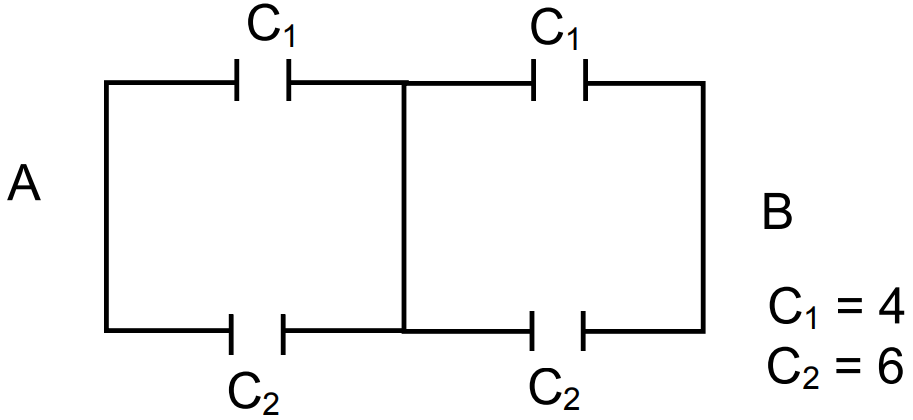
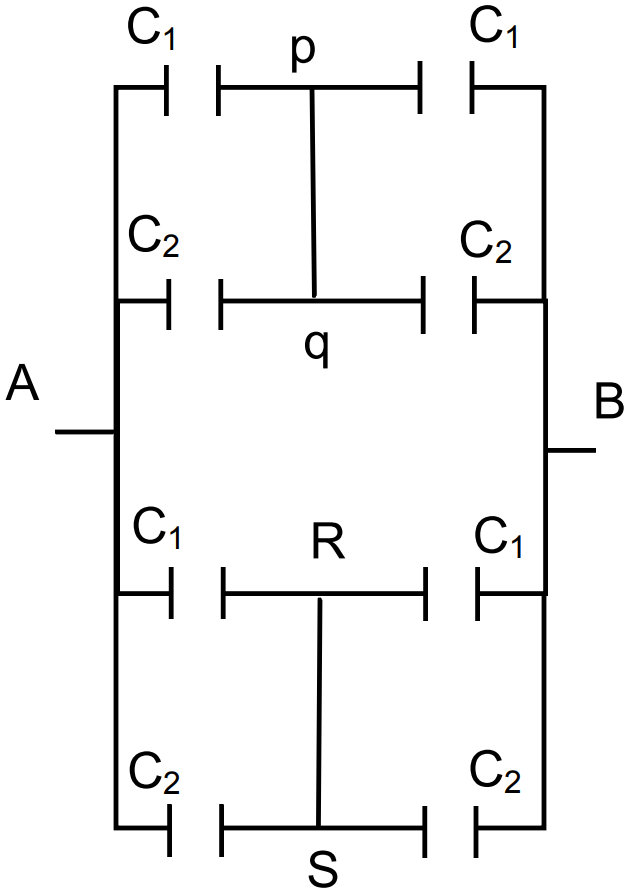
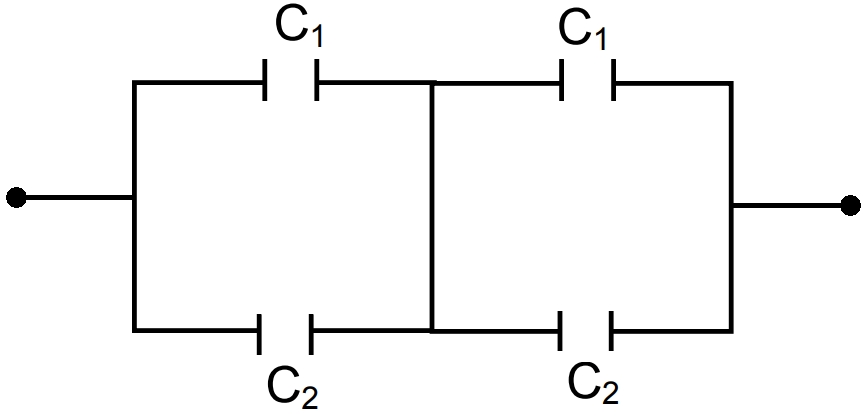
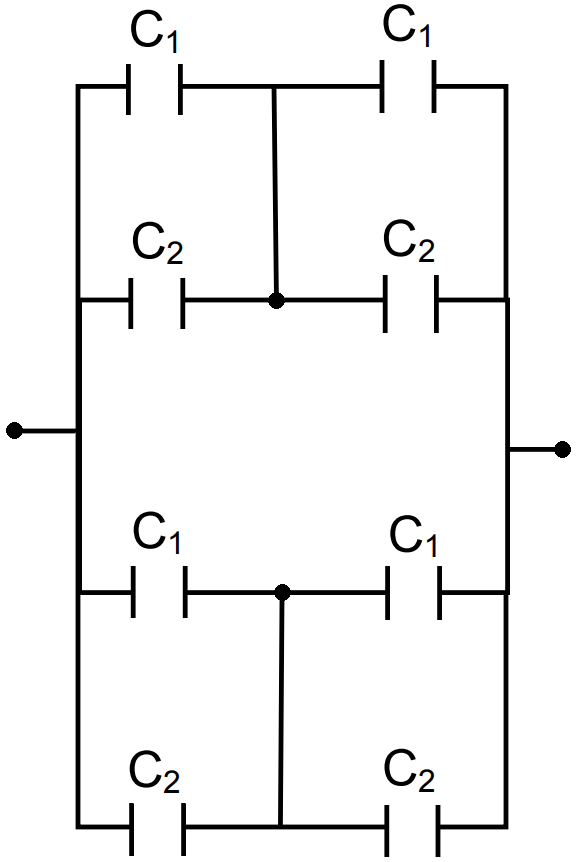
Take $\text{C}_1=4.0\mu\text{F}$ and $\text{C}_2=6.0\mu\text{F}$ in figure. Calculate the equivalent capacitance of the combination between the points indicated.
Answer

  1. $\therefore C_1, C_1$ are series & $C_2, C_2 $ are series as the V is same at p & q. So no current pass through p & q.

$\frac{1}{\text{C}}=\frac{1}{\text{C}_1}=\frac{1}{\text{C}_2}$
$\Rightarrow\frac{1}{\text{C}}=\frac{1+1}{\text{C}_1\text{C}_2}$
$\text{C}_{\text{p}}=\frac{\text{C}_1}{2}=\frac{4}{2}=2\mu\text{F}$
And $\text{C}_{\text{q}}=\frac{\text{C}_2}{2}=\frac{6}{2}=3\mu\text{F}$
$\therefore\text{C}=\text{C}_{\text{p}}+\text{C}_{\text{q}}=2+3=5\mu\text{F}$
  1. $\text{C}_1=4\mu\text{F},\ \text{C}_2=6\mu\text{F}$

In case of p & q, q = 0
$\therefore\text{C}_{\text{p}}=\frac{\text{C}_1}{2}=\frac{4}{2}=2\mu\text{F}$
$\text{C}_{\text{q}}=\frac{\text{C}_2}{2}=\frac{6}{2}=3\mu\text{F}$
& $\text{C}'=2+3=5\mu\text{F}$
$\text{C}\ \&\ \text{C}' =5\mu\text{F}$
$\therefore$ The equation of capacitor $\text{C}=\text{C}'+\text{C}''=5+5=10\mu\text{F}$

Need a full question paper?

Generate a complete, print-ready paper with questions like this in minutes — across 16+ boards, with answer keys.
Start Generating Free

Similar questions

Positronium is just like a H-atom with the proton replaced by the positively charged anti-particle of the electron (called the positron which is as massive as the electron). What would be the ground state energy of positronium?
Two point charges $q$ and $-q$ are located at points $(0,0,-a)$ and $(0,0, a)$ respectively.
$i$. Find the electrostatic potential at $(0,0, z)$ and $(x, y, 0)$.
$ii.$ How much work is done in moving a small test charge from the point $(5,0,0)$ to $(-7,0,0)$ along the $X$-axis?
$iii.$ How would your answer change if the path of the test charge between the same points is not along the $x$-axis but along any other random path?
$iv$. If the above point charges are now placed in the same positions in a uniform external electric field $\vec{E}$, what would be the potential energy of the charge system in its orientation of unstable equilibrium? Justify your answer in each case.
When a p-n junction is reverse-biased, the current becomes almost constant at $25\mu\text{A}.$ When it is forwardbiased at 200mV, a current of $75\mu\text{A}$ is obtained. Find the magnitude of diffusion current when the diode is,
  1. Unbiased.
  2. Reverse-biased at 200mV.
  3. Forward-biased at 200mV.
Quite often, connecting wires carrying currents in opposite directions are twisted together in using electrical appliances. Explain how it avoids unwanted magnetic fields.
An LR circuit with emf $\in$ is connected at t = 0.
  1. Find the charge Q which flows through the battery during 0 to t.
  2. Calculate the work done by the battery during this period.
  3. Find the heat developed during this period.
  4. Find the magnetic field energy stored in the circuit at time t.
  5. Verify that the results in the three parts above are consistent with energy conservation.
A jar of height h is filled with a transparent liquid of refractive index μ (Fig). At the centre of the jar on the bottom surface is a dot. Find the minimum diameter of a disc, such that when placed on the top surface symmetrically about the centre, the dot is invisible.
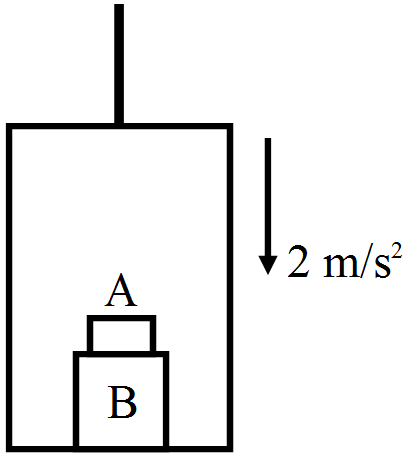
The elevator shown in figure is descending with an acceleration of $2m/s^2$. The mass of the block A is 0.5kg. What force is exerted by the block A on the block B?
Consider a neutron and an electron bound to each other due to gravitational force. Assuming Bohr's quantization rule for angular momentum to be valid in this case, derive an expression for the energy of the neutron-electron system.
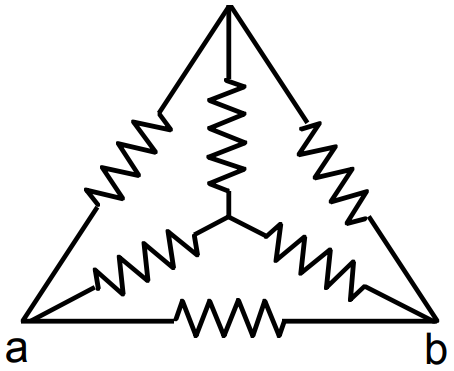
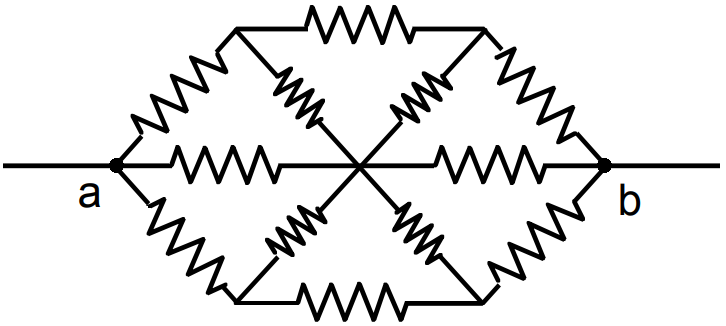
Find the equivalent resistance of the circuits shown in the figure. between the points a and b. Each resistor has resistance r.

Find the current in the wire for the configuration shown in Fig. Wire PQ has negligible resistance. B, the magnetic field is coming out of the paper. θ is a fixed angle made by PQ travelling smoothly over two conducting parallel wires seperated by a distance d.