MCQ
$\tan \left[ {\frac{1}{2}{{\sin }^{ - 1}}\left( {\frac{{2a}}{{1 + {a^2}}}} \right) + \frac{1}{2}{{\cos }^{ - 1}}\left( {\frac{{1 - {a^2}}}{{1 + {a^2}}}} \right)} \right] = $
  • A
    $\frac{{2a}}{{1 + {a^2}}}$
  • B
    $\frac{{1 - {a^2}}}{{1 + {a^2}}}$
  • $\frac{{2a}}{{1 - {a^2}}}$
  • D
    None of these

Answer

Correct option: C.
$\frac{{2a}}{{1 - {a^2}}}$
c
(c) $\tan \left[ {\frac{1}{2}{{\sin }^{ - 1}}\left( {\frac{{2a}}{{1 + {a^2}}}} \right) + \frac{1}{2}{{\cos }^{ - 1}}\left( {\frac{{1 - {a^2}}}{{1 + {a^2}}}} \right)} \right]$

$ = \tan \left[ {\frac{1}{2}{{\sin }^{ - 1}}\left( {\frac{{2\tan \theta }}{{1 + {{\tan }^2}\theta }}} \right) + \frac{1}{2}{{\cos }^{ - 1}}\left( {\frac{{1 - {{\tan }^2}\theta }}{{1 + {{\tan }^2}\theta }}} \right)} \right]$

(Let $a = \tan \theta $)

$ = \tan \left[ {\frac{1}{2}{{\sin }^{ - 1}}(\sin 2\theta ) + \frac{1}{2}{{\cos }^{ - 1}}(\cos 2\theta )} \right]$

$ = \tan (2\theta ) = \tan 2\theta = \frac{{2\tan \theta }}{{1 - {{\tan }^2}\theta }} = \frac{{2a}}{{1 - {a^2}}}$

Trick : Put $a = 0$, then tan $(0+0)=0;$ which is given by $(a)$ and $(c)$.

Again put $a = 1$, then $\tan \left( {\frac{\pi }{4} + \frac{\pi }{4}} \right) = \infty $, which is given by $(c).$
Need a full question paper?

Generate a complete, print-ready paper with questions like this in minutes — across 16+ boards, with answer keys.

Start Generating Free

Similar questions

If the vectors $3i+\lambda \,j+k$  and $2i-j+8k$  are perpendicular, then $\lambda $ is
The set points where the function f(x) given by $\text{f(x)=}|\text{x}-3|\cos\text{x}$ is  diffrentiable, is:
  1. R
  2. R - {3}
  3. $(0,\infty)$
  4. None of these.
The objective function of a linear programming problem is:
  1. A constraint
  2. Function to be optimised
  3. A relation between the variables
  4. None of these
The sum of the order and degree of the differential equation $1+\left(\frac{d y}{d x}\right)^4=7\left(\frac{d^2 y}{d x^2}\right)^3$ is
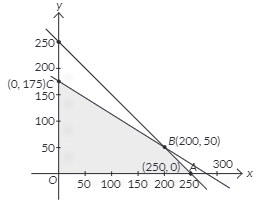
The corner points of the bounded feasible region of an LPP are $O(0,0), A(250,0), B(200,50)$ and $C(0,175)$. If the maximum value of the objective function $Z=2 a x+$ by occurs at the points $A(250,0)$ and $B(200,50)$, then the relation between $a$ and $b$ is:
Image
An urn contains 9 balls two of which are red, three blue and four black. Three balls are drawn at random. The probability that they are of the same colour is,
  1. $\frac{5}{84}$
  2. $\frac{3}{9}$
  3. $\frac{3}{7}$
  4. $\frac{7}{17}$
If $A=\left[\begin{array}{ccc}3 & -1 & 2 \\ 2 & 1 & 3 \\ 1 & -3 & K\end{array}\right]$ is non-invertible matrix, then value of K :
If $\cos^{-1}\text{x}>\sin^{-1}\text{x},$ then:
  1. $\frac{1}{\sqrt2}<\text{x}\leq1$
  2. $0\leq\text{x}\leq\frac{1}{\sqrt2}$
  3. $-1\leq\text{x}<\frac{1}{\sqrt2}$
  4. $\text{x}>0$
The graph of the function $y = f(x)$ is symmetrical about the line $x = 2$, then
If A and B are square matrices of order n x n such that, A− B= (A − B)(A + B), then of the following will always be true?
  1. A = B
  2. AB = BA
  3. either of A or B is a zero matrix
  4. either of A or B is an identify matrix