Question
Tautomerism is exhibited by

Answer

Get the step-by-step solution for this question inside the Vidyadip app.

Get the answer in the app

Need a full question paper?

Generate a complete, print-ready paper with questions like this in minutes — across 16+ boards, with answer keys.

Start Generating Free

Similar questions

Which of the following isomeric heptanes can yield seven different monochlorinated products upon free radical chlorination ? (structured only)
Consider the cell at $25^{\circ} \mathrm{C}$

$\mathrm{Zn}\left|\mathrm{Zn}^{2+}(\mathrm{aq}),(1 \mathrm{M}) \| \mathrm{Fe}^{3+}(\mathrm{aq}), \mathrm{Fe}^{2+}(\mathrm{aq})\right| \mathrm{Pt}(\mathrm{s})$

The fraction of total iron present as $\mathrm{Fe}^{3+}$ ion at the cell potential of $1.500\, \mathrm{~V}$ is $\mathrm{X} \times 10^{-2}$. The value of $x$ is $.....$ (Nearest integer).

$\left(\right.$ Given $\left.E_{\mathrm{Fe}^{3+} / \mathrm{Fe}^{2+}}^{0}=0.77\, \mathrm{~V}, \mathrm{E}_{\mathrm{Zn}^{2+} / \mathrm{Zn}}^{0}=-0.76 \,\mathrm{~V}\right)$
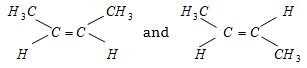
General formula of paraffin is
For the electrochemical cell, $M|{M^ + }||{X^ - }|X,$ ${E^o}({M^ + }/M)$ $= 0.44\, V$  and ${E^o}(X/{X^ - })$ $= 0.33\,V$. From this data one can deduce that
exhibit which isomerism
$Cu ( s )+ Sn ^{2+}(0.001 M ) \rightarrow Cu ^{2+}(0.01 M )+ Sn ( s )$

The Gibbs free energy change for the above reaction at $298\, K$ is $x \times 10^{-1} \,k\,J\, mol ^{-1}$;

The value of $x$ is ..... [nearest integer]$\left [\text { Given : } E _{ Cu ^{2} / / Cu }=0.34\, V ; E _{ Sn ^{2} / Sn }^{\ominus}=-0.14 \,V ; F=96500\, C\, mol ^{-1}\right]$

The measurement of the electron position is associated with an uncertainty in momentum, which is equal to $1 \times 10^{-18} \ g \ cm \ s^{-1}.$ The uncertainty in electron velocity is (mass of an electron is $9 \times 10^{-28}\  g$)
A first row transition metal in its $+2$ oxidation state has a spin$-$only magnetic moment value of $3.86 \ BM.$ The atomic number of the metal is
The $ - OH$ group of methyl alcohol cannot be replaced by chlorine by the action of
$[Co(NH3)_6]^{3+}$ and $[CoF_6]^{3–}$ are respectively known as: