MCQ
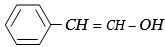
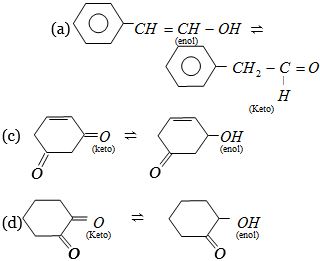
Tautomerism is exhibited by
- A
- B

- C

- ✓

Generate a complete, print-ready paper with questions like this in minutes — across 16+ boards, with answer keys.
$3 HC \equiv CH _{( g )} \rightleftharpoons C _{6} H _{6(\ell)}$
[Given: $\Delta_{f} G ^{\circ}( HC \equiv CH )=-2.04 \times 10^{5}\, J mol ^{-1}$
$\Delta_{f} G ^{\circ}\left( C _{6} H _{6}\right)=-1.24 \times 10^{5}\, J mol ^{-1} ; R =8.314\,\left. J K ^{-1} mol ^{-1}\right]$
$C(s) + O_2(g) \to CO_2(g) + x\ kJ$
$CO(g) + \frac {1}{2}O_2(g) \to CO_2(g) + y\,kJ$
The heat of formation of $CO(g)$ is
Assertion $(A) :$ Metallic character decreases and non-metallic character increases on moving from left to right in a period.
Reason $(R)$ $:$ It is due to increase in ionisation enthalpy and decrease in electron gain enthalpy, when one moves from left to right in a period.
In the light of the above statements, choose the most appropriate answer from the options given below :