MCQ
Temperature is a measure of ...........
  • Hotness or coldness
  • B
    Heat possessed by a body
  • C
    Potential energy
  • D
    Thermal energy

Answer

Correct option: A.
Hotness or coldness
a
(a)

Temperature is the measure of hotness and coldness.

Need a full question paper?

Generate a complete, print-ready paper with questions like this in minutes — across 16+ boards, with answer keys.
Start Generating Free

Similar questions

A $0.1 \mathrm{~kg}$ mass is suspended from a wire of negligible mass. The length of the wire is $1 \mathrm{~m}$ and its crosssectional area is $4.9 \times 10^{-7} \mathrm{~m}^2$. If the mass is pulled a little in the vertically downward direction and released, it performs simple harmonic motion of angular frequency $140 \ \mathrm{rad} \mathrm{s}^{-1}$. If the Young's modulus of the material of the wire is $\mathrm{n} \times 10^9 \mathrm{Nm}^{-2}$, the value of $\mathrm{n}$ is
If the collision frequency of hydrogen molecules in a closed chamber at $27^{\circ} \mathrm{C}$ is $\mathrm{Z}$, then the collision frequency of the same system at $127^{\circ} \mathrm{C}$ is :
The density of a cube is measured by measuring its mass and the length of its sides. If the maximum errors in the measurement of mass and length are $3\%$ and $2\%$ respectively, then the maximum error in the measurement of density is:
On a frictionless horizontal plane, a bob of mass $m=0.1 kg$ is attached to a spring with natural length $l_0=0.1 m$. The spring constant is $k_1=0.009 Nm ^{-1}$ when the length of the spring $I > l_0$ and is $k_2=0.016 Nm ^{-1}$ when $ I < l_0$. Initially the bob is released from $l=0.15 m$. Assume that Hooke's law remains valid throughout the motion. If the time period of the full oscillation is $T=(n \pi) s$, then the integer closest to $n$ is. . . . .
In order to shift a body of mass $m$ from a circular orbit of radius $3R$ to a higher radius $5R$ around the earth, the work done is
The function $(sin\,\omega t -cos\,\omega t)$ represents
Sound waves travel fastest in
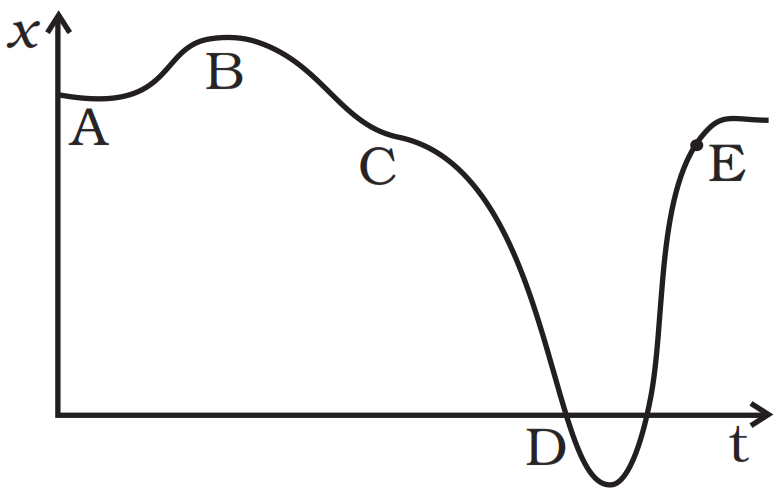
A graph of $x$ versus $t$ is shown in Fig. Choose correct alternatives from below:
A planet takes $200$ days to complete one revolution around the Sun. If the distance of the planet from Sun is reduced to one fourth of the original distance, how many days will it take to complete one revolution
The radii of two soap bubbles are $r_1$ and $r_2$. In isothermal conditions, two meet together in vaccum. Then the radius of the resultant bubble is given by