Question
  1. $\text{Cu}|\text{Cu}^{2+}(1\text{M})||\text{Ag}^+(1\text{M})|\text{Ag}$
$\text{E}^0_\frac{\text{Cu}^{2+}}{\text{Cu}}=0.34\text{V}$

$\text{E}^0_\frac{\text{Ag}^+}{\text{Ag}}=+0.80\text{V}$
  1. Write reaction at anode and cathode.
  2. Write net cell reaction.
  3. Calculate e.m.f. of the cell.
  1. What is meant by E.M.F of cell? How is it measured?
Answer

  1.  
  1. $\text{Cu}\text{(S)}\xrightarrow{ \ \ \ \ }\text{Cu}^{2+}\text{(aq)}+2\text{e}^-$ At anode
$2\text{Ag}^+\text{(aq)}+2\text{e}^-\xrightarrow{ \ \ \ \ \ \ }2\text{Ag}\text{(s)}$ At cathode
  1. $\text{Cu}\text{(s)}+2\text{Ag}^+\text{(aq)}\xrightarrow{ \ \ \ \ \ }\text{Cu}^{2+}\text{(aq)}+2\text{Ag(s)}$
$\text{E}^0_\text{cell}=\text{E}^0_\frac{\text{Ag}+}{\text{Ag}}-\text{E}^0_\frac{\text{Cu}^{2+}}{\text{Cu}}$

$=+0.80\text{V}-0.34\text{V}$

$=0.46\text{V}$
  1. It is equal to maximum potential difference when no current is drawn from the cell.

Need a full question paper?

Generate a complete, print-ready paper with questions like this in minutes — across 16+ boards, with answer keys.

Start Generating Free

Similar questions

Complete the following equations for the reaction between
i. $\mathrm{Ca}+\mathrm{H}_2 \mathrm{O}$
ii. $\mathrm{Ca}(\mathrm{OH})_2+\mathrm{Cl}_2$
iii. $\mathrm{BeO}+\mathrm{NaOH}$
iv. $\mathrm{BaO}_2+\mathrm{H}_2 \mathrm{SO}_4$
If B-Cl bond has a dipole moment, explain why $BCl_3$ molecule has zero dipole moment.
What is electron gain enthalpy? State the periodic trend of it in groups and periods.
Write short notes on the following: (i) Hydroboration of alkenes (ii) Polymerisation of alkenes
What is heat capacity? Write the derivation of relationship between c, and c
Write a relation between $\triangle G$ and Q and define the meaning of each term and answer the following:
a. Why a reaction proceeds forward when $Q < K$ and no net reaction occurs when $Q = K$.
b. Explain the effect of an increase in pressure in terms of reaction quotient Q for the reaction:
$
CO(g)+3 H_2(g) \rightleftharpoons CH_4(g)+H_2 O(g)
$
i. The equilibrium constant of a reaction is $2 \times 10^{-3}$ at $25^{\circ} \mathrm{C}$ and $2 \times 10^{-2}$ at $50^{\circ} \mathrm{C}$ Is the reaction endothermic or exothermic?
ii. The solubility of $\mathrm{CaF}_2$ in water at 298 K is $1.7 \times 10^{-3}$ gram per 100 ml of the solution.
Calculate solubility product of $\mathrm{CaF}_2$.
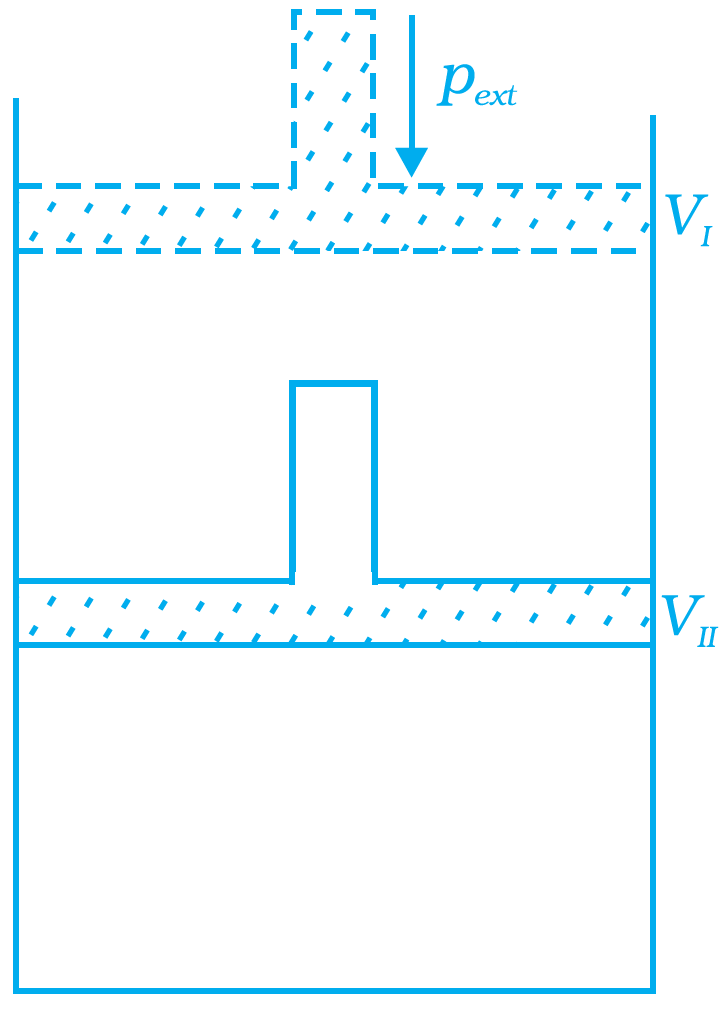
What will be the work done on an ideal gas enclosed in a cylinder, when it is compressed by a constant external pressure, $p_{ext}$​​​​​​​ in a single step as shown in Fig. Explain graphically.
What is Lattice Enthalpy? How is its value determined with the help of Born-Haber cycle?
The concentration of sulphide ion in $0.1$ M HCl solution saturated with hydrogen sulphide is $1.0 \times 10^{-19} \mathrm{M}$. If $10$ mL of this is added to $5$ mL of $0.04$ M solution of the following: $\mathrm{FeSO}_4, \mathrm{MnCl}_2, \mathrm{ZnCl}_2$ and $\mathrm{CdCl}_2$. in which of these solutions precipitation will take place?