MCQ
$\text{If}\ \sin\alpha+\sin\beta=\text{a}\text{ and }\cos\alpha-\cos\beta=\text{b},\ \text{than }\tan\frac{\alpha-\beta}{2}=$
  • A
    $-\frac{\text{a}}{\text{b}}$
  • $-\frac{\text{b}}{\text{a}}$
  • C
    $\sqrt{\text{a}^2+\text{b}^2}$
  • D
    None of these

Answer

Correct option: B.
$-\frac{\text{b}}{\text{a}}$
Given:
$\sin\alpha+\sin\beta=\text{a}...(\text{i})$
$\cos\alpha-\cos\beta=\text{b}...(\text{ii})$
Dividing (i) by (ii):
$\Rightarrow\ \frac{\sin\alpha+\sin\beta}{\cos\alpha-\cos\beta}=\frac{\text{a}}{\text{b}}$
$\Rightarrow\ \frac{2\sin\big(\frac{\alpha+\beta}{2}\big)\cos\big(\frac{\alpha-\beta}{2}\big)}{-2\sin\big(\frac{\alpha+\beta}{2}\big)\sin\big(\frac{\alpha-\beta}{2}\big)}=\frac{\text{a}}{\text{b}}$ $\Big[\because\ \sin\text{A}+\sin\text{B}=2\sin\Big(\frac{\text{A+B}}{2}\Big)\cos\Big(\frac{\text{A}-\text{B}}{2}\Big)\text{ and }\cos\text{A}+\cos\text{B}$
$\Rightarrow\ \frac{\sin\Big(\frac{\alpha+\beta}{2}\Big)\cos\Big(\frac{\alpha-\beta}{2}\Big)}{-\sin\Big(\frac{\alpha+\beta}{2}\Big)\cos\Big(\frac{\alpha-\beta}{2}\Big)}=\frac{\text{a}}{\text{b}}$
$\Rightarrow\ \cot\Big(\frac{\alpha-\beta}{2}\Big)=-\frac{\text{a}}{\text{b}}$
$\Rightarrow\ \frac{1}{\cot\Big(\frac{\alpha-\beta}{2}\Big)}=\frac{1}{-\frac{\text{a}}{\text{b}}}$
$\Rightarrow\ \tan\Big(\frac{\alpha-\beta}{2}\Big)=-\frac{\text{b}}{\text{a}}$

Need a full question paper?

Generate a complete, print-ready paper with questions like this in minutes — across 16+ boards, with answer keys.
Start Generating Free

Similar questions

There are $10$ pairs of shoes in a cupboard from which $4$ shoes are picked at random. The probability that there is at least one pair, is
If tangents are drawn from point $P(3\ sin\theta + 4\ cos\theta , 3\ cos\theta\ -\ 4\ sin\theta)$ , $\theta = \frac {\pi}{8}$ to the ellipse $\frac{{{x^2}}}{{16}} + \frac{{{y^2}}}{9} = 1$ then angle between the tangents is
If $x = y\cos \frac{{2\pi }}{3} = z\cos \frac{{4\pi }}{3}$, then $xy + yz + zx = $
If the roots of the equation $\frac{1}{{x + p}} + \frac{1}{{x + q}} = \frac{1}{r}$ are equal in magnitude but opposite in sign, then the product of the roots will be
Let $a, b \in R$ be such that the equation $a x^{2}-2 b x+15=0$ has a repeated root $\alpha$. If $\alpha$ and $\beta$ are the roots of the equation $x^{2}-2 b x+21=0$, then $\alpha^{2}+\beta^{2}$ is equal to
If the length of the latus rectum of a parabola, whose focus is $( a , a )$ and the tangent at its vertex is $x+y=a$, is $16 $, then $|a|$ is equal to.
Let $R$ be the interior region between the lines $3 x-y+1=0$ and $x+2 y-5=0$ containing the origin. The set of all values of a, for which the points $\left(a^2, a+1\right)$ lie in $R$, is :
A quadratic polynomial $ y = f (x)$  with absolute term  $3$  neither touches nor intersects the abscissa axis and is symmetric about the line $x = 1$ . The coefficient of the leading term of the polynomial is unity. A point $A(x_1, y_1)$  with abscissa $x_1 = 1$  and a point $B(x_2, y_2) $ with ordinate $y_2 = 11 $ are given in a cartisian rectangular system of co-ordinates $OXY $ in the first quadrant on the curve $y = f (x)$  where $ 'O'$  is the origin. The graph of $y = f(x)$ represents a parabola whose focus has the co-ordinates
The equation of a circle passing through points of intersection of the circles ${x^2} + {y^2} + 13x - 3y = 0$ and $2{x^2} + 2{y^2} + 4x - 7y - 25 = 0$ and point $(1, 1)$ is
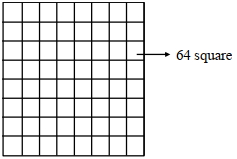
Two squares are chosen at random on a chessboard (see figure). The probability that they have a side in common is :