MCQ
Thalium shows different oxidation states because
- AIt is a transition element
- ✓Of inert pair effect
- COf its amphoteric character
- DOf its higher reactivity
Electronic configuration of Thallium is $[ Xe ] \,4 f ^{14} \,5 d ^{10}\, 6 s ^2 \,6 p ^1$.
$d$ and $f$ electrons of inner shells provide poor shielding, thus the attraction of the nucleus on the $s$ electrons of the outermost shell increases. This is called the inert pair effect.
Whereas, $s$ electrons provide strong shielding to $p$ electrons, thus making it easy for the $p$ electrons to be released.
Thus, although Thallium shows $+3$ and $+1$ oxidation states, $+1$ is more common.
Generate a complete, print-ready paper with questions like this in minutes — across 16+ boards, with answer keys.
${(C{H_3} - C{H_2})_2}CuLi\xrightarrow{{C{H_3} - Cl}}\Pr oduct$
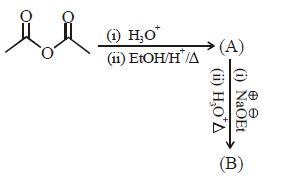
$(i)$ $6C(s) + 3{H_2}(g) \to {C_6}{H_6}(l);\,\Delta H = + 45.9\,kJ$
$(ii)$ ${H_2}(g) + \frac{1}{2}{O_2}(g) \to {H_2}O(l);\,\Delta H = - 285.9\,kJ$
$(iii)$ $C(s) + {O_2}(g) \to C{O_2}(g);\,\Delta H = - 393.5\,kJ$
........$kJ$
$CH_3 - CH = CH - CH_3 \xrightarrow{{{O_3}}} A $$\xrightarrow[{Zn}]{{{H_2}O}} B.$
The compound $B$ is