MCQ
That ion or molecule which forms a complex compound with transitional metal ion is called
  • A
    Recipient
  • Ligand
  • C
    Coordinate ion
  • D
    No special name

Answer

Correct option: B.
Ligand
b
It’s obvious.

Need a full question paper?

Generate a complete, print-ready paper with questions like this in minutes — across 16+ boards, with answer keys.

Start Generating Free

Similar questions

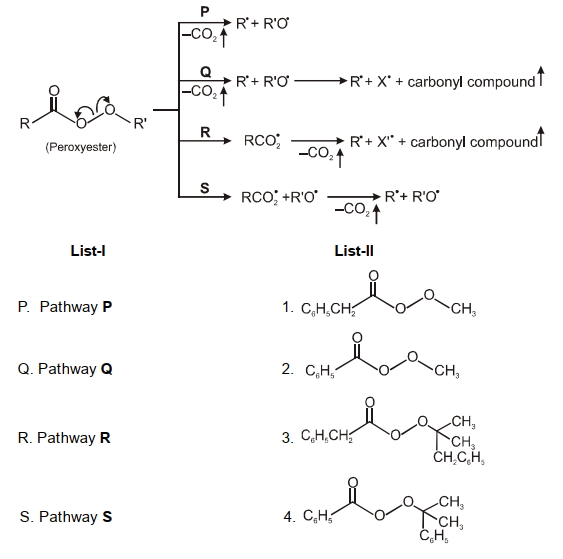
Different possible thermal decomposition pathways for peroxyesters are shwon below. Match each pathway from List-$I$ with an appropriate structure from List-$II$ and select the correct answer using the code given below the lists. $Image$

Codes: $ \quad P \quad Q \quad R \quad S $
Arrange the following in order of their leaving group tendency?

$(I)\,\,B{r^ - }{\mkern 1mu} {\mkern 1mu} {\mkern 1mu} {\mkern 1mu} $       $(II)\,\,\begin{array}{*{20}{c}}
  {{\mkern 1mu} {\mkern 1mu} {\mkern 1mu} {\mkern 1mu} {\mkern 1mu} O{\mkern 1mu} } \\ 
  {{\mkern 1mu} {\mkern 1mu} {\mkern 1mu} {\mkern 1mu} ||} \\ 
  {{H_3}C - C - {O^ - }} 
\end{array}$    $(III)\,\,C{H_3}C{H_2}{O^ - }$    $(IV)\,\,Ph - {O^ - }$

In which of the following reactions, an increase in the volume of the container will favour the formation of products?
The number of molecules in $8.96\;L$ of a gas at ${0\,^o}C$ and $1$ atmosphere pressure is approximately
$1.0\,gm$ of pure calcium carbonate was found to require $50\,ml$ of dilute $HCl$ for complete reaction. The strength of the $HCl$ solution is given by ........ $N$
Two solutions of $X$ and $Y$ electrolytes are taken in two beakers and diluted by adding  $500\, mL$ of water. $\Lambda_m$ of $X$ increases by $1.5$ times while that of $Y$ increases by $20$  times, what could be the electrolytes $X$ and $Y$ ?
Then during electrolysis of a solution of $AgNO_3$, $ 9650$  coulombs of charge pass through the electroplating bath, the mass of silver deposited in the cathode will be .............. $\mathrm{g}$
$O_2$ is formed in Hydrolysis of
Which pair of compounds does not represent same homologous series ?
The specific conductivity of $N/10$ $KCl$ solution at ${20\,^o}C$ is $0.0212\,oh{m^{ - 1}}\,c{m^{ - 1}}$ and the resistance of cell containing this solution at ${20\,^o}C$ is $55\,ohm$. The cell constant is ............. $\mathrm{cm}^{-1}$