MCQ
The above reaction is
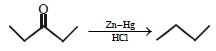
- AFinkelstein reaction
- BWilliamson's synthesis
- ✓Clemmen's reduction
- DSchotten Bauman reaction
Generate a complete, print-ready paper with questions like this in minutes — across 16+ boards, with answer keys.
$\mathrm{CH}_{3}-\mathrm{CH}=\mathrm{CH}_{2}$ $\xrightarrow[{{\text{H}}_{2}}{{\text{O}}_{2}},\bar{O}\text{H}]{\text{B}{{\text{H}}_{3}},\text{THF}}(P)$ $\xrightarrow[\text{C}{{\text{H}}_{2}}\text{C}{{\text{l}}_{2}}]{\text{ Pyridinium Chloro Chromate }(\text{PCC})}$ $(Q)$
$\mathrm{CH}_{3}-\mathrm{CH}=\mathrm{CH}_{2}$ $\xrightarrow[NaB{{H}_{4}}\,,\,H{{O}^{\Theta }}]{Hg\,{{(OAc)}_{2}}\,,\,{{H}_{2}}O}(R)$ $\xrightarrow[\text{C}{{\text{H}}_{2}}\text{C}{{\text{l}}_{2}}]{\text{ Pyridinium Chloro Chromate }(\text{PCC})}$ $(S)$
|
List $- I$ (Products formed) |
List $- II$ (Reaction of carbonyl compound with) |
| $(a)$ Cyanohydrin | $(i)$ $NH _{2} OH$ |
| $(b)$ Acetal | $(ii)$ $RNH _{2}$ |
| $(c)$ Schiff's base | $(iii)$ alcohol |
| $(d)$ Oxime | $(iv)$ $HCN$ |
Choose the correct answer from the options given below: