MCQ
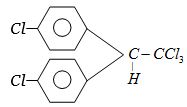
. The above structural formula refers to
- A$BHC$
- B$DNA$
- ✓$DDT$
- D$RNA$
Generate a complete, print-ready paper with questions like this in minutes — across 16+ boards, with answer keys.
$\begin{gathered}
{\left[ {Al{{\left( {{H_2}O} \right)}_6}} \right]^{ + 3}} + HCO_3^ - \rightleftarrows {\left[ {Al{{\left( {{H_2}O} \right)}_5}OH} \right]^{ + 2}} + {H_2}C{O_3} \hfill \\
\,\,\,\,\,\,\,\,\,\,\,\,(A)\,\,\,\,\,\,\,\,\,\,\,\,\,\,\,\,\,\,\,\,(B)\,\,\,\,\,\,\,\,\,\,\,\,\,\,\,\,\,\,\,\,\,\,\,\,\,\,\,\,\,\,\,\,\,\,\,\,\,(C)\,\,\,\,\,\,\,\,\,\,\,\,\,\,\,\,\,\,\,\,\,\,\,(D) \hfill \\
\end{gathered} $
species behaving as bronsted -lowry acid are
Assertion $A :$ Flourine forms one oxoacid.
Reason $R$ : Flourine has smallest size amongst all halogens and is highly electronegative
In the light of the above statements, choose the most appropriate answer from the options given below.