MCQ
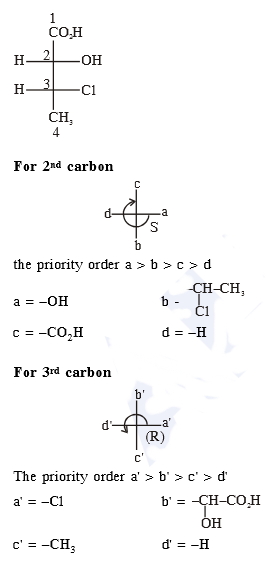
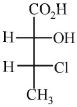
The absolute configuration of given is :
  • A
    $(2S,3S)$
  • B
    $(2R,3R)$
  • C
    $(2R,3S)$
  • $(2S,3R)$

Answer

Correct option: D.
$(2S,3R)$
d

Need a full question paper?

Generate a complete, print-ready paper with questions like this in minutes — across 16+ boards, with answer keys.

Start Generating Free

Similar questions

In a regular octahedral molecule $MX_6,$ the number of $X -M -X$ bonds of $180^o $ are :-
In the given reaction :

$\begin{array}{*{20}{c}}
  {\,\,\,\,\,OH\,\,\,\,\,\,\,OH} \\ 
  {|\,\,\,\,\,\,\,\,\,\,\,\,\,\,\,|} \\ 
  {C{H_3} - CH - C - C{H_3}} \\ 
  {\,\,\,\,\,\,\,\,\,\,\,\,\,\,\,\,\,|} \\ 
  {\,\,\,\,\,\,\,\,\,\,\,\,\,\,\,\,\,\,\,\,\,\,\,\,\,C{H_3}} 
\end{array}\xrightarrow{{HI{O_4}}}(a) + (b)$

$(a)$ and $(b)$ respectively be :
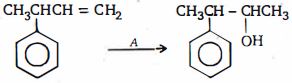
Reagent $A$ may be
The correct statement with respect to dinitrogen is
$IUPAC$ name of the given compound is ?
$(CH_3)_3CCH=CHC_6H_4Br-p$
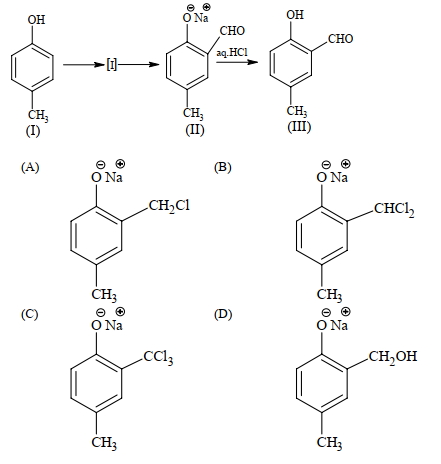
Reimer-Tiemann reaction introduces an aldehyde group, on to the aromatic ring of phenol, ortho to the hydroxyl group. This reaction involves electrophilic aromatic substitution. This is a general method for the synthesis of substituted salicyladehydes as depicted below.

$Image$

$1.$ Which one of the following reagents is used in the above reaction?

$(A)$ aq. $\mathrm{NaOH}+\mathrm{CH}_3 \mathrm{Cl}$

$(B)$ aq. $\mathrm{NaOH}+\mathrm{CH}_2 \mathrm{Cl}_2$

$(C)$ aq. $\mathrm{NaOH}+\mathrm{CHCl}_3$

$(D)$ aq. $\mathrm{NaOH}+\mathrm{CCl}_4$

$2.$ The electrophile in this reaction is

$(A)$ : $\mathrm{CHCl}$ $(B)$ ${ }^{+} \mathrm{CHCl}_2$

$(C)$ $\mathrm{CCl}_2$ $(D)$. $\mathrm{CCl}_3$

$3.$ The structure of the intermediate $I$ is

$Image$

Give the answer question $1, 2$ and $3.$
The enthalpy of formation of ammonia is $-46.0\, kJ\, mol^{-1}$. The enthalpy change for the reaction $2NH_3 (g) \longrightarrow 2N_2(g) + 3H_2 (g$) is.....$kJ\, mol^{-1}$
Nitrogen gas is liberated by thermal decomposition of
Energy of the electron in Hydrogen atom is given by
The enthalpy of vapour is $10\ kcal/mole$ higher than liquid at $350\  K$ and $2\ atm$ . Under given conditions, the difference in internal energy of vapour and liquid will be ......$cal.$