MCQ
The absolute zero is the temperature at which
  • A
    Water freezes
  • B
    All substances exist in solid state
  • Molecular motion ceases
  • D
    None of the above

Answer

Correct option: C.
Molecular motion ceases
c
(c)At absolute zero $($i.e. $0 \,K)$ $v_{rms}$ becomes zero.

Need a full question paper?

Generate a complete, print-ready paper with questions like this in minutes — across 16+ boards, with answer keys.

Start Generating Free

Similar questions

The intensity of radiation emitted by the sun has its maximum value at a wavelength of $510\;nm$ and that emitted by the north star has the maximum value at $350\;nm$. If these stars behave like black bodies, then the ratio of the surface temperature of the sun and north star is
The function of time representing a simple harmonic motion with a period of $\frac{\pi}{\omega}$ is :
A research satellite of mass $200 \,kg$ circles the earth in an orbit of average radius $3\,R/2$ where $ R$ is the radius of the earth. Assuming the gravitational pull on a mass of $1 \,kg$ on the earth’s surface to be $10 \,N$, the pull on the satellite will be ........ $N$. 
$Assertion$ : Two balls of different masses are thrown vertically upward with same speed. They will pass through their point of projection in the downward direction with the same speed.

$Reason$ : The maximum height and downward velocity attained at the point of projection are independent of the mass of the ball

If there are no heat losses, the heat released by the condensation of x gram of steam at 100°C into water at 100°C can be used to convert y gram of ice at 0°C into water at 100°C. Then the ratio y : x is nearly:
Two projectiles A and B thrown with speeds in the ratio $1:\sqrt{2}$ acquired the same height. If A is thrown at an angle of 45° with the horizontal, then angle of projection of B will be:
The temperature of $100 \,gm$ of water is to be raised from $24^{\circ} C$ to $90^{\circ} C$ by adding steam to it. The mass of the steam required for this purpose is ........... $g$
Some liquid is filled in a cylindrical vessel of radius $R$. Let $ F_1 $ be the force applied by the liquid on the bottom of the cylinder. Now the same liquid is poured into a vessel of uniform square crss-section of side $R$. Let $F_2$ be the force applied by the liquid on the bottom of this new vessel. Then:
A body is revolving with a uniform speed $v$ in a circle of radius $r$. The tangential acceleration is
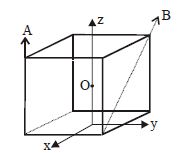
With reference to figure of a cube of edge $a$ and mass $m$, state whether the following
($O$ is the centre of the cube.) option is correct

$(a)$ The moment of inertia of cube about $z-$ axis is $I_z$ = $I_x + I_y$

$(b)$ The moment of inertia of cube about $A-$ axis is $I_A$=${I_z} + \frac{{m{a^2}}}{2}$

$(c)$ The moment of inertia of cube about $B-$ axis is $I_B$=${I_z} + \frac{{m{a^2}}}{2}$

$(d)$  $I_x$ = $I_z$