Question
The acceleration associated with a mass 'm' moving in a circular path is to be found. It is given that the velocity at any instant is v = krt, where k is a constant. Classify the motion and find acceleration.

Answer

Given, v = krt Since velocity changes with time, the motion in circular path involves tangential acceleration. So it is a non-uniform circular motion. $\text{a}_\text{r}=\frac{\text{v}^2}{\text{r}}=\text{k}^2\text{rt}^2$ or $\text{a}_\text{k}=\frac{\text{dv}}{\text{dt}}=\text{kr}$ Net acceleration $=\text{a}_\text{n}=\sqrt{\text{a}^2_\text{r}+\text{a}^2_\text{t}}$ $=\sqrt{(\text{k}^2\text{rt}^2)^2+(\text{kr}^2)}=\text{kr}\sqrt{1+\text{k}^2\text{t}^4}.$

Need a full question paper?

Generate a complete, print-ready paper with questions like this in minutes — across 16+ boards, with answer keys.
Start Generating Free

Similar questions

When you lift a box from the floor and put it on an almirah the potential energy of the box increases, but there is no change in its kinetic energy. Is it a violation of conservation of energy?
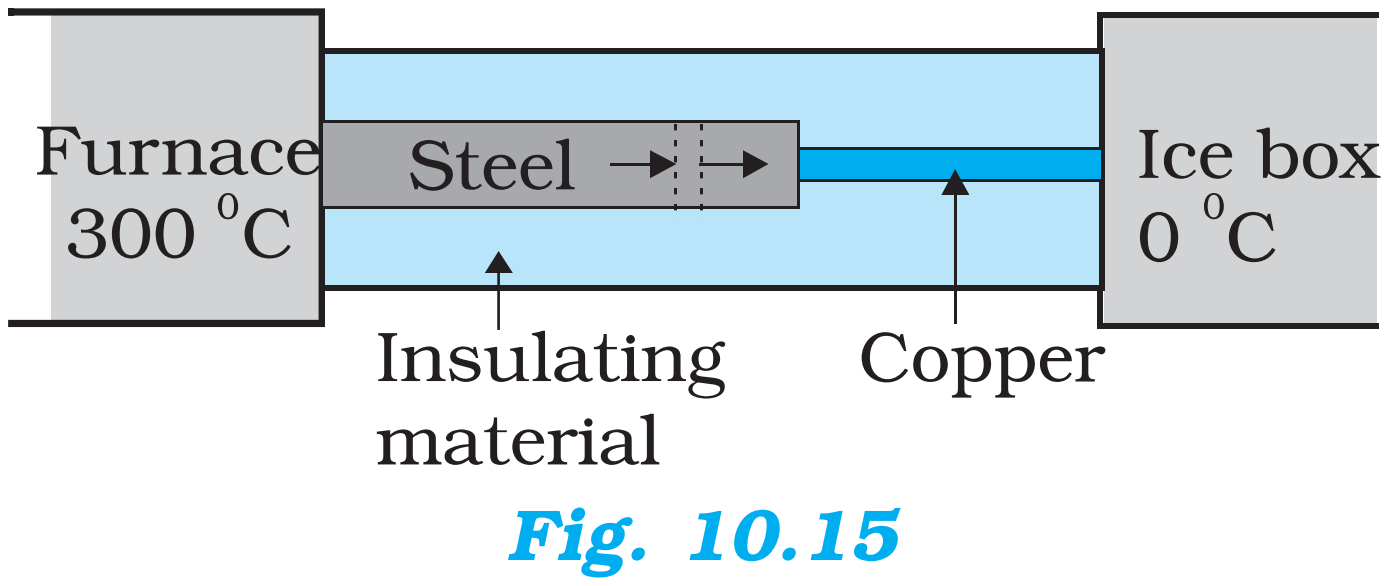
What is the temperature of the steel-copper junction in the steady state of the system shown in Fig. 10.15. Length of the steel rod $=15.0 cm$, length of the copper rod $=10.0 cm$, temperature of the furnace $=300^{\circ} C$, temperature of the other end $=0{ }^{\circ} C$. The area of cross section of the steel rod is twice that of the copper rod. (Thermal conductivity of steel $=50.2 J s ^{-1} m ^{-1} K ^{-1}$; and of copper $\left.=385 J s ^{-1} m ^{-1} K ^{-1}\right)$.
Image
What is the change in momentum between the initial and final points of the projectile path, if the range is maximum?
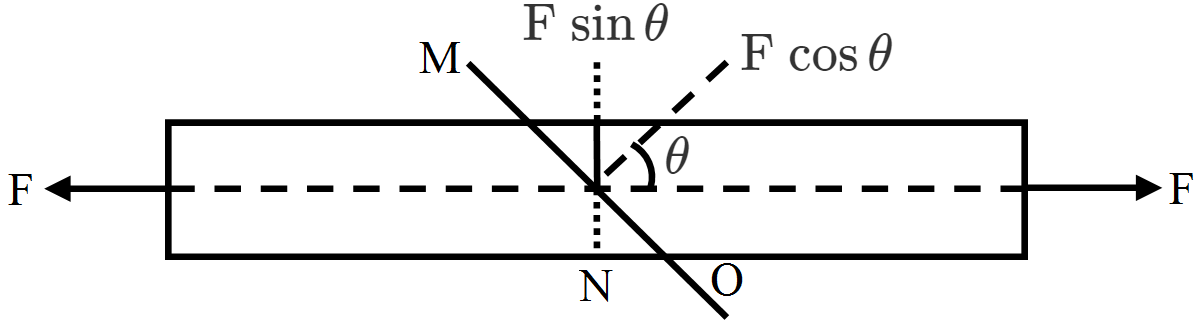
A bar of cross$-$section $A$ is subjected to equal and opposite tensile forces at its ends. Consider a plane section of the bar whose normal makes an angle $q$ with the axis of the bar.
  1. What is the tensile stress on this plane?
  2. What is the shearing stress on this plane?
  3. For what value of $q$ is the tensile stress maximum?
  4. For what value of $q$ is the shearing stress maximum?
A cylinder rotating at an angular speed of $50rev/s$ is brought in contact with an identical stationary cylinder. Because of the kinetic friction, torques act on the two cylinders, accelerating the stationary one and decelerating the moving one. If the common magnitude of the acceleration and deceleration be one revolution per second square, how long will it take before the two cylinders have equal angular speed?
Define kinetic energy density of a wave. Derive an expression for its maximum value. Using it, prove that the intensity of the wave is, $\text{I}=\frac{1}{2}\rho \omega^2\text{A}^2\nu.$
Ans.
An electron travelling with a speed of $5 \times 10^3ms^{-1}$ passes through an electric field with an acceleration of $10^{12}ms^{-2}​​​​​​​$. How long will it take for the electron to double its speed?
A particle of mass $10g$ is placed in a potential field given by $U = 50x^2 + 100 erg/gm$. Calculate the frequency of oscillation.
If earth contracts to half its radius. What would be the length of the day?
Suppose the average mass of raindrops is $3.0 \times 10^{-5}$ kg and their average terminal velocity $9m s^{-1}$. Calculate the energy transferred by rain to each square metre of the surface at a place which receives 100 cm of rain in a year.