The acceleration due to gravity at a place is ${\pi ^2}\,m/se{c^2}$. Then the time period of a simple pendulum of length one metre is
Easy


Download our appand get started for free
Experience the future of education. Simply download our apps or reach out to us for more information. Let's shape the future of learning together!No signup needed.*
Similar Questions
- 1A bob of mass $'m'$ suspended by a thread of length $l$ undergoes simple harmonic oscillations with time period ${T}$. If the bob is immersed in a liquid that has density $\frac{1}{4}$ times that of the bob and the length of the thread is increased by $1 / 3^{\text {rd }}$ of the original length, then the time period of the simple harmonic oscillations will be :-View Solution
- 2In the reported figure, two bodies $A$ and $B$ of masses $200\, {g}$ and $800\, {g}$ are attached with the system of springs. Springs are kept in a stretched position with some extension when the system is released. The horizontal surface is assumed to be frictionless. The angular frequency will be $.....\,{rad} / {s}$ when ${k}=20 \,{N} / {m} .$View Solution

- 3A simple pendulum with length $100\,cm$ and bob of mass $250\,g$ is executing S.H.M. of amplitude $10\,cm$. The maximum tension in the string is found to be $\frac{x}{40}\,N$. The value of $x$ is $..........$.View Solution
- 4A spring mass system executes damped harmonic oscillations given by the equationView Solution
$y = A{e^{ - \frac{{bt}}{{2m}}}}\sin (\omega 't + \phi )$
where the symbols have their usual meanings. If a $2\ kg$ mass $(m)$ is attached to a spring of force constant $(K)$ $1250\ N/m$ , the period of the oscillation is $\left( {\pi /12} \right)s$ . The damping constant $‘b’$ has the value. ..... $kg/s$
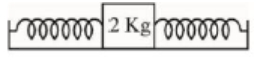
- 5A block of mass $2\,kg$ is attached with two identical springs of spring constant $20\,N / m$ each. The block is placed on a frictionless surface and the ends of the springs are attached to rigid supports (see figure). When the mass is displaced from its equilibrium position, it executes a simple harmonic motion. The time period of oscillation is $\frac{\pi}{\sqrt{x}}$ in SI unit. The value of $x$ is $..........$View Solution
- 6A particle executes simple hormonic motion between $x =\, -A$ and $x = +A$ . It starts from $x = 0$ moves in $+x-$ direction. The time taken for it to move from $x = 0$ to $x = \frac {A}{2}$ is $T_1$ and to move from $\frac {A}{2}$ to $\frac {A}{\sqrt 2}$ is $T_2$ , thenView Solution
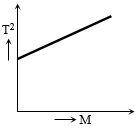
- 7The graph shown was obtained from experimental measurements of the period of oscillations $T$ for different masses $M$ placed in the scale pan on the lower end of the spring balance. The most likely reason for the line not passing through the origin is that theView Solution
- 8The maximum velocity of a particle, executing simple harmonic motion with an amplitude $7\ mm$, is $4.4\ m/s$. The period of oscillation is .... $sec$View Solution
- 9If the length of the simple pendulum is increased by $44\%$, then what is the change in time period of pendulum ..... $\%$View Solution
- 10A particle executing $SHM$ of amplitude $4\,cm$ and $T = 4s.$ The time taken by it to move from $+2\,cm$ to $+2\sqrt 3\,cm$ isView Solution