MCQ
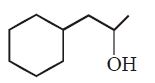
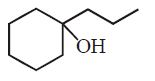
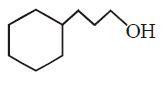
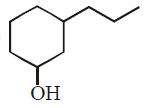
The alcohol which show turbidity immediate when reacted with $(HCl + ZnCl_2)$
  • A


  • C

  • D

Answer

Correct option: B.

b
$3^o$-alcohol give terbidity immediate.

Need a full question paper?

Generate a complete, print-ready paper with questions like this in minutes — across 16+ boards, with answer keys.

Start Generating Free

Similar questions

Major product of the given reaction is 

$H_2C = CH - CH_2 - I \xrightarrow[CC{{l}_{4}}]{HI(excess)}$

$\mathrm{PCl}_{5} \rightleftharpoons \mathrm{PCl}_{3}+\mathrm{Cl}_{3} \quad \mathrm{~K}_{\mathrm{c}}=1.844$

$3.0$ $moles$ of $\mathrm{PCl}_{5}$ is introduced in a $1\, \mathrm{~L}$ closed reaction vessel at $380\, \mathrm{~K}$. The number of moles of $\mathrm{PCl}_{5}$ at equilibrium is $.....\,\times 10^{-3}$. (Round off to the Nearest Integer)
The $IUPAC$ name of $n-$butyl chloride is
The solubility product of $AgI$ at $25\,^oC$ is $1.0 \times {10^{ - 16}}\,mo{l^2}\,{L^{ - 2}}$. The solubility if $AgI$ in ${10^{ - 4}}\,N$ solution of $KI$ at $25\,^oC$ is approximately (in $mol$ ${l^{ - 1}})$
For the process dry ice $\xrightarrow{{}}\,C{O_2}(g)$
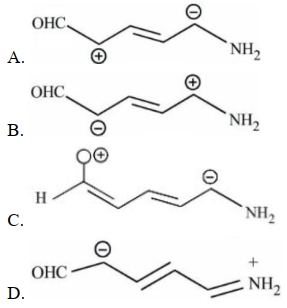
Increasing order of stability of the resonance structure is:
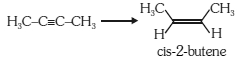
The most suitable reagent for the following conversion is
What is the correct sequence of reagents used for converting nitrobenzene into $m$ -dibromobenzene?
Given below are two statements: one is labelled as Assertion $(A)$ and the other is labelled as Reason $(R).$

Assertion $(A) :$ Treatment of bromine water with propene yields $1-$bromopropan$-2-$ol.

Reason $(R):$ Attack of water on bromonium ion follows Markovnikov rule and results in $1-$bromopropan$-2-$ol.

In the light of the above statements, choose the most appropriate answer from the options given below:

Two electrons of one atom $A$ and two electrons of another atom $B$ are utilized to form a compound $AB.$ This is an example of