The amplitude of a damped oscillator becomes one third in $2\, sec$. If its amplitude after $6\, sec$ is $1/n$ times the original amplitude then the value of $n$ is
Medium
Download our app for free and get started
since $A_{t}=A_{0} e^{\frac{-b t}{2 m}}$
When $t=2$ sec, $\quad \frac{A}{3}=A e^{\frac{-2 b}{2 m}}$
$\frac{1}{3}=e^{-b / m}$
When $t=6$ sec
$\frac{A_{0}}{n}=A_{0} e^{\frac{-6 b}{2 m}}$
$\frac{1}{n}=\left(e^{\frac{-b}{m}}\right)^{3}$
$\frac{1}{n}=\left(\frac{1}{3}\right)^{3}$
$n=3^{3}$

Download our appand get started for free
Experience the future of education. Simply download our apps or reach out to us for more information. Let's shape the future of learning together!No signup needed.*
Similar Questions
- 1A heavy small-sized sphere is suspended by a string of length $l$. The sphere rotates uniformly in a horizontal circle with the string making an angle $\theta $ with the vertical. Then the time period of this conical pendulum isView Solution
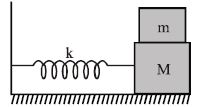
- 2In the arrangement, spring constant $k$ has value $2\,N\,m^{-1}$ , mass $M = 3\,kg$ and mass $m = 1\,kg$ . Mass $M$ is in contact with a smooth surface. The coefficient of friction between two blocks is $0.1$ . The time period of $SHM$ executed by the system isView Solution
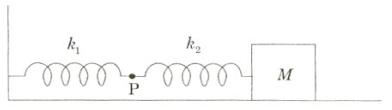
- 3The mass $M$ shown in the figure oscillates in simple harmonic motion with amplitude $A$. The amplitude of the point $P$ isView Solution
- 4A cylindrical block of density $\rho$ is partially immersed in a liquid of density $3\rho .$ The plane surface of the block remains parallel to the surface of the liquid. The height of the block is $60\, cm.$ The block performs $SHM$ when displaced from its mean position. [Use $ g = 9.8\, m/s^2$]View Solution
- 5Two simple harmonic motions $y_1 = A \sin \omega t$ and $y_2 =A \cos \omega t$ are superimposed on a particle of mass $m.$ The total mechanical energy of the particle is :View Solution
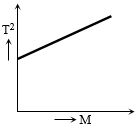
- 6The graph shown was obtained from experimental measurements of the period of oscillations $T$ for different masses $M$ placed in the scale pan on the lower end of the spring balance. The most likely reason for the line not passing through the origin is that theView Solution
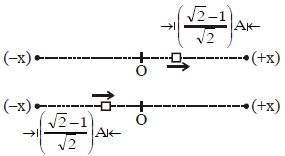
- 7Two bodies performing $SHM$ have same amplitude and frequency. Their phases at a certain instant are as shown in the figure. The phase difference between them isView Solution
- 8Two pendulums differ in lengths by $22\,cm$ . They oscillate at the same place such that one of them makes $15\,oscillations$ and the other makes $18\,oscillations$ during the same time. The lengths (in $cm$ ) of the pendulums areView Solution
- 9A particle of mass $10\, gm$ moves in a field where potential energy per unit mas is given by expression $v = 8 \times 10^4\, x^2\, erg/gm$. If the total energy of the particle is $8 \times 10^7\, erg$ then the relation between $x$ and time $t$ isView Solution
- 10If a simple harmonic oscillator has got a displacement of $0.02\, m$ and acceleration equal to $2.0\,m{s^{ - 2}}$ at any time, the angular frequency of the oscillator is equal to .... $rad\,{s^{ - 1}}$View Solution