The amplitude of a simple pendulum, oscillating in air with a small spherical bob, decreases from $10\, cm$ to $8\, cm$ in $40\, seconds$ . Assuming that Stokes law is valid, and ratio of the coefficient of viscosity of air to that of carbon dioxide is $1.3$ . The time in which amplitude of this pendulum will reduce from $10\, cm$ to $5\, cm$ in carbon dioxide will be close to ..... $s$ $(ln\, 5 = 1.601,ln\, 2 = 0 .693)$
JEE MAIN 2014, Medium


Download our appand get started for free
Experience the future of education. Simply download our apps or reach out to us for more information. Let's shape the future of learning together!No signup needed.*
Similar Questions
- 1Starting from the mean position a body oscillates simple harmonically with a period of $2\,s.$ After what time will its kinetic energy be $75\%$ of the total energy ?View Solution
- 2A heavy small-sized sphere is suspended by a string of length $l$. The sphere rotates uniformly in a horizontal circle with the string making an angle $\theta $ with the vertical. Then the time period of this conical pendulum isView Solution
- 3View SolutionWhich of the following is a necessary and sufficient condition for S.H.M.
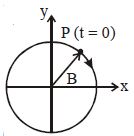
- 4Figure shows the circular motion of a particle. The radius of the circle, the period, sense of revolution and the initial position are indicated on the figure. The simple harmonic motion of the $x-$ projection of the radius vector of the rotating particle $P$ isView Solution
- 5Two masses $m_1=1 \,kg$ and $m_2=0.5 \,kg$ are suspended together by a massless spring of spring constant $12.5 \,Nm ^{-1}$. When masses are in equilibrium $m_1$ is removed without disturbing the system. New amplitude of oscillation will be .......... $cm$View Solution
- 6Astone is swinging in a horizontal circle $0.8\, m$ in diameter at $30 \,rev / min.$ Adistant horizontal light beam causes a shadow of the stone to be formed on a nearly vertical wall. The amplitude and period of the simple harmonic motion for the shadow of the stone areView Solution
- 7A spring mass system executes damped harmonic oscillations given by the equationView Solution
$y = A{e^{ - \frac{{bt}}{{2m}}}}\sin (\omega 't + \phi )$
where the symbols have their usual meanings. If a $2\ kg$ mass $(m)$ is attached to a spring of force constant $(K)$ $1250\ N/m$ , the period of the oscillation is $\left( {\pi /12} \right)s$ . The damping constant $‘b’$ has the value. ..... $kg/s$
- 8Two particles $A$ and $B$ of equal masses are suspended from two massless springs of spring constants $K _{1}$ and $K _{2}$ respectively.If the maximum velocities during oscillations are equal, the ratio of the amplitude of $A$ and $B$ isView Solution
- 9A pendulum has time period $T$ in air. When it is made to oscillate in water, it acquired a time period $T' = \sqrt 2 T$. The density of the pendulum bob is equal to (density of water $= 1$)View Solution
- 10The motion of a particle varies with time according to the relation $y = a(\sin \omega \,t + \cos \omega \,t)$, thenView Solution