Question
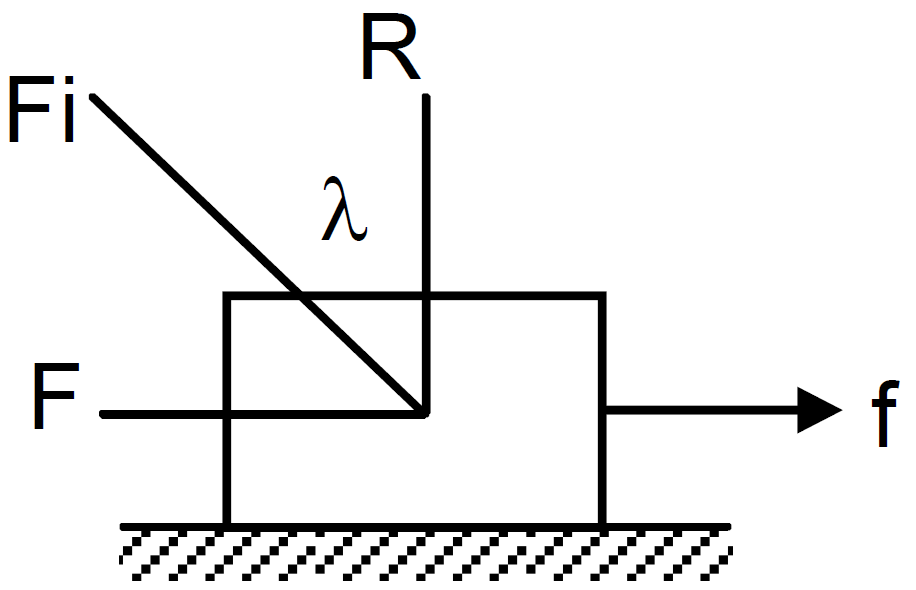
The angle between the resultant contact force and the normal force exerted by a body on the other is called the angle of friction. Show that, if $\lambda$ be the angle of friction and la the coefficient of static friction, $\lambda\leq\tan^{-1}\mu.$
Answer


$f \rightarrow $ applied force
$F_i \rightarrow $ contact force
$F \rightarrow $ frictional force
$R \rightarrow $ normal reaction
$\mu=\tan\lambda=\frac{\text{F}}{\text{R}}$
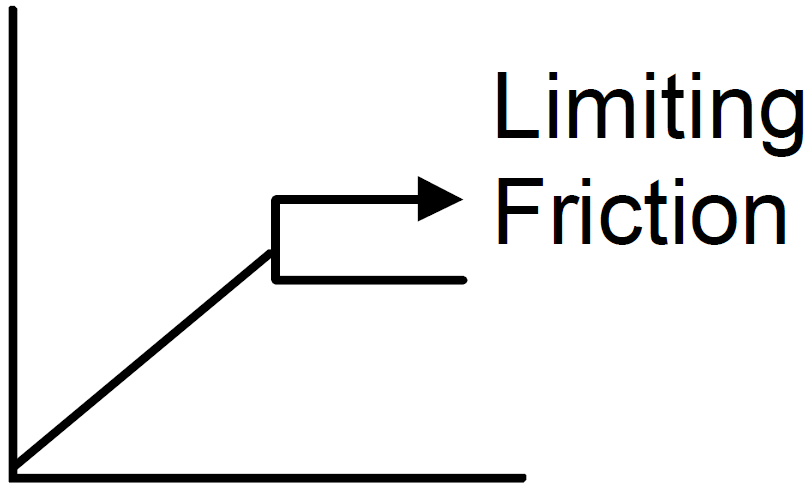
When $\text{F}=\mu\text{R, F}$ is the limiting friction $($max friction$)$. When applied force increase, force of friction increase upto limiting friction $(\mu\text{R})$
Before reaching limiting friction

$\text{F}<\mu\text{R}$
$\therefore\tan\lambda=\frac{\text{F}}{\text{R}}\leq\frac{\mu\text{R}}{\text{R}}\Rightarrow\tan\lambda\leq\mu\Rightarrow\lambda\leq\tan^{-1}\mu$

Need a full question paper?

Generate a complete, print-ready paper with questions like this in minutes — across 16+ boards, with answer keys.

Start Generating Free

Similar questions

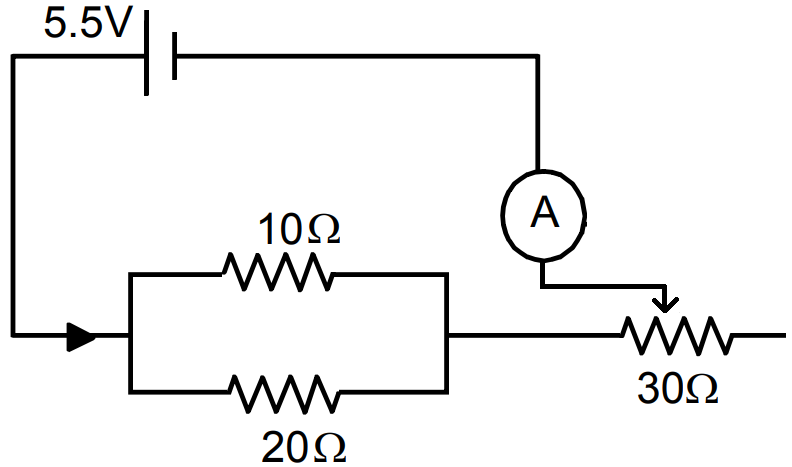
The resistance of the rheostat shown in the figure. is $30\Omega.$ Neglecting the meter resistance, find the minimum and maximum currents through the ammeter as the rheostat is varied.
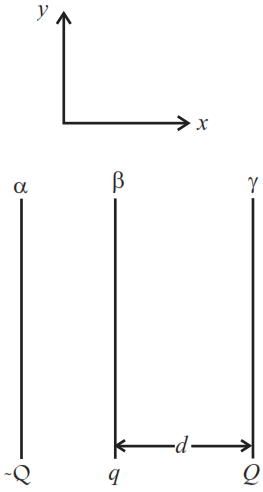
Two fixed, identical conducting plates $(\alpha\ \ \ \beta)$, each of surface area $S$ are charged to $-Q$ and $q,$ respectively, where $Q > q > 0.$ A third identical plate $(\gamma)$, free to move is located on the other side of the plate with charge $q$ at $a$ distance $d ($Fig$).$ The third plate is released and collides with the plate $\beta$. Assume the collision is elastic and the time of collision is sufficient to redistribute charge amongst $\beta\ \ \ \gamma$.

Find the charges on $\beta$ and $\gamma$ after the collision.
$\text{ }^{212}_{33}\text{Bi}$ can disintegrate either by emitting an $\alpha-$ particle of by emitting a $\beta^-$ particle.
  1. Write the two equations showing the products of the decays.
  2. The probabilities of disintegration $\alpha$ and $\beta -$ decays are in the ratio $\frac{7}{13}.$ The overall half $-$ life of $^{212}Bi$ is one hour. If $1g$ of pure $^{212}Bi$ is taken at $12.00$ noon, what will be the composition of this sample at $1P.m$. the same day?
Monochromatic radiation of wavelength $640.2 nm (1nm = 10^{–9} m)$ from a neon lamp irradiates photosensitive material made of caesium on tungsten. The stopping voltage is measured to be $0.54 V.$ The source is replaced by an iron source and its $427.2\ nm$ line irradiates the same photo-cell. Predict the new stopping voltage.
$i$. There are two sets of apparatus of Young's double-slit experiment. Inset $A,$ the phase difference between the two waves emanating from the slits does not change with time, whereas in set $B,$ the phase difference between the two waves from the slits changes rapidly with time. What difference will be observed in the pattern obtained on the screen in the two setups?
$ii$. Deduce the expression for the resultant intensity in both the above $-$ mentioned setups $( A$ and $B ),$ assuming that the waves emanating from the two slits have the same amplitude a and same wavelength $\lambda$.
The work function of caesium metal is 2.14 eV. When light of frequency $6 \times 10^{14}$ Hz is incident on the metal surface photo-emission of electrons occurs. What is the
(a) Maximum kinetic energy of emitted electrons
(b) Stopping potential, and
(c) Maximum speed of the emitted photo-electrons?
In an agricultural experiment, a solution containing 1 mole of a radioactive material $\Big(\text{t}_{\frac{1}{2}}=14.3\text{ days}\Big)$ was injected into the roots of a plant. The plant was allowed 70 hours to settle down and then activity was measured in its fruit. If the activity measured was $1\mu\text{Ci},$ what per cent of activity is transmitted from the root to the fruit in steady state?
The magnetic field B and the magnetic intensity H in material are found to be 1.6T and 1000A/m reepectively. Calculate the relative permeability $\mu_\text{r}$ and the susceptibility x of the material.
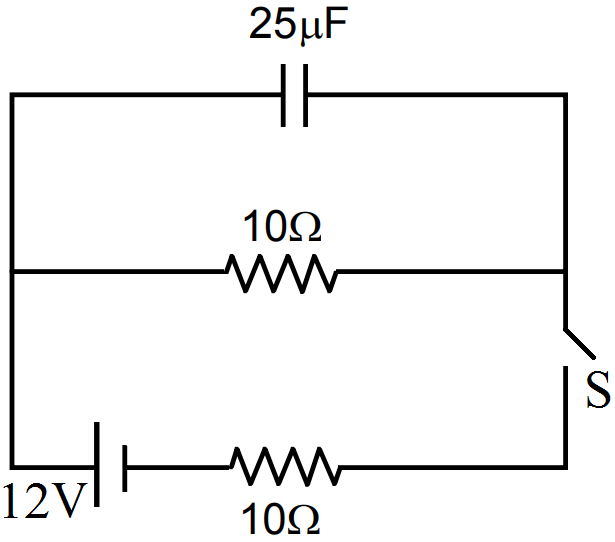
The switch S shown in figure. is kept closed for a long time and is then opened at t = 0. Find the current in the middle $1.0\Omega$ resistor at t = 1ms.
Answer the following Questions.
  1. Find expressions for the force and torque on an electric dipole kept in a uniform electric field.
OR
An electric dipole is held in a uniform electric field. (i) Using suitable diagram show that it does not undergo any translatory motion, and (ii) derive an expression for torque acting on it and specify its direction.
  1. Derive an expression for the work done in rotating a dipole from the angle $\theta_0$ to $\theta_1$ in a uniform electric field E.
​​​​​​​OR
  1. Define torque acting on a dipole of dipole moment $\vec{\text{p}}$ placed in a uniform electric field $\vec{\text{E}}.$ Express it in the vector form and point out the direction along which it acts.
  2. What happens if the field is non-uniform?
  3. What would happen if the external field $\vec{\text{E}}$ is increasing (i) parallel to $\vec{\text{p}}$ and (ii) anti-parallel to $\vec{\text{p}}?$