Question
The angle between the resultant contact force and the normal force exerted by a body on the other is called the angle of friction. Show that, if $\lambda$ be the angle of friction and la the coefficient of static friction, $\lambda\leq\tan^{-1}\mu.$
Answer


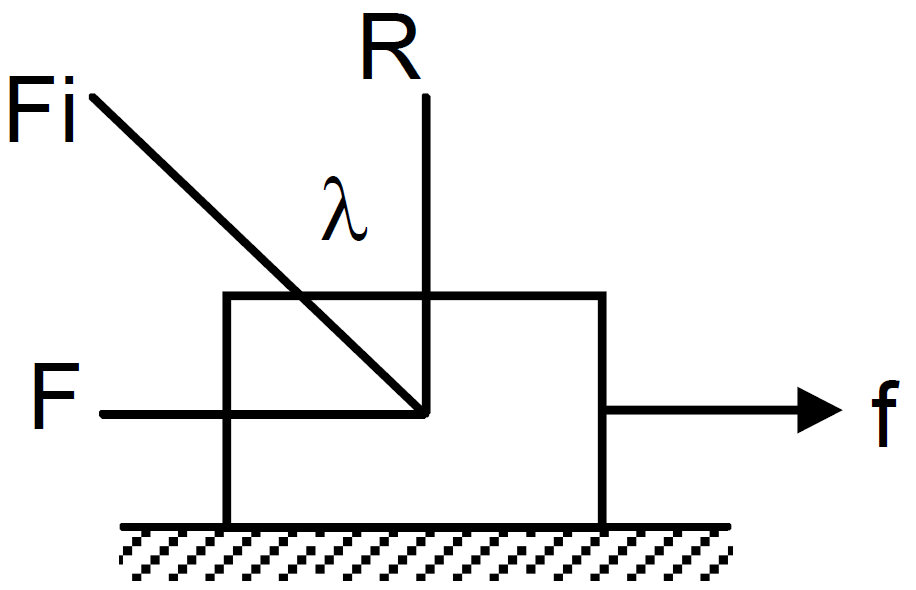
$f$ → applied force
$F_i$ → contact force
$F$ → frictional force
$R$ → normal reaction
$\mu=\tan\lambda=\frac{\text{F}}{\text{R}}$
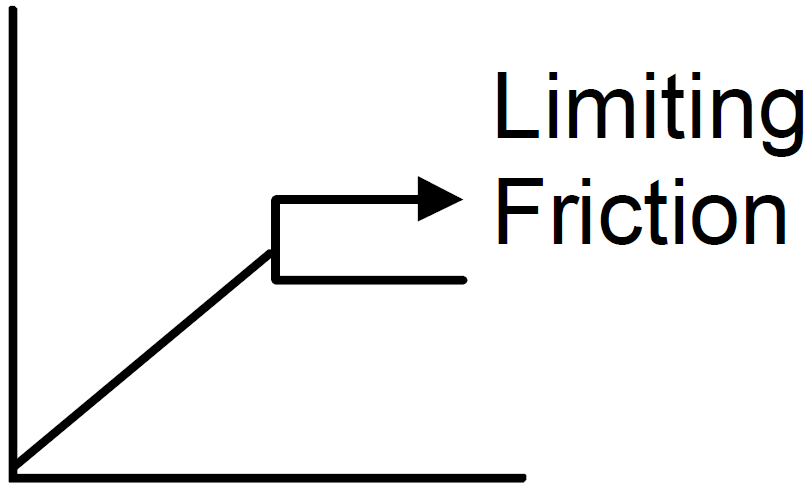
When $\text{F}=\mu\text{R, F}$ is the limiting friction (max friction). When applied force increase, force of friction increase upto limiting friction $(\mu\text{R})$
Before reaching limiting friction

$\text{F}<\mu\text{R}$
$\therefore\tan\lambda=\frac{\text{F}}{\text{R}}\leq\frac{\mu\text{R}}{\text{R}}\Rightarrow\tan\lambda\leq\mu\Rightarrow\lambda\leq\tan^{-1}\mu$

Need a full question paper?

Generate a complete, print-ready paper with questions like this in minutes — across 16+ boards, with answer keys.

Start Generating Free

Similar questions

A certain element emits $\text{K}_\alpha$ X-ray of energy 3.69keV. Use the data from the previous problem to identify the element.
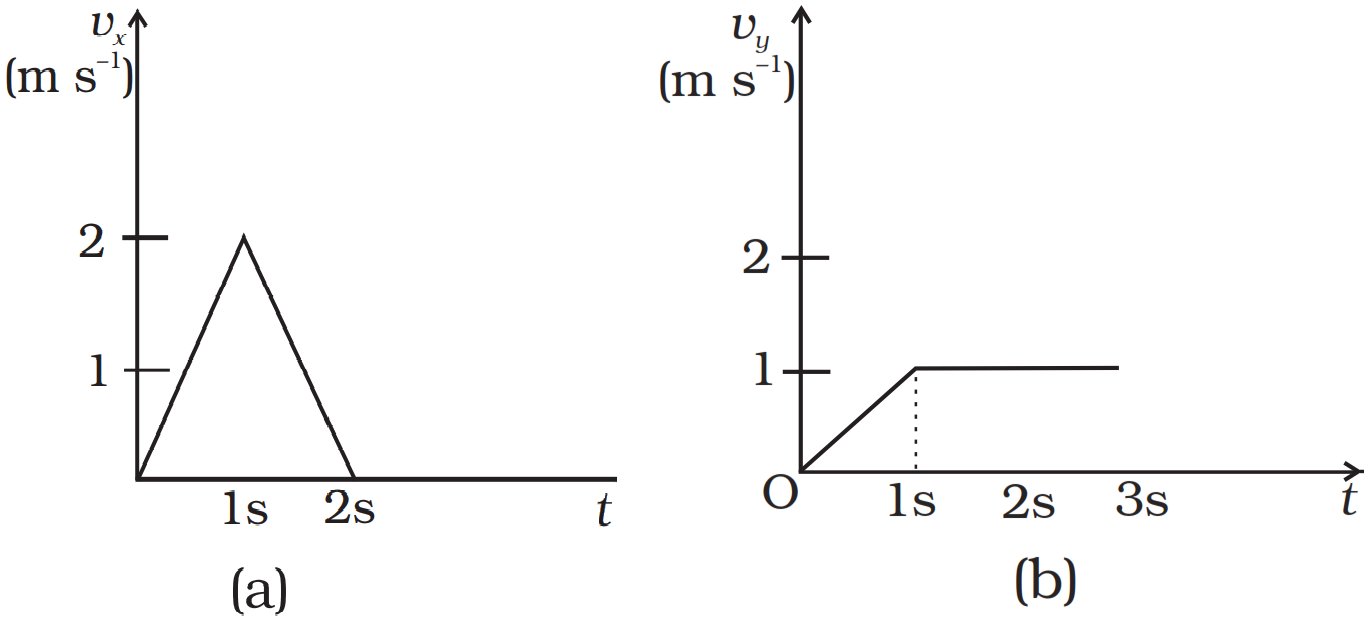
$(v_{x,} t)$, and $(v_{y,} t )$ diagrams for a body of unit mass. Find the force as a function of time.
A vector has both magnitude and direction. Does it mean that anything that has magnitude and direction is necessarily a vector? The rotation of a body can be specified by the direction of the axis of rotation, and the angle of rotation about the axis. Does that make any rotation a vector?
Assume that a tunnel is dug along a chord of the earth, at a perpendicular distance $\frac{\text{R}}{2}$ from the earth's centre where R is the radius of the earth. The wall of the tunnel is frictionless.
  1. Find the gravitational force exerted by the earth on a particle of mass m placed in the tunnel at a distance x from the centre of the tunnel.
  2. Find the component of this force along the tunnel and perpendicular to the tunnel.
  3. Find the normal force exerted by the wall on the particle.
  4. Find the resultant force on the particle.
  5. Show that the motion of the particle in the tunnel is simple harmonic and find the time period.
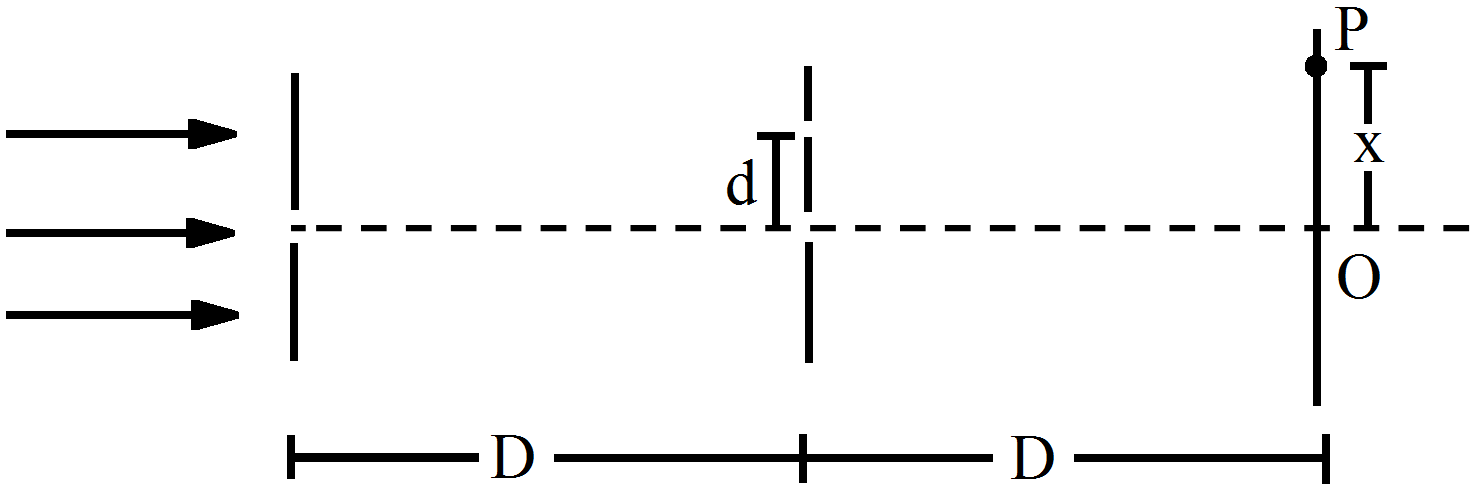
Consider the arrangement shown in figure (17-E4). The distance D is large compared to the separation d between the slits.
  1. Find the minimum value of d so that there is a dark fringe at 0.
  2. Suppose d has this value. Find the distance x at which the next bright fringe is formed.
  3. Find the fringe-width.
Consider a rectangular block of wood moving with a velocity $v_0$ in a gas at temperature T and mass density ρ. Assume the velocity is along x-axis and the area of cross-section of the block perpendicular to v0 is A. Show that the drag force on the block is $4\rho\text{ Av}_0\sqrt{\frac{\text{KT}}{\text{m}}}$ where m is the mass of the gas molecule.
An icecream vendor applies a 20kg wt of force at an angle 60° with the horizontal. If the displacement is 20m, estimate the work done.
In Millikan’s oil drop experiment, what is the terminal speed of an uncharged drop of radius $2.0 \times 10^{–5}m$ and density $1.2 \times 10^3 kg m^{–3}$. Take the viscosity of air at the temperature of the experiment to be $1.8 \times 10^{–5} Pa\ s$. How much is the viscous force on the drop at that speed ? Neglect buoyancy of the drop due to air.
A cylindrical piece of cork of density of base area A and height h floats in a liquid of density $\rho_1.$ The cork is depressed slightly and then released. Show that the cork oscillates up and down simple harmonically with a period $\text{T}=2\pi\sqrt{\frac{\text{h}\rho}{\rho_1\text{g}}}$ where $\rho$ is the density of cork. (Ignore damping due to viscosity of the liquid).
A 2kg block is placed over a $4kg$ block and both are placed on a smooth horizontal surface. The coefficient of friction between the blocks is $0.20$. Find the acceleration of the two blocks if a horizontal force of $12N$ is applied to:
  1. The upper block.
  2. The lower block. Take $g = 10m/s^2$​​​​​​​.